There are several classification systems to understand the evolution of play in children.
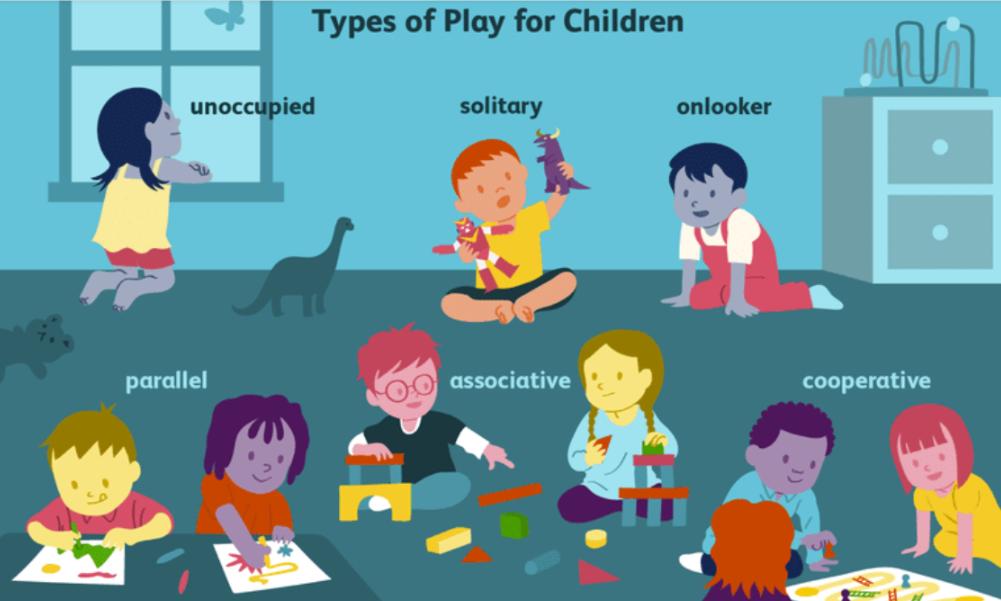
If we look at the interaction with peers, it can be classified:
- 0-2 years. Solitary play. During this stage, children play alone. For example, a child may be in a room full of children but will choose to play with blocks without relying on the others.
- 2-2.5 years. Onlooker play. The child will enjoy watching others play.
- 2.5-3 years. Parallel play. During parallel play, children play next to each other but do not share the same activity.
- 3-4 years. Associative play. During associative play, children play the same game or activity but do not cooperate with each other or interact during play.
- 4-6 years. Cooperative play. During cooperative play, children learn to play with their peers. They begin to use social skills and interact with their friends.
If we look at the content of play, it can be classified:
- 0-2 years. Functional play. Appears during Piaget's sensorimotor stage. For example, babies exploring toys, putting toys in their mouths to explore them, turning pages of a book, or throwing a toy for you to pick up.
- 2-6 years. Symbolic play. Appears during Piaget's preoperational stage.
- Construction play. Children use pieces to make more complex constructions.
- Representational game. Children use one object to represent another (pick up a shoe and use it “like a phone”).
- 6 years and older. Rule-based play. Piaget's stage of concrete and formal operations. Children begin to use board games, card games, or sports that involve rules.