In unserem geografischen Kontext wird allen Neugeborenen der Fersentest angeboten Neugeborenen-Screening auf angeborene Krankheiten, die derzeit in der valencianischen Gemeinschaft 10 Krankheiten umfasst.
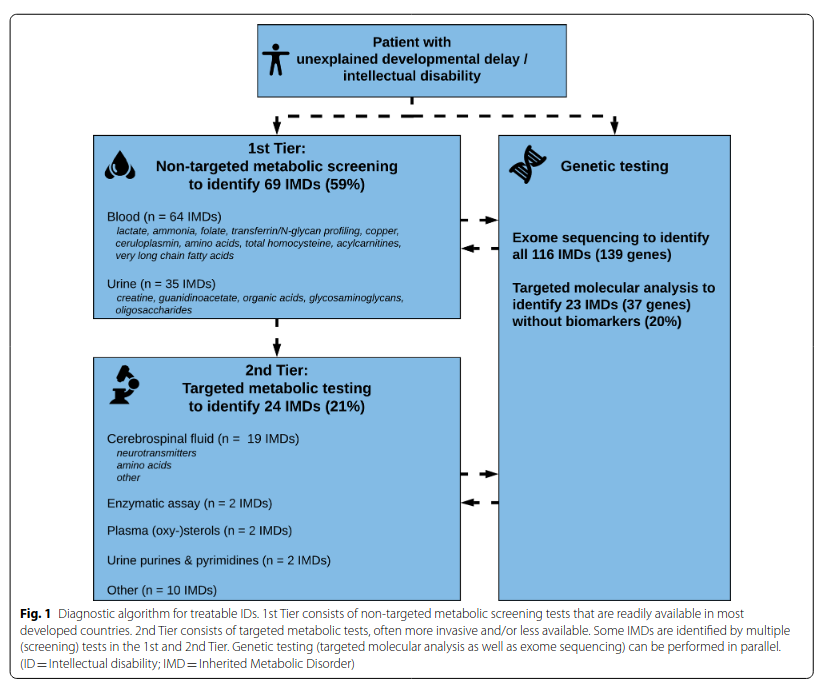
Die klinische Leitlinie zur Diagnose globaler Entwicklungsverzögerung und geistiger Behinderung der American Academy of Neurology und der American Academy of Pediatrics empfahl in ihrer Leitlinie aus dem Jahr 2006 nicht die systematische Durchführung von Stoffwechselstudien bei Kindern mit globaler Entwicklungsverzögerung, da deren diagnostische Ausbeute bei 1–5 % lag. In der Überprüfung von 2014 wurde diese Empfehlung jedoch geändert und die Stoffwechselstudie wurde bei Kindern ohne erkennbare Ursache einbezogen. Dabei folgte das von van Karnebeeck vorgeschlagene Protokoll, das auf zwei Schritten basiert:
1. Schritt: Zielloses Stoffwechselscreening.
- Blut:
- Laktat.
- Ammonium.
- Aminosäuren.
- Folat.
- Sialotransferrine.
- Kupfer und Celluloplasmin.
- Gesamtes Homocystein.
- Acylcarnitine.
- VLCFA.
- Urin:
- Organische Säuren.
- Kreatin und GAA.
- Glucosaminglycane.
- Oligosaccharide.
2. Schritt: Gezieltes Stoffwechselscreening.
- CSF:
- Neurotransmitter.
- Aminosäuren.
- Blut:
- Urin:
Welche Patienten können jedoch auch aufgrund des Vorliegens bestimmter Daten aus der Krankengeschichte oder explorativer Merkmale, die die Wahrscheinlichkeit einer Metabolopathie erhöhen, zu einer Stoffwechselstudie angeregt werden (Wann vermutet man einen Stoffwechsel?).
Im Internet Behandelbarer Ausweis Es können Informationen eingeholt werden, um die entsprechende Studie besser leiten zu können.
Im Internet Vademecum Metabolicumgibt es ein frei zugängliches Kompendium zu allen angeborenen Stoffwechselstörungen.
19955111
{19955111:5WUGPWQ8}
1
Vancouver
50
Standard
944
https://neuropediatoolkit.org/wp-content/plugins/zotpress/
%7B%22status%22%3A%22success%22%2C%22updateneeded%22%3Afalse%2C%22instance%22%3Afalse%2C%22meta%22%3A%7B%22request_last%22%3A0%2C%22request_next%22%3A0%2C%22used_cache%22%3Atrue%7D%2C%22data%22%3A%5B%7B%22key%22%3A%225WUGPWQ8%22%2C%22library%22%3A%7B%22id%22%3A19955111%7D%2C%22meta%22%3A%7B%22creatorSummary%22%3A%22Moeschler%20et%20al.%22%2C%22parsedDate%22%3A%222014-09-01%22%2C%22numChildren%22%3A1%7D%2C%22bib%22%3A%22%26lt%3Bdiv%20class%3D%26quot%3Bcsl-bib-body%26quot%3B%20style%3D%26quot%3Bline-height%3A%201.35%3B%20%26quot%3B%26gt%3B%5Cn%20%20%26lt%3Bdiv%20class%3D%26quot%3Bcsl-entry%26quot%3B%20style%3D%26quot%3Bclear%3A%20left%3B%20%26quot%3B%26gt%3B%5Cn%20%20%20%20%26lt%3Bdiv%20class%3D%26quot%3Bcsl-left-margin%26quot%3B%20style%3D%26quot%3Bfloat%3A%20left%3B%20padding-right%3A%200.5em%3B%20text-align%3A%20right%3B%20width%3A%201em%3B%26quot%3B%26gt%3B1.%26lt%3B%5C%2Fdiv%26gt%3B%26lt%3Bdiv%20class%3D%26quot%3Bcsl-right-inline%26quot%3B%20style%3D%26quot%3Bmargin%3A%200%20.4em%200%201.5em%3B%26quot%3B%26gt%3BMoeschler%20JB%2C%20Shevell%20M%2C%20Moeschler%20JB%2C%20Shevell%20M%2C%20Saul%20RA%2C%20Chen%20E%2C%20et%20al.%20Comprehensive%20Evaluation%20of%20the%20Child%20With%20Intellectual%20Disability%20or%20Global%20Developmental%20Delays.%20Pediatrics%20%5BInternet%5D.%202014%20Sept%201%20%5Bcited%202015%20June%2029%5D%3B134%283%29%3Ae903%26%23x2013%3B18.%20Available%20from%3A%20%26lt%3Ba%20class%3D%26%23039%3Bzp-ItemURL%26%23039%3B%20href%3D%26%23039%3Bhttp%3A%5C%2F%5C%2Fpediatrics.aappublications.org%5C%2Fcontent%5C%2F134%5C%2F3%5C%2Fe903%26%23039%3B%26gt%3Bhttp%3A%5C%2F%5C%2Fpediatrics.aappublications.org%5C%2Fcontent%5C%2F134%5C%2F3%5C%2Fe903%26lt%3B%5C%2Fa%26gt%3B%26lt%3B%5C%2Fdiv%26gt%3B%5Cn%20%20%26lt%3B%5C%2Fdiv%26gt%3B%5Cn%26lt%3B%5C%2Fdiv%26gt%3B%22%2C%22data%22%3A%7B%22itemType%22%3A%22journalArticle%22%2C%22title%22%3A%22Comprehensive%20Evaluation%20of%20the%20Child%20With%20Intellectual%20Disability%20or%20Global%20Developmental%20Delays%22%2C%22creators%22%3A%5B%7B%22creatorType%22%3A%22author%22%2C%22firstName%22%3A%22John%20B.%22%2C%22lastName%22%3A%22Moeschler%22%7D%2C%7B%22creatorType%22%3A%22author%22%2C%22firstName%22%3A%22Michael%22%2C%22lastName%22%3A%22Shevell%22%7D%2C%7B%22creatorType%22%3A%22author%22%2C%22firstName%22%3A%22John%20B.%22%2C%22lastName%22%3A%22Moeschler%22%7D%2C%7B%22creatorType%22%3A%22author%22%2C%22firstName%22%3A%22Michael%22%2C%22lastName%22%3A%22Shevell%22%7D%2C%7B%22creatorType%22%3A%22author%22%2C%22firstName%22%3A%22Robert%20A.%22%2C%22lastName%22%3A%22Saul%22%7D%2C%7B%22creatorType%22%3A%22author%22%2C%22firstName%22%3A%22Emily%22%2C%22lastName%22%3A%22Chen%22%7D%2C%7B%22creatorType%22%3A%22author%22%2C%22firstName%22%3A%22Debra%20L.%22%2C%22lastName%22%3A%22Freedenberg%22%7D%2C%7B%22creatorType%22%3A%22author%22%2C%22firstName%22%3A%22Rizwan%22%2C%22lastName%22%3A%22Hamid%22%7D%2C%7B%22creatorType%22%3A%22author%22%2C%22firstName%22%3A%22Marilyn%20C.%22%2C%22lastName%22%3A%22Jones%22%7D%2C%7B%22creatorType%22%3A%22author%22%2C%22firstName%22%3A%22Joan%20M.%22%2C%22lastName%22%3A%22Stoler%22%7D%2C%7B%22creatorType%22%3A%22author%22%2C%22firstName%22%3A%22Beth%20Anne%22%2C%22lastName%22%3A%22Tarini%22%7D%5D%2C%22abstractNote%22%3A%22Global%20developmental%20delay%20and%20intellectual%20disability%20are%20relatively%20common%20pediatric%20conditions.%20This%20report%20describes%20the%20recommended%20clinical%20genetics%20diagnostic%20approach.%20The%20report%20is%20based%20on%20a%20review%20of%20published%20reports%2C%20most%20consisting%20of%20medium%20to%20large%20case%20series%20of%20diagnostic%20tests%20used%2C%20and%20the%20proportion%20of%20those%20that%20led%20to%20a%20diagnosis%20in%20such%20patients.%20Chromosome%20microarray%20is%20designated%20as%20a%20first-line%20test%20and%20replaces%20the%20standard%20karyotype%20and%20fluorescent%20in%20situ%20hybridization%20subtelomere%20tests%20for%20the%20child%20with%20intellectual%20disability%20of%20unknown%20etiology.%20Fragile%20X%20testing%20remains%20an%20important%20first-line%20test.%20The%20importance%20of%20considering%20testing%20for%20inborn%20errors%20of%20metabolism%20in%20this%20population%20is%20supported%20by%20a%20recent%20systematic%20review%20of%20the%20literature%20and%20several%20case%20series%20recently%20published.%20The%20role%20of%20brain%20MRI%20remains%20important%20in%20certain%20patients.%20There%20is%20also%20a%20discussion%20of%20the%20emerging%20literature%20on%20the%20use%20of%20whole-exome%20sequencing%20as%20a%20diagnostic%20test%20in%20this%20population.%20Finally%2C%20the%20importance%20of%20intentional%20comanagement%20among%20families%2C%20the%20medical%20home%2C%20and%20the%20clinical%20genetics%20specialty%20clinic%20is%20discussed.%22%2C%22date%22%3A%2209%5C%2F01%5C%2F2014%22%2C%22section%22%3A%22%22%2C%22partNumber%22%3A%22%22%2C%22partTitle%22%3A%22%22%2C%22DOI%22%3A%2210.1542%5C%2Fpeds.2014-1839%22%2C%22citationKey%22%3A%22%22%2C%22url%22%3A%22http%3A%5C%2F%5C%2Fpediatrics.aappublications.org%5C%2Fcontent%5C%2F134%5C%2F3%5C%2Fe903%22%2C%22PMID%22%3A%2225157020%22%2C%22PMCID%22%3A%22%22%2C%22ISSN%22%3A%220031-4005%2C%201098-4275%22%2C%22language%22%3A%22en%22%2C%22collections%22%3A%5B%22TSGGWJ4V%22%2C%22WP7IK3VM%22%5D%2C%22dateModified%22%3A%222026-07-15T22%3A40%3A32Z%22%7D%7D%5D%7D
1.
Moeschler JB, Shevell M, Moeschler JB, Shevell M, Saul RA, Chen E, et al. Umfassende Beurteilung von Kindern mit geistiger Behinderung oder allgemeinen Entwicklungsverzögerungen. Pediatrics [Internet]. 1. September 2014 [zitiert am 29. Juni 2015];134(3):e903–18. Verfügbar unter:
http://pediatrics.aappublications.org/content/134/3/e903