
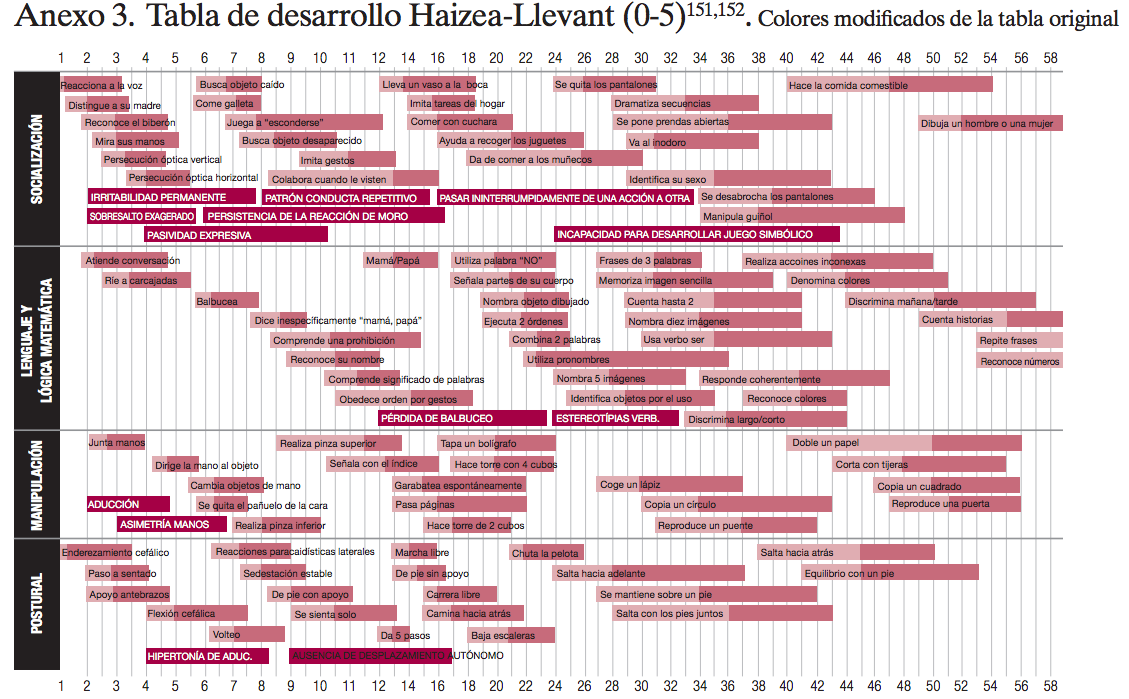
By neurodevelopment, we mean the process of acquiring skills and capacities carried out by the central nervous system throughout childhood. It is a hierarchical, sequential, and stereotyped process, genetically coded but modulated by the environment.
We can classify neurodevelopment into different domains, depending on the skills that are involved.
- Engine.
- Communication and language.
- Cognition.
- Socio-emotional.
- Adaptive.
In addition, there are some specific multidomain skills that are useful when assessing a child's neurodevelopment.
On the other hand, many physiological functions are also conditioned by neurodevelopment, so in children they must be assessed taking this into account.
Quantitative assessment.
Developmental milestones. What do we mean?
- For their correct assessment, it is necessary to know the expected milestones according to age.
- Traditionally in pediatrics, they have been learned taking into account the age at which the average population acquires them, instead of knowing their statistical distribution over time or developmental window (age at which it is reached by the 10th percentile, the 50th percentile, and the 90th percentile).
- It is fully demonstrated that the use of screening tests It is much more precise in clinical assessment, since it allows for a better evaluation than applying a list of "normal milestones."
The Denver-II test is a screening tool based on the US population.
The Haizea-Llevant test is based on the Spanish population.
Quantification of development. The best strategy to compare.
Screening tests, however, only serve to know the status of development at a specific point in time, and to differentiate neurotypical children from those who present warning signs.
When we have identified a child with neurodevelopmental problems, it is necessary to measure through a development scale, the different domains and global development, and compare it with a standardized population. Developmental scales usually allow the calculation of a «developmental or equivalent age«.
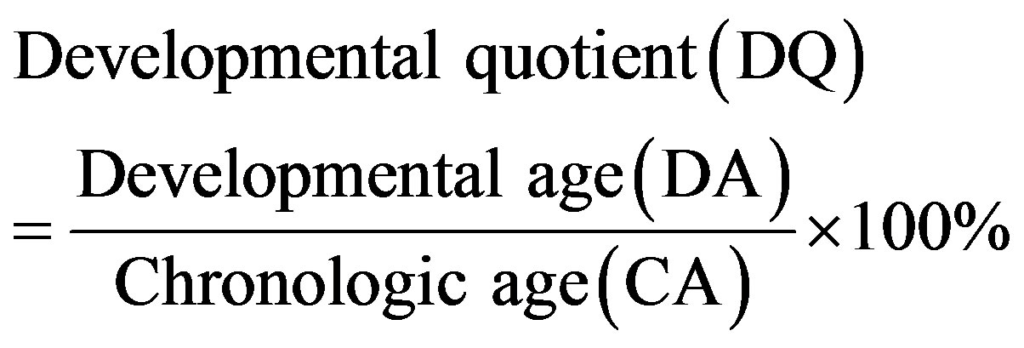
With a developmental age, we will be able to calculate the developmental quotient. They can be classified into mild delay (DQ 70-100), moderate (DQ 50-70), and severe (DQ less than 50).
Some developmental scales even provide a standardized score with the statistical position of the child relative to the normal cohort (z or T score), allowing us to know the statistical deviation and therefore the severity of the problem.
Developmental trajectories. The most powerful tool for forecasting.
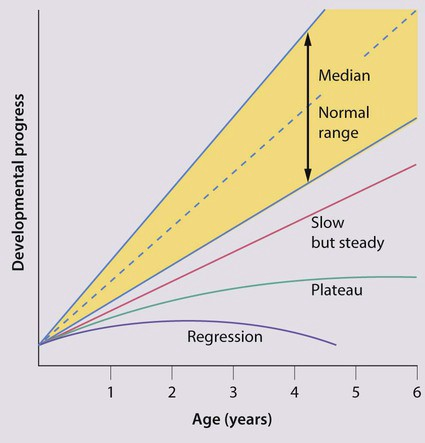
However, an isolated measurement in time only allows us to know the static situation. When we obtain several successive measurements, we can infer a developmental trajectory, which is a very powerful tool when it comes to being able to infer a forecast. It is especially important to keep evolutionary records to be able to diagnose early Developmental regression.
Qualitative assessment.
In addition to assessing whether development is occurring with a gap compared to neurotypical development, it is necessary to consider whether there are symptoms whose presence by itself is a warning sign (Red flags).
- Developmental regression. Loss of previously acquired skills, regardless of their intensity, is a reason for neurological assessment.
- Persistent irritability in infants under 12 months.
- Asymmetry in manipulation in infants under 12 months.
- Repetitive behavior pattern in those over 12 months of age.
- Behavior pattern that shifts from one activity to another permanently in those over 18 months of age.
- Inability to develop symbolic play starting from 24 months.
- Verbal stereotypies (guttural sounds) starting from 24 months.
- Pathological neurological examination.
- Pathological dysmorphological examination.
- Pathological skin examination.
- Pathological head circumference.
Training tools:
There are several tools to train in neurodevelopmental assessment.
- On the web pathways videos with normal developmental milestones based on chronological age are available.
- On the CUDAP website, a screening test with video recordings to be applied by parents is available.