

19955111
{19955111:436UEE9K}
1
vancouver
50
default
4527
https://neuropediatoolkit.org/wp-content/plugins/zotpress/
statussuccessupdateneededfalseinstancefalsemetarequest_last0request_next0used_cachetruedatakey436UEE9Klibraryid19955111metacreatorSummaryKyleetal.parsedDate2018numChildren1bibltdivclassquotcsl-bib-bodyquotstylequotline-height1.35quotgtnltdivclassquotcsl-entryquotstylequotclearleftquotgtnltdivclassquotcsl-left-marginquotstylequotfloatleftpadding-right0.5emtext-alignrightwidth1emquotgt1.ltdivgtltdivclassquotcsl-right-inlinequotstylequotmargin0.4em01.5emquotgtKyleSMVashiNJusticeMJ.Rettsyndromeaneurologicaldisorderwithmetaboliccomponents.OpenBiolInternet.2018cited2023Feb1982170216.Availablefromltaclass039zp-ItemURL039href039httpsroyalsocietypublishing.orgdoi10.1098rsob.170216039gthttpsroyalsocietypublishing.orgdoi10.1098rsob.170216ltagtltdivgtnltdivgtnltdivgtdataitemTypejournalArticletitleRettsyndromeaneurologicaldisorderwithmetaboliccomponentscreatorscreatorTypeauthorfirstNameStephanieM.lastNameKylecreatorTypeauthorfirstNameNeetilastNameVashicreatorTypeauthorfirstNameMonicaJ.lastNameJusticeabstractNoteRettsyndromeRTTisaneurologicaldisordercausedbymutationsintheX-linkedgenemethyl-CpG-bindingprotein2nMECP2naubiquitouslyexpressedtranscriptionalregulator.DespiteremarkablescientificprogresssinceitsdiscoverythemechanismbywhichnMECP2nmutationscauseRTTsymptomsislargelyunknown.Consequentlytreatmentoptionsforpatientsarecurrentlylimitedandcentredonsymptomrelief.ThoughttobeanentirelyneurologicaldisorderRTTresearchhasfocusedontheroleofnMECP2ninthecentralnervoussystem.HoweverthevarietyofphenotypesidentifiedinnMecp2nmutantmousemodelsandRTTpatientsimplicateimportantrolesforMeCP2inperipheralsystems.HerewereviewthehistoryofRTThighlightingbreakthroughsinthefieldthathaveledustopresentday.WeexplorethecurrentevidencesupportingmetabolicdysfunctionasacomponentofRTTpresentingrecentstudiesthathaverevealedperturbedlipidmetabolisminthebrainandperipheraltissuesofmousemodelsandpatients.SuchfindingsmayhaveanimpactonthequalityoflifeofRTTpatientsasbothdietaryanddruginterventioncanalterlipidmetabolism.UltimatelyweconcludethatathoroughknowledgeofMeCP2039svariedfunctionaltargetsinthebrainandbodywillberequiredtotreatthiscomplexsyndrome.date022018sectionpartNumberpartTitleDOI10.1098rsob.170216citationKeyurlhttpsroyalsocietypublishing.orgdoi10.1098rsob.170216PMIDPMCIDISSN2046-2441languageencollectionsAV4DY38YdateModified2026-07-15T224044Z
1.
Kyle SM, Vashi N, Justice MJ. Rett syndrome: a neurological disorder with metabolic components. Open Biol [Internet]. 2018 [cited 2023 Feb 19];8(2):170216. Available from: https://royalsocietypublishing.org/doi/10.1098/rsob.170216
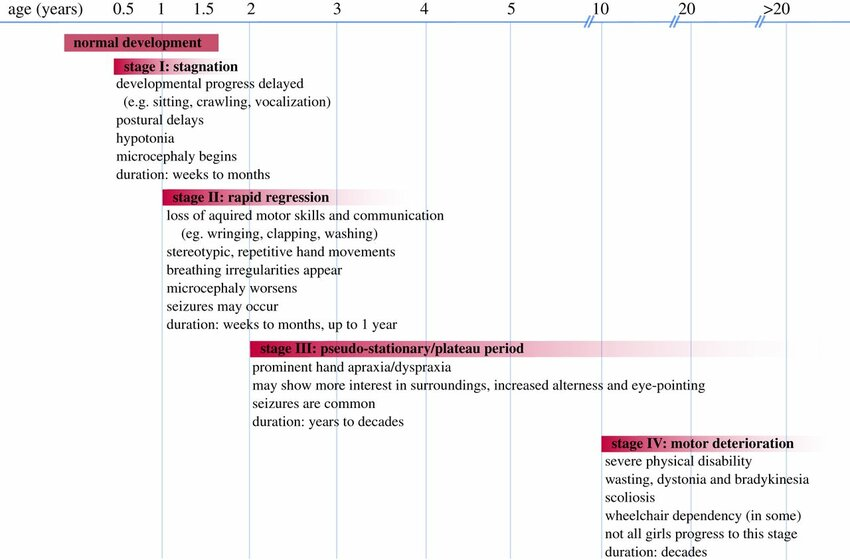
Rett syndrome, a neurodevelopmental disorder linked to the X chromosome (MECP2 gene), typically progresses through four defined clinical stages that mark its developmental trajectory:
- Stage I (Early Onset – 6 to 18 months): Subtle slowing of development, loss of interest in play, and slowing of head growth.
- Stage II (Rapid Destruction – 1 to 4 years): Rapid regression of language and voluntary use of the hands, appearance of characteristic manual stereotypies (hand washing), irritability and breathing disorders while awake.
- Stage III (Pseudostationary – 2 to 10 years): Stabilization of motor symptoms. It highlights apraxia, epileptic seizures and progressive scoliosis, although eye contact (eye communication) improves.
- Stage IV (Late Motor Impairment – older than 10 years): Loss of mobility or ambulation if present, rigidity, spasticity, muscle atrophy and generalized weakness. Cognitive and ocular communication functions are usually preserved in this stage.