In our geographical context, all newborns are offered the heel prick test or neonatal screening for congenital diseases, which currently in the Valencian Community includes 10 diseases.
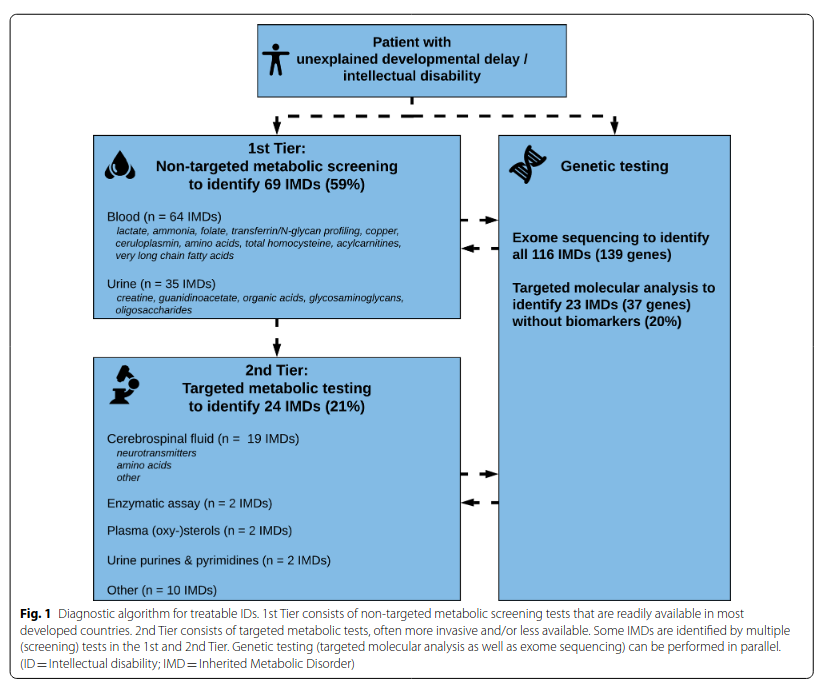
The clinical guideline for the diagnosis of global developmental delay and intellectual disability of the American Academy of Neurology and the American Academy of Pediatrics did not recommend systematic metabolic studies in children with global developmental delay in their 2006 guideline, since its diagnostic yield was 1-5%. However, in the 2014 revision this recommendation was changed, and metabolic study was included in those children without an identifiable cause, following the protocol proposed by van Karnebeeck, based on 2 steps:
1st step: Non-targeted metabolic screening.
- Blood:
- Lactate.
- Ammonium.
- Amino acids.
- Folate.
- Sialotransferrins.
- Copper and ceruloplasmin.
- Total homocysteine.
- Acylcarnitines.
- VLCFA.
- Urine:
- Organic acids.
- Creatine and GAA.
- Glycosaminoglycans.
- Oligosaccharides.
2nd step: Targeted metabolic screening.
- CSF:
- Neurotransmitters.
- Amino acids.
- Blood:
- Urine:
However, which patients can also be guided to undergo a metabolic study based on the presence of certain data from the clinical history or exploratory characteristics that increase the probability of a metabolopathy (When to suspect a metabolism?).
On the web Treatable ID Information can be sought to more appropriately guide the appropriate study.
On the web Vademecum Metabolicum, there is a free access compendium on all inborn errors of metabolism.
19955111
{19955111:5WUGPWQ8}
1
vancouver
50
default
944
https://neuropediatoolkit.org/wp-content/plugins/zotpress/
%7B%22status%22%3A%22success%22%2C%22updateneeded%22%3Afalse%2C%22instance%22%3Afalse%2C%22meta%22%3A%7B%22request_last%22%3A0%2C%22request_next%22%3A0%2C%22used_cache%22%3Atrue%7D%2C%22data%22%3A%5B%7B%22key%22%3A%225WUGPWQ8%22%2C%22library%22%3A%7B%22id%22%3A19955111%7D%2C%22meta%22%3A%7B%22creatorSummary%22%3A%22Moeschler%20et%20al.%22%2C%22parsedDate%22%3A%222014-09-01%22%2C%22numChildren%22%3A1%7D%2C%22bib%22%3A%22%26lt%3Bdiv%20class%3D%26quot%3Bcsl-bib-body%26quot%3B%20style%3D%26quot%3Bline-height%3A%201.35%3B%20%26quot%3B%26gt%3B%5Cn%20%20%26lt%3Bdiv%20class%3D%26quot%3Bcsl-entry%26quot%3B%20style%3D%26quot%3Bclear%3A%20left%3B%20%26quot%3B%26gt%3B%5Cn%20%20%20%20%26lt%3Bdiv%20class%3D%26quot%3Bcsl-left-margin%26quot%3B%20style%3D%26quot%3Bfloat%3A%20left%3B%20padding-right%3A%200.5em%3B%20text-align%3A%20right%3B%20width%3A%201em%3B%26quot%3B%26gt%3B1.%26lt%3B%5C%2Fdiv%26gt%3B%26lt%3Bdiv%20class%3D%26quot%3Bcsl-right-inline%26quot%3B%20style%3D%26quot%3Bmargin%3A%200%20.4em%200%201.5em%3B%26quot%3B%26gt%3BMoeschler%20JB%2C%20Shevell%20M%2C%20Moeschler%20JB%2C%20Shevell%20M%2C%20Saul%20RA%2C%20Chen%20E%2C%20et%20al.%20Comprehensive%20Evaluation%20of%20the%20Child%20With%20Intellectual%20Disability%20or%20Global%20Developmental%20Delays.%20Pediatrics%20%5BInternet%5D.%202014%20Sept%201%20%5Bcited%202015%20June%2029%5D%3B134%283%29%3Ae903%26%23x2013%3B18.%20Available%20from%3A%20%26lt%3Ba%20class%3D%26%23039%3Bzp-ItemURL%26%23039%3B%20href%3D%26%23039%3Bhttp%3A%5C%2F%5C%2Fpediatrics.aappublications.org%5C%2Fcontent%5C%2F134%5C%2F3%5C%2Fe903%26%23039%3B%26gt%3Bhttp%3A%5C%2F%5C%2Fpediatrics.aappublications.org%5C%2Fcontent%5C%2F134%5C%2F3%5C%2Fe903%26lt%3B%5C%2Fa%26gt%3B%26lt%3B%5C%2Fdiv%26gt%3B%5Cn%20%20%26lt%3B%5C%2Fdiv%26gt%3B%5Cn%26lt%3B%5C%2Fdiv%26gt%3B%22%2C%22data%22%3A%7B%22itemType%22%3A%22journalArticle%22%2C%22title%22%3A%22Comprehensive%20Evaluation%20of%20the%20Child%20With%20Intellectual%20Disability%20or%20Global%20Developmental%20Delays%22%2C%22creators%22%3A%5B%7B%22creatorType%22%3A%22author%22%2C%22firstName%22%3A%22John%20B.%22%2C%22lastName%22%3A%22Moeschler%22%7D%2C%7B%22creatorType%22%3A%22author%22%2C%22firstName%22%3A%22Michael%22%2C%22lastName%22%3A%22Shevell%22%7D%2C%7B%22creatorType%22%3A%22author%22%2C%22firstName%22%3A%22John%20B.%22%2C%22lastName%22%3A%22Moeschler%22%7D%2C%7B%22creatorType%22%3A%22author%22%2C%22firstName%22%3A%22Michael%22%2C%22lastName%22%3A%22Shevell%22%7D%2C%7B%22creatorType%22%3A%22author%22%2C%22firstName%22%3A%22Robert%20A.%22%2C%22lastName%22%3A%22Saul%22%7D%2C%7B%22creatorType%22%3A%22author%22%2C%22firstName%22%3A%22Emily%22%2C%22lastName%22%3A%22Chen%22%7D%2C%7B%22creatorType%22%3A%22author%22%2C%22firstName%22%3A%22Debra%20L.%22%2C%22lastName%22%3A%22Freedenberg%22%7D%2C%7B%22creatorType%22%3A%22author%22%2C%22firstName%22%3A%22Rizwan%22%2C%22lastName%22%3A%22Hamid%22%7D%2C%7B%22creatorType%22%3A%22author%22%2C%22firstName%22%3A%22Marilyn%20C.%22%2C%22lastName%22%3A%22Jones%22%7D%2C%7B%22creatorType%22%3A%22author%22%2C%22firstName%22%3A%22Joan%20M.%22%2C%22lastName%22%3A%22Stoler%22%7D%2C%7B%22creatorType%22%3A%22author%22%2C%22firstName%22%3A%22Beth%20Anne%22%2C%22lastName%22%3A%22Tarini%22%7D%5D%2C%22abstractNote%22%3A%22Global%20developmental%20delay%20and%20intellectual%20disability%20are%20relatively%20common%20pediatric%20conditions.%20This%20report%20describes%20the%20recommended%20clinical%20genetics%20diagnostic%20approach.%20The%20report%20is%20based%20on%20a%20review%20of%20published%20reports%2C%20most%20consisting%20of%20medium%20to%20large%20case%20series%20of%20diagnostic%20tests%20used%2C%20and%20the%20proportion%20of%20those%20that%20led%20to%20a%20diagnosis%20in%20such%20patients.%20Chromosome%20microarray%20is%20designated%20as%20a%20first-line%20test%20and%20replaces%20the%20standard%20karyotype%20and%20fluorescent%20in%20situ%20hybridization%20subtelomere%20tests%20for%20the%20child%20with%20intellectual%20disability%20of%20unknown%20etiology.%20Fragile%20X%20testing%20remains%20an%20important%20first-line%20test.%20The%20importance%20of%20considering%20testing%20for%20inborn%20errors%20of%20metabolism%20in%20this%20population%20is%20supported%20by%20a%20recent%20systematic%20review%20of%20the%20literature%20and%20several%20case%20series%20recently%20published.%20The%20role%20of%20brain%20MRI%20remains%20important%20in%20certain%20patients.%20There%20is%20also%20a%20discussion%20of%20the%20emerging%20literature%20on%20the%20use%20of%20whole-exome%20sequencing%20as%20a%20diagnostic%20test%20in%20this%20population.%20Finally%2C%20the%20importance%20of%20intentional%20comanagement%20among%20families%2C%20the%20medical%20home%2C%20and%20the%20clinical%20genetics%20specialty%20clinic%20is%20discussed.%22%2C%22date%22%3A%2209%5C%2F01%5C%2F2014%22%2C%22section%22%3A%22%22%2C%22partNumber%22%3A%22%22%2C%22partTitle%22%3A%22%22%2C%22DOI%22%3A%2210.1542%5C%2Fpeds.2014-1839%22%2C%22citationKey%22%3A%22%22%2C%22url%22%3A%22http%3A%5C%2F%5C%2Fpediatrics.aappublications.org%5C%2Fcontent%5C%2F134%5C%2F3%5C%2Fe903%22%2C%22PMID%22%3A%2225157020%22%2C%22PMCID%22%3A%22%22%2C%22ISSN%22%3A%220031-4005%2C%201098-4275%22%2C%22language%22%3A%22en%22%2C%22collections%22%3A%5B%22TSGGWJ4V%22%2C%22WP7IK3VM%22%5D%2C%22dateModified%22%3A%222026-07-15T22%3A40%3A32Z%22%7D%7D%5D%7D
1.
Moeschler JB, Shevell M, Moeschler JB, Shevell M, Saul RA, Chen E, et al. Comprehensive Evaluation of the Child With Intellectual Disability or Global Developmental Delays. Pediatrics [Internet]. 2014 Sept 1 [cited 2015 June 29];134(3):e903–18. Available from:
http://pediatrics.aappublications.org/content/134/3/e903