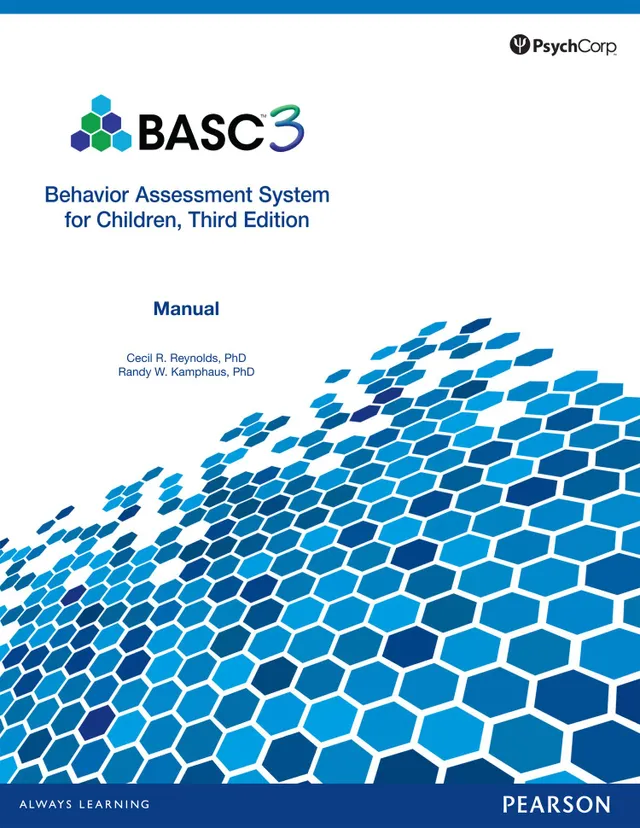

Standardized questionnaires for quantifying ADHD symptoms are an indispensable daily tool to evaluate the necessity and adequacy of pharmacological treatment. An optimal treatment will be one that achieves the best symptomatic benefit with the least presence of adverse effects.
Analysis table of the ADHD guideline on symptom questionnaires.
Summary of diagnostic tools available at TEA Ediciones for ADHD diagnosis, including both questionnaires and cognitive assessment tools.
There are different types of questionnaires, which we could classify into 3 groups.
Specific
These are surveys with semi-quantitative scales (Likert-type), which usually have parent and teacher versions, thus allowing the views of multiple observers to be collected. The results can be interpreted either qualitatively (criterion-referenced assessment, typically using the DSM-5 symptom list, requiring at least 6 symptoms of moderate-to-severe intensity in at least 1 of the 2 symptom domains of inattention or hyperactivity-impulsivity) or quantitatively (comparing the results with scores obtained by a healthy cohort matched by age and sex, and using a statistical criterion to determine the diagnostic threshold, at 1.5 or 2 SD depending on the test).
They are not a differential diagnosis tool, as the diagnosis is clinical, but they do allow standardizing the evaluation of symptoms by applying a more uniform assessment system, and monitoring target symptoms (symptoms potentially treatable and improvable with drugs).
ADHD-RS-IV
This is an 18-item questionnaire (9 for hyperactivity-impulsivity; 9 for inattention, interspersed throughout the questionnaire, corresponding to the 9 symptoms of the DSM-5 diagnostic criteria, quantifiable via a 0-3 Likert scale).
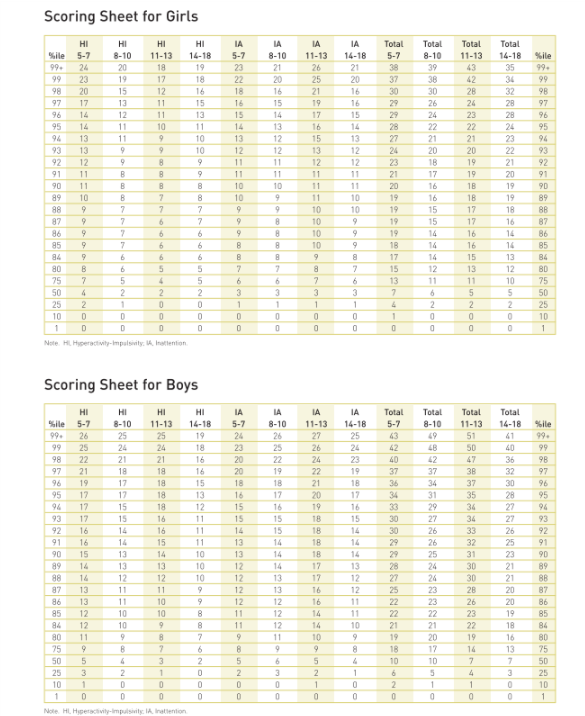
There are standardized percentile scores, validated in the US population, which can be used to perform a quantitative assessment.
SNAP-IV
The SNAP-IV scale is virtually identical to the ADHD-RS-IV; it is an 18-item questionnaire, 9 for hyperactivity-impulsivity and 9 for inattention, which are distributed in blocks (not interspersed) and for which standardized scores are available based on a (US) sample of healthy children grouped by demographic variables. The cut-off points used apply the 95th percentile (1.6 SD).
Semi-specific
They are not based on the DSM symptom list, but use their own diagnostic systems. They include symptoms from the behavioral domain and allow the identification of the most common comorbid disorders.
Conners
The Conners questionnaires are a group of diagnostic tools that have been reissued and revised over the last 3 decades, so there are several editions, and it is necessary to have the latest update (2008, Conners-3). It is proprietary/paid and it is necessary to have the norms for its interpretation. There are 2 versions, short and extended, for both parents and teachers.
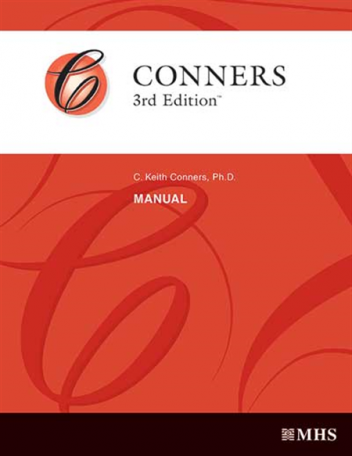
It is currently no longer available on the TEA publisher's website. There is online information available since some professionals continue to use it given its wide distribution

Non-specific
These are all general psychopathology questionnaires that allow screening for a wide variety of symptoms (affective, psychotic, attentional, academic, behavioral, self-concept, etc.) and, although they are not designed to specifically evaluate ADHD symptoms, they include items that help identify this symptomatology.