
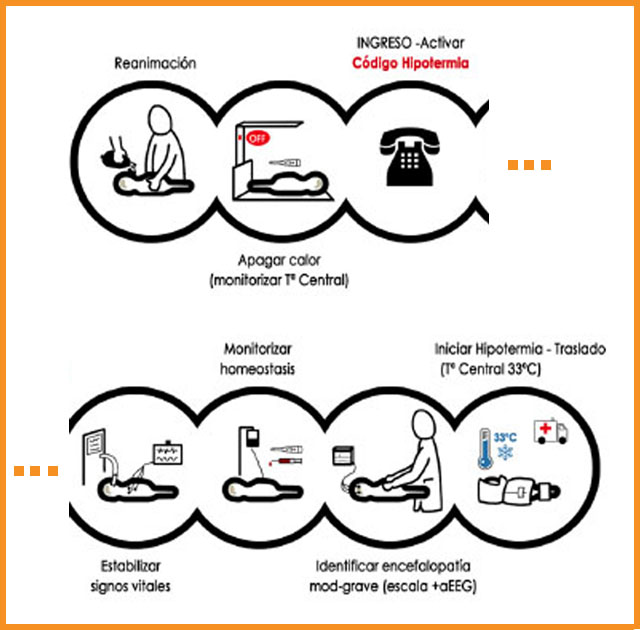
Treatment criteria:
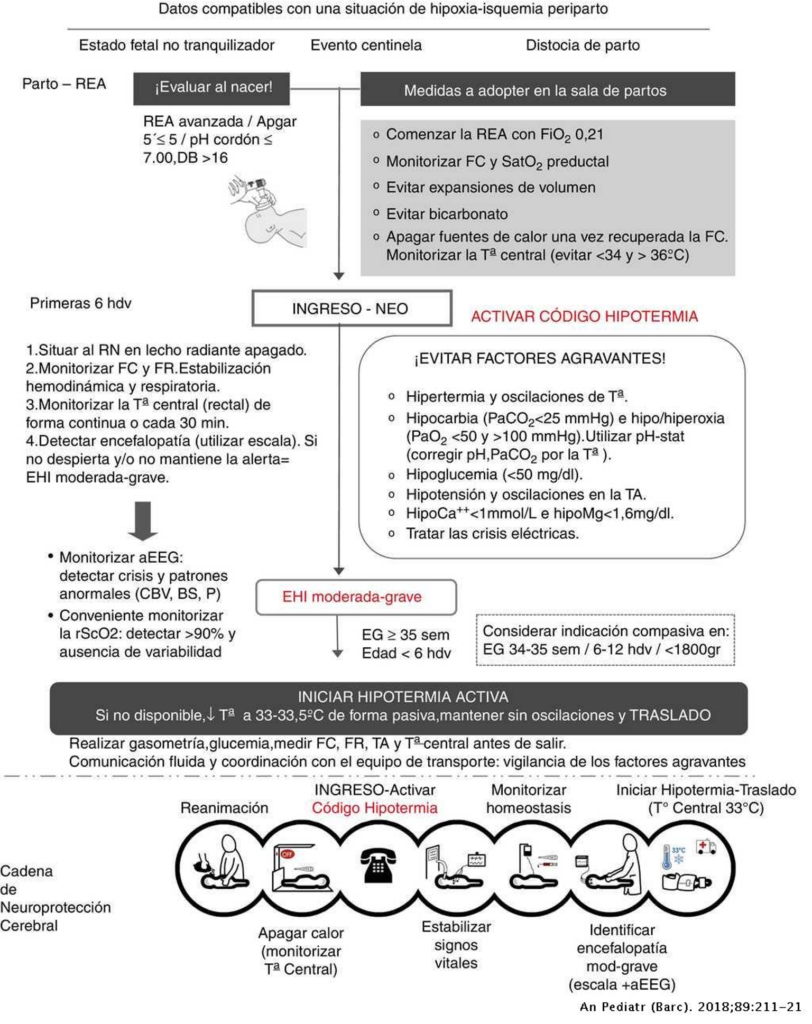
Criterion A: Newborns of more than 34 completed weeks of GA with at least 1 of the parameters of severe acidosis:
- Apgar score less than 5 at 5 minutes.
- Resuscitation in the delivery room for more than 10 minutes, via positive pressure ventilation (face mask or endotracheal tube).
- pH less than 7 in the worst blood gas analysis during the first hour of life (cord, arterial, venous, or capillary blood).
- Base deficit greater than 16 mmol/L in the worst blood gas analysis during the first hour of life (cord, arterial, venous, or capillary blood).
Criterion B. All newborns who meet Criterion A will be neurologically evaluated using Criterion B.
- Seizures.
- Clinical signs of moderate or severe HIE: The following 3 criteria must be met:
- Altered state of consciousness (diminished or absent response to stimulation).
- Abnormal tone (focal or generalized hypotonia).
- Abnormal primitive reflexes (weak/absent suck, abnormal Moro, etc.).
Criterion C: Electroencephalographic tracing. As soon as possible, and for at least 30 minutes, activity will be monitored with aEEG.
Two situations may occur:
- Normal aEEG (CNV): within the first 6 hours of life, this indicates a high probability of normal neurological prognosis and, if the neurological examination is consistent (mild HIE), discontinuation of hypothermia will be considered. Whenever possible, it should be confirmed with a conventional EEG.
- Altered aEEG: Corroborates the diagnosis of moderate-severe HIE, and treatment must be maintained for 72 hours:
- Normal baseline tracing (CNV) with seizures.
- Status epilepticus.
- Altered baseline tracing: DNV, burst-suppression.
- Suppressed baseline tracing: low voltage, isoelectric.
19955111
{19955111:QL4US6UJ}
1
vancouver
50
default
4180
https://neuropediatoolkit.org/wp-content/plugins/zotpress/
statussuccessupdateneededfalseinstancefalsemetarequest_last0request_next0used_cachetruedatakeyQL4US6UJlibraryid19955111metacreatorSummaryArnaezetal.parsedDate2018numChildren1bibltdivclassquotcsl-bib-bodyquotstylequotline-height1.35quotgtnltdivclassquotcsl-entryquotstylequotclearleftquotgtnltdivclassquotcsl-left-marginquotstylequotfloatleftpadding-right0.5emtext-alignrightwidth1emquotgt1.ltdivgtltdivclassquotcsl-right-inlinequotstylequotmargin0.4em01.5emquotgtArnaezJGarcia-AlixACalvoSLubixE1n-LxF3pezS.AsistenciaenEspaxF1adelrecixE9nnacidoconasfixiaperinatalcandidatoahipotermiaterapxE9uticadurantelasprimerasseishorasdevida.AnalesdePediatrxEDaInternet.2018cited2022Dec19894211x201321.Availablefromltaclass039zp-ItemURL039href039httpslinkinghub.elsevier.comretrievepiiS1695403317304496039gthttpslinkinghub.elsevier.comretrievepiiS1695403317304496ltagtltdivgtnltdivgtnltdivgtdataitemTypejournalArticletitleAsistenciaenEspau00f1adelreciu00e9nnacidoconasfixiaperinatalcandidatoahipotermiaterapu00e9uticadurantelasprimerasseishorasdevidacreatorscreatorTypeauthorfirstNameJuanlastNameArnaezcreatorTypeauthorfirstNameAlfredolastNameGarcia-AlixcreatorTypeauthorfirstNameSaralastNameCalvocreatorTypeauthorfirstNameSimu00f3nlastNameLubiu00e1n-Lu00f3pezabstractNoteIntroductionTheprocessofcareandassistancefrombirthtothestartingoftherapeutichypothermiaTHiscrucialinordertoimproveitseffectivenessandpreventtheworseningofhypoxic-ischaemicinjury.nMethodsAnationalcross-sectionalstudycarriedoutin2015byuseofaquestionnairesenttoallleveliiiunitsonthecareofthenewbornu226535weeksgestationwithintheufb01rsthoursoflifeafteraperinatalasphyxiaevent.AccordingtoclinicalpracticeguidelinesthequalityofcarewascomparedbetweenthehospitalsthatcarriedoutordidnotcarryoutTHandaccordingtothelevelofcare.nResultsAtotalof8990hospitalsparticipatedofwhich5790performedTH.Theyallusedresuscitationprotocolsandturnedofftheradiantwarmerafterstabilisation.Allofthemperformedglucoseandbloodgasanalysismonitoredthecentraltemperatureputthenewbornonadietandperformedatleasttwoexaminationsforthediagnosisofhypoxic-ischaemicencephalopathy.Greaterthanone-third35ofhospitalsdidnothaveamplitude-integratedelectroencephalogramand657wereTH-hospitals.ThequalityofcareamonghospitalswithandwithoutTHwassimilarchildbirthbeingbetterinthosethatperformedTHandthosewithahigherlevelofcare.LevelIIIchospitalshadhigherscoresthantheothers.TheTH-hospitalsmentionednotalwayshavingneonatologistswithexperienceinneurologicalassessmentandinterpretationofamplitude-integratedelectroencephalogram25orinbrainultrasound62.nConclusionsInresponsetotherecommendationsoftheasphyxiatednewbornthereisapropernationalhealthcarestandardwithdifferencesaccordingtothelevelofcareandwhetherTHisoffered.Moreamplitude-integratedelectroencephalogramdevicesarenecessaryaswellasmoreneonatologiststrainedintheevaluationsthatwillberequirebythenewbornwithhypoxic-ischaemicencephalopathy.date102018sectionpartNumberpartTitleDOI10.1016j.anpedi.2017.11.003citationKeyurlhttpslinkinghub.elsevier.comretrievepiiS1695403317304496PMIDPMCIDISSN16954033languageescollectionsF3H4DBMIdateModified2026-05-05T170321Z
1.
Arnaez J, Garcia-Alix A, Calvo S, Lubián-López S. Care in Spain of newborns with perinatal asphyxia who are candidates for therapeutic hypothermia during the first six hours of life. Annals of Pediatrics [Internet]. 2018 [cited 2022 Dec 19];89(4):211–21. Available from: https://linkinghub.elsevier.com/retrieve/pii/S1695403317304496