
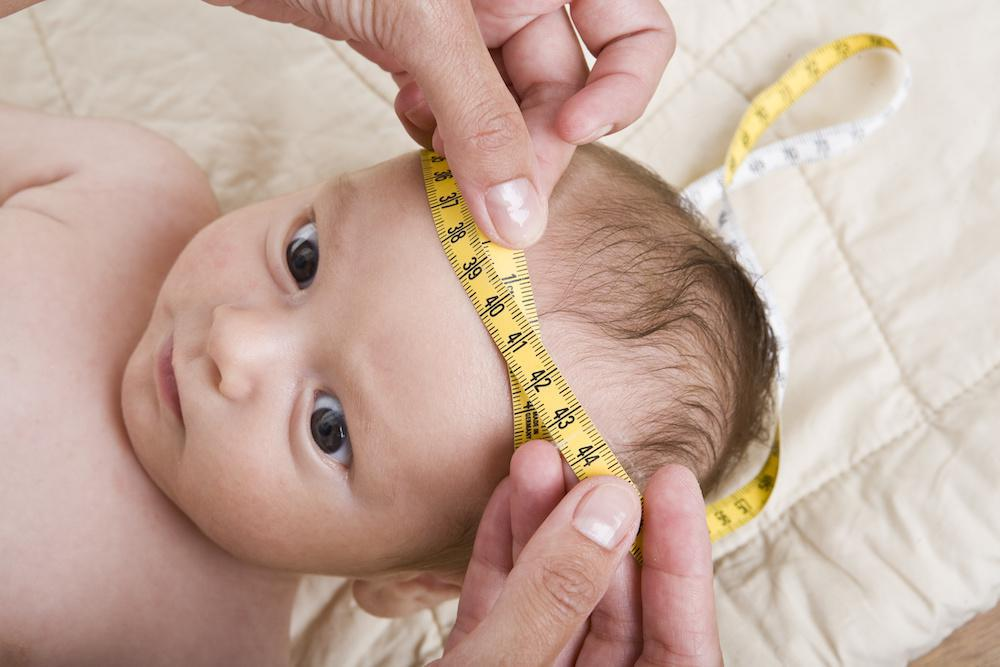
Cephalic growth is one of the easily monitorable parameters in pediatric age that allows us to evaluate growth, development, and the presence of underlying neurological problems.
Quantitative problems. Head circumference.
The main measurement tool is head circumference.
The objective is to detect those diseases that present with macrocephaly and microcephaly.
However, its measurement is not without problems:
- Being a perimeter, it does not take into account alterations in shape (qualitative problems). It is an external measurement through which we try to assess an internal variable (brain volume). The same perimeter can contain different volumes depending on the shape (a sphere has more volume than an ellipse).
- It is one of the least reliable anthropometric measurements (presence of hair, child's movements, different measurements depending on the position of the tape measure, etc.), so measurement error is very common. It is necessary to repeat the measurement multiple times over time to infer a trend.
- Head size is highly determined by genetics.
- This means it is advisable to use charts from a representative population in order to avoid biases due to over- or under-diagnosis. The Spanish population has a higher average head size than the reference sample of WHO charts, so it is advisable to compare Spanish children with Orbegozo charts, and children from other countries with WHO charts.
- Furthermore, in the case of significant deviation, it will be necessary to measure the head circumference of both parents in order to rule out the possibility of a familial macrocephaly.
- There are some genetic diseases for which specific charts exist.
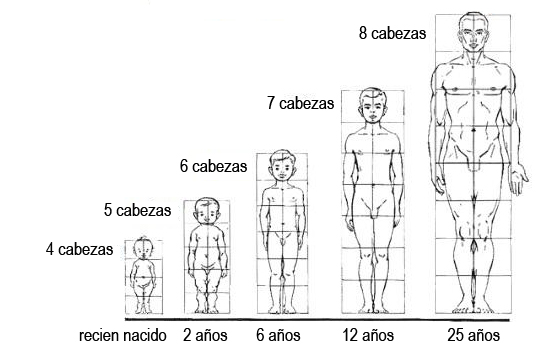
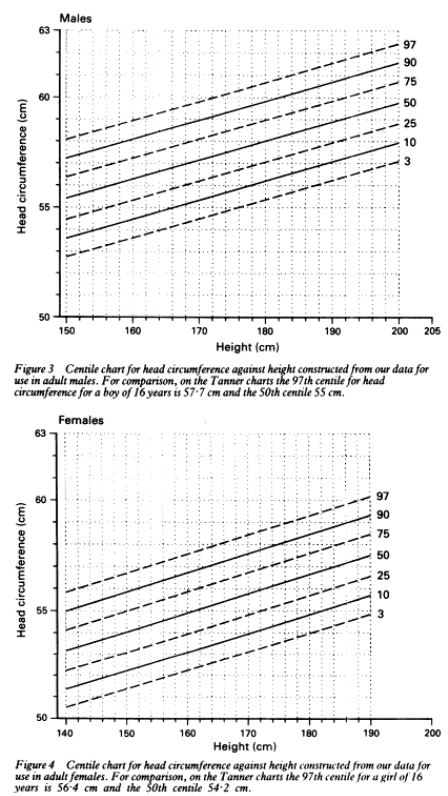
- In cases of doubt, head circumference can also be corrected based on height, as they should be proportional. A child with harmonic microcephaly or macrocephaly (same z-score for weight, height, and HC) would not be a cause for concern, but a child with relative microcephaly or macrocephaly would be (even if it does not exceed +/-2SD for their reference population). It should be borne in mind that the proportion between height and HC changes throughout life. Height age can be calculated, and then the HC percentile evaluated based on their height age rather than their chronological age.

19955111
{19955111:KHG275TG}
1
vancouver
50
default
3908
https://neuropediatoolkit.org/wp-content/plugins/zotpress/
statussuccessupdateneededfalseinstancefalsemeta request_last0request_next0used_cachetruedatakey KHG275TGlibraryid19955111metacreatorSummaryBush byetal.parsedDate1992-10numChildren4bibltdiv% 20classquotcsl-bib-bodyquotstylequotline-height1.35quotgt%3 Bnltdivclassquotcsl-entryquotstylequotclearleftq uotgtnltdivclassquotcsl-left-marginquotstylequot%3 Bfloatleftpadding-right0.5emtext-alignrightwidth1emquot%2 6gt1.ltdivgtltdivclassquotcsl-right-inlinequotstylequ otmargin0.4em01.5emquotgtBushbyKMColeTMatthewsJN%2 0GoodshipJA.Centilesforadultheadcircumference.ArchDisChildInternet.1 992Octcited2022Nov2467101286x20137.Availablefromlt% 3Baclass039zp-ItemURL039href039httpswww.ncbi.nlm.nih. govpmcarticlesPMC1793909039gthttpswww.ncbi.nlm.nih.gov pmcarticlesPMC1793909ltagtltdivgtnl tdivgtnltdivgtdataitemTypejournalArticle%2 2titleCentilesforadultheadcircumference.creatorscreatorT ypeauthorfirstNameKMlastNameBushbycreatorTyp eauthorfirstNameTlastNameColecreatorType% 22authorfirstNameJNlastNameMatthewscreatorType%2 2authorfirstNameJAlastNameGoodshipabstractNote% 22ReferencerangeforheadcircumferenceontheTannerchartsdonotgobeyondage 16.Inthisstudytheheadcircumferenceandheightsof354adultsintwoBr itishcentresweremeasured.Thecentilechartsconstructedfromthesemeasurementssh owthatadultheadcircumferenceisrelatedtoheight.Themeanheadcircumference% 20ofamaleofaverageheightisabovethe97thcentilefora16yearoldo ntheTannercharts.Thepaediatricchartsarethereforeinappropriateforusein%2 0adultmales.date1992-10sectionpartNumberpa rtTitleDOI10.1136adc.67.10.1286citationKeyurl%2 2httpswww.ncbi.nlm.nih.govpmcarticlesPMC1793909PMID 1444530PMCIDPMC1793909ISSN0003-9888language% 2CcollectionsFIGWWIGEdateModified2026-05-09T065226Z
1.
Bushby KM, Cole T, Matthews JN, Goodship JA. Centiles for adult head circumference. Arch Dis Child [Internet]. 1992 Oct [cited 2022 Nov 24];67(10):1286–7. Available from: https://www.ncbi.nlm.nih.gov/pmc/articles/PMC1793909/
Qualitative problems. Cephalic diameters.
For the measurement of cephalic diameters, the craniometer.