

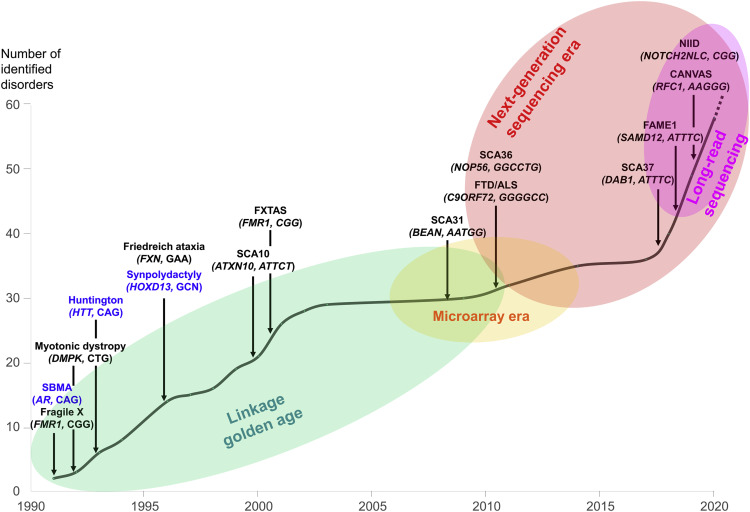
1. Clasificación por tamaño de unidad
- STR (microsatélites): 1-6 pb → grueso de patología neurológica
- VNTR (sentido amplio): número variable de copias, unidad mayor
- Minisatélites clásicos: 10-60 pb (INS, MUC1)
- Macrosatélites: miles de pb — mismo principio (nº variable de copias), unidad muchísimo mayor (FSHD/D4Z4)
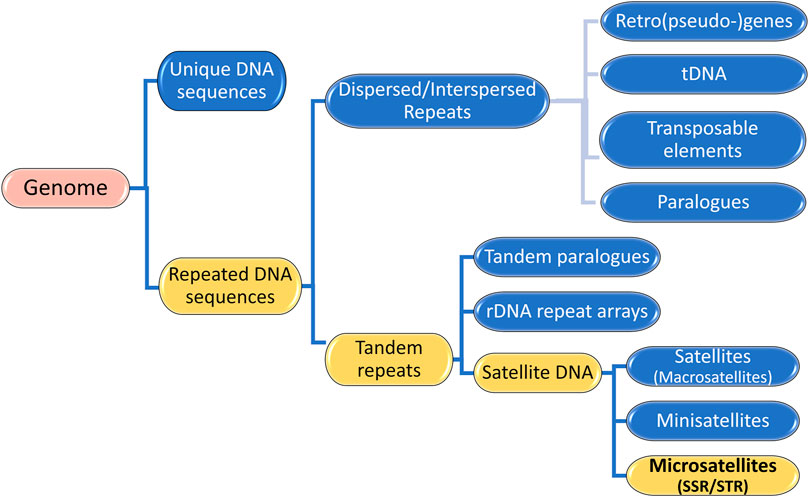
2. Por qué son inestables (mecanismo común)
- Deslizamiento de la ADN polimerasa durante replicación
- Hebra naciente se disocia y reasocia en registro desplazado → bucle
- Bucle en hebra naciente → expansión
- Bucle en hebra molde → contracción
- A mayor longitud previa, mayor probabilidad de bucle → inestabilidad no lineal tras umbral crítico (normal → premutación → mutación completa)
Consecuencia clínica: anticipación genética = manifestación fenotípica de esta inestabilidad meiótica creciente (sesgo paterno o materno según la enfermedad).
3. Tres mecanismos según localización de la repetición (bloque STR)
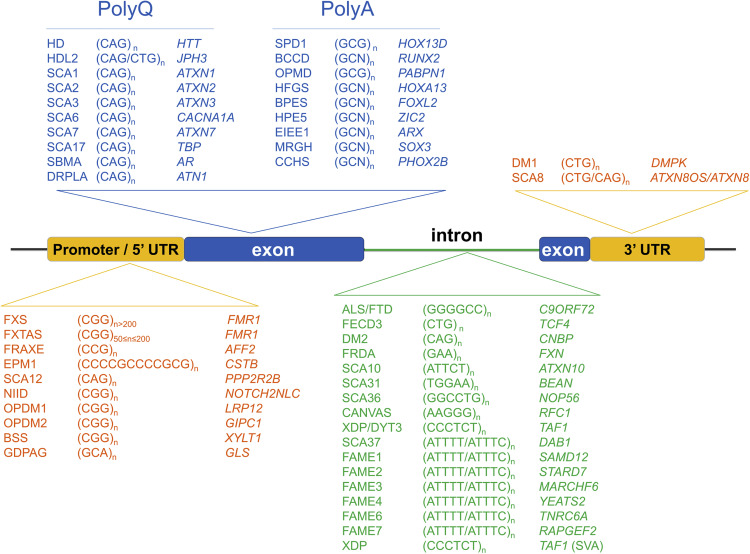
A) Exón codificante, tripletes (CAG=poliQ)
- Proteína anómala con tracto de poliglutamina
- Mal plegamiento → agregación intranuclear
- Ganancia de función tóxica, dominante
- Ej.: Huntington, SCAs, Kennedy (ligada a X)
B) Región no codificante (UTR, intrón), gran expansión
- Silenciamiento epigenético → hipermetilación → pérdida de función (X frágil, Friedreich)
- Toxicidad de ARN → secuestro de proteínas de splicing por ARN mensajero con repetición expandida (miotónica, C9orf72)
Durch STR verursachte neurologische Erkrankungen.
| Abgekürzter Phänotyp (MIM-Nummer) | Gen | Art der Vererbung | Motiv wiederholen | Standort auf Gene | Pathogene Wiederholungszahla | Chromosom | Koordinaten (hg38) | Klinischer Phänotyp | Referenzen | |
|---|---|---|---|---|---|---|---|---|---|---|
| C9-FTD C9-ALS (#10550) | C9orf72 | ANZEIGE. | GGGGCC | 5'-Region | 24–4000 | chr9 | 27573485 | 27573546 | Frontotemporale Demenz, Amyotrophe Lateralsklerose | [32, 47, 65] |
| LEINWAND (#614575) | RFC1 | A.R. | (AAGGG)400–2000 (ACAGG)exp AAAAG (normal) | Einführung 2 | 400–2000 | chr4 | 39348425 | 39348483 | Kleinhirnataxie, Neuropathie und vestibuläres Areflexie-Syndrom | [11, 28, 138] |
| DM1 (#160900) | DMPK | ANZEIGE. | CTG (Unterbrechungen: CCG) | 3‘-Region | 50–10.000 | chr19 | 45770205 | 45770266 | Myotone Dystrophie 1 | [60, 176] |
| DM2 (#602668) | CNBP (ZNF9) | ANZEIGE. | CCTG | Einleitung 1 | 50–11.000 | chr3 | 129172577 | 129172656 | Myotone Dystrophie 2 | [176] |
| DRPLA (#125370) | ATN1 | ANZEIGE. | CAG | Exon 5 | 49–93 | chr12 | 6936717 | 6936775 | Dentatorubral-pallidoluysische Atrophie | [78] |
| EIEE1/XLID (#308350) (#300419) (#300215) | ARX | XL | GCC | Exon 2 | 17–27 | chrX | 25013654 | 25013697 | Klinisches Krankheitsspektrum einschließlich entwicklungsbedingter und epileptischer Enzephalopathie 1, Hydranenzephalie mit abnormalen Genitalien, X-chromosomaler Lissenzephalie 2 und X-chromosomaler geistiger Behinderung 29 | [73, 150] |
| FAME1 (#601068) | SAMD12 | ANZEIGE. | TTTCA innerhalb der TTTTA-Wiederholungsregion | Einführung 4 | 105–3680 | chr8 | 118366813 | 118366918 | Familiäre myoklonische Epilepsie bei Erwachsenen 1 | [22, 68] |
| RUHM2 (#607876) | STARD7 | ANZEIGE. | ATTTC innerhalb der ATTTT-Wiederholungsregion | Einleitung 1 | 150–460 | chr2 | 96197067 | 96197124 | Familiäre myoklonische Epilepsie bei Erwachsenen 2 | [27] |
| RUHM3 (#613608) | MÄRZF6 | ANZEIGE. | TTTCA innerhalb der TTTTA-Wiederholungsregion | Einleitung 1 | 700–1035 | chr5 | 10356339 | 10356411 | Familiäre myoklonische Epilepsie bei Erwachsenen 3 | [40] |
| RUHM6 (#618074) | TNRC6A | ANZEIGE. | TTTCA innerhalb der TTTTA-Wiederholungsregion | Einleitung 1 | ? (nur 1 Familie) | chr16 | 24613439 | 24613532 | Familiäre myoklonische Epilepsie bei Erwachsenen 6 | [68] |
| RUHM7 (#618075) | RAPGEF2 | ANZEIGE. | TTTCA innerhalb der TTTTA-Wiederholungsregion | Einleitung 14 | ? (nur 1 Familie) | chr4 | 159342527 | 159342618 | Familiäre myoklonische Epilepsie bei Erwachsenen 7 | [68] |
| FRAXE (#309548) | FMR2 (AFF2) | XLR | GCC | 5'-Region | > 200 | chrX | 148500605 | 148500753 | Geistige Behinderung, X-chromosomal, FRAXE-Typ | [53] |
| FRDA (#229300) | FXN | A.R. | GAA | Einleitung 1 | 66–1300 | chr9 | 69037275 | 69037314 | Friedreich-Ataxie | [5, 19, 162] |
| FXS (#300624) FXTAS (#300623) | FMR1 | XL | CGG | 5'-Region | 200–3000 55–200 | chrX | 147911979 | 147912111 | Fragiles-X-Syndrom Fragiles X-Tremor/Ataxie-Syndrom, vorzeitiges Ovarialversagen 1 | [162] [56] |
| HD (#143100) | HTT | ANZEIGE. | CAG (Unterbrechungen: CAA) | Exon 1 | 36–250 | chr4 | 3074876 | 3074941 | Huntington-Krankheit | [96, 101] |
| HDL1 (#603218) | PRNP | ANZEIGE. | 24-Base Oktapeptid PHGGGWGQ | Exon 2 | 8–14 | chr20 | 4699379 | 4699380 | Huntington-ähnliche Krankheit 1 | [108] |
| HDL2 (#606438) | JPH3 | ANZEIGE. | CTG | Exon 2A | 40–59 | chr16 | 87604283 | 87604329 | Huntington-ähnliche Krankheit 2 | [62] |
| HMN | VWA1 | A.R. | GGCCGGCGAGC | Exon 1 | 3 | chr1 | 1435799 | 1435820 | Hereditäre axonale motorische Neuropathie | [121] |
| NIID (#603472) | NOTCH2NLC | ANZEIGE. | CGG | 5′-Region | 66–517 | chr1 | 149390803 | 149390842 | Neuronale intranukleäre Einschlusserkrankung | [55, 118, 146] |
| OPDM1 (#164310) | LRP12 | ANZEIGE. | CGG | 5′-Region | 90–130 | chr8 | 104588965 | 104588999 | Okulopharyngodistale Myopathie | [69] |
| OPDM2 (#618940) | GIPC1 | ANZEIGE. | CGG | 5'-Region | 70–164 | chr19 | 14496029 | 14496104 | Okulopharyngodistale Myopathie | [172] |
| OPMD (#164300) | PABPN1 | ANZEIGE. | G.C.G. | Exon 1 | 7–18 | chr14 | 23321472 | 23321511 | Okulopharyngeale Muskeldystrophie | [15, 129] |
| OPML1 (#618637) | NUTM2B-AS1 | ANZEIGE. | CGG | 5′-Region | 16–160 | chr10 | 79826364 | 79826403 | Okulopharyngeale Myopathie mit Leukenzephalopathie 1 | [69] |
| SBMA (#313200) | A.R. | XLR | CAG | Exon 1 | 38–68 | chrX | 67545317 | 67545419 | Spinale und Bulbäre Muskelatrophie Kennedy (Kennedy-Krankheit) | [44, 82, 147] |
| SCA1 (#164400) | ATXN1 | ANZEIGE. | CAG (Unterbrechungen: CAT) | Exon 8 | 39–91 | chr6 | 16327636 | 16327723 | Spinozerebelläre Ataxie 1 | [120, 141] |
| SCA2 (#183090) | ATXN2 | ANZEIGE. | CAG (Unterbrechungen: CAA, CGG, CGC) | Exon 1 | 33–200 (29–32 erhöhtes ALS-Risiko) | chr12 | 111598950 | 111599019 | Spinozerebelläre Ataxie 2 | [18, 133, 141, 148] |
| SCA3 (#109150) | ATXN3 | ANZEIGE. | CAG | Exon 10 | 53–87 | chr14 | 92071011 | 92071052 | Spinozerebelläre Ataxie 3 | [74] |
| SCA6 (183086) | CACNA1A | ANZEIGE. | CAG | Exon 47 | 19–33 | chr19 | 13207858 | 13207897 | Spinozerebelläre Ataxie 6 | [141, 181] |
| SCA7 (#164500) | ATXN7 | ANZEIGE. | CAG | Exon 1 | 34–460 | chr3 | 63912685 | 63912716 | Spinozerebelläre Ataxie 7 | [18, 30] |
| SCA8 (#608768) | ATXN8 | ANZEIGE. | CAG/TAG | 3’UTR | 74–1300 | Chr.13 | 70139383 | 70139428 | Spinozerebelläre Ataxie 8 | [79, 141, 155] |
| SCA10 (#603516) | ATXN10 | ANZEIGE. | ATTCT (Unterbrechungen: ATCCT) | Einführung 9 | 280–4500 | chr22 | 45795355 | 45795424 | Spinozerebelläre Ataxie 10 | [88, 100, 141] |
| SCA12 (#604326) | PPP2R2B | ANZEIGE. | CAG | 5'-Region | 51–78 | chr5 | 146878729 | 146878758 | Spinozerebelläre Ataxie 12 | [63, 94, 141] |
| SCA17 (#607136) | TBP | ANZEIGE. | CAG (Unterbrechungen: CAT, CAA) | Exon 3 | 43–66 | chr6 | 170561907 | 170562017 | Spinozerebelläre Ataxie 17, Huntington-ähnliche 4 | [97, 115, 141] |
| SCA31 (#117210) | BOHNE1 | ANZEIGE. | TGGAA innerhalb der TAAAA- und TAGAA-Wiederholungsregion | Einführung/ Intergene Region | 500–760 (> 110 TGGAA-Wiederholungen) | chr16 | 66495475 | 66495509 | Spinozerebelläre Ataxie 31 | [134] |
| SCA36 (#614153) | NOP56 | ANZEIGE. | GGCCTG | Einleitung 1 | 650–2500 | chr20 | 2652733 | 2652775 | Spinozerebelläre Ataxie 36 | [77] |
| SCA37 (#615945) | DAB1 | ANZEIGE. | ATTTC innerhalb (ATTTT)7–400 Bereich wiederholen | 5'-Region | 31–75 | chr1 | 57367044 | 57367125 | Spinozerebelläre Ataxie 37 | [139] |
| ULD (#254800) | CSTB | A.R. | CCCCGCCCCGCG | Stromaufwärts 5’UTR | 30–125 | chr21 | 43776444 | 43776479 | Progressive myoklonische Epilepsie 1A (Unverricht- und Lundborg-Krankheit) | [87, 91] |
aDiese Bereiche variieren zwischen den Studien und häufig ist die Obergrenze unbekannt. Es ist wichtig zu beachten, dass diese nur potenziell pathogen sind. Es gibt einen kleinen Teilbereich (< 1 %) der gesunden Kontrollpopulation, der erweiterte Allele ohne klinische Manifestationen aufweist. Ebenso gibt es Allele, die unter dem angegebenen Bereich liegen und intermediäre Allele und Prämutationssyndrome aufweisen können
Angeborene und Entwicklungskrankheiten, die durch STR verursacht werden.
| Phänotyp (OMIM#) | Gen | Motiv | Pathogene Wiederholungszahl | Standort | (hg38) | Referenzen | ||
|---|---|---|---|---|---|---|---|---|
| BPES (#110100) | FOXL2 | G.C.G. | 22–24 | Exon | chr3 | 138946022 | 138946062 | [116] |
| CCHS (#209880) | PHOX2B | G.C.G. | 24–33 | Exon | chr4 | 41745976 | 41746022 | [7] |
| DBQD2 (#615777) | XYLT1 | GGC | 100–800 | 5'-Region | chr16 | 17470869 | 17470967 | [86] |
| FECD3 (#613267) | TCF4 | TGC | > 50 | Einführung | chr18a | 55222184a | 55635956a | [167] |
| BIPAG (#618412) | GLS | GCA | > 300 | 5'-Region | chr2 | 190880873 | 190880920 | [159] |
| H.F.G. (#140000) | HOXA13 | G.C.G. | 24–26 | Exon | chr7 | 27199827 | 27199967 | [50] |
| HPE5 (#609637) | ZIC2 | G.C.G. | 25 | Exon | Chr.13 | 99985449 | 99985494 | [17] |
| HSAN8 (#616488) | PRDM12 | G.C.G. | 18–19 | Exon | chr9 | 130681606 | 130681641 | [23] |
| SPD1 (#186000) | HOXD13 | G.C.G. | 22–29 | Exon | chr2 | 176093058 | 176093099 | [2] |
| XLMR (#300123) | SOX3 | G.C.G. | 15–26 | Exon | chr3 | 181712415 | 181712456 | [89] |
aOrt des gesamten Gens aufgeführt
4. Bloque VNTR (sentido amplio)
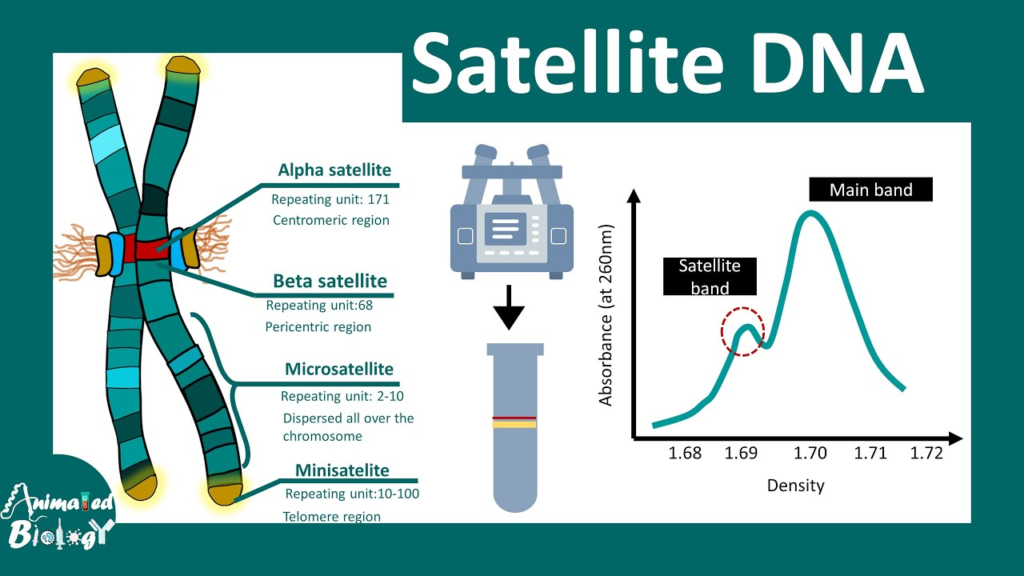
Minisatélites clásicos
- Variación de número de copias sin umbral patogénico brusco
- Modulan riesgo poligénico (INS → diabetes tipo 1) o causan enfermedad estructural (MUC1 → ADTKD)
- Base histórica del «DNA fingerprinting» forense
Macrosatélites
— FSHD como caso paradigmático
- D4Z4 (subtelómero 4q35): unidad de 3.3 kb
- Normal: 11-100 copias / Patológico: ≤10 copias (FSHD1) — contracción, no expansión
- Contracción abre cromatina → desrepresión de DUX4 (normalmente silenciado en músculo adulto) → toxicidad
- Requiere haplotipo permisivo 4qA (misma contracción en 4qB no causa enfermedad)
- FSHD2: array normal, pero mutación en SMCHD1 → mismo resultado (desrepresión de DUX4) por vía trans, no por contracción cis
- No sigue anticipación genética clásica (mecanismo epigenético, no carrera de repeticiones)
- Sí, hay un grupo pequeño pero importante de enfermedades que comparten con FSHD el mecanismo «atípico» (repetición grande, no microsatélite clásico, y/o mecanismo epigenético en vez de toxicidad directa). Las más relevantes para tu esquema:
—- Síndrome ICF (Inmunodeficiencia, Inestabilidad Centromérica, anomalías Faciales)
- Afecta repeticiones satélite 2 y 3 (secuencias pericentroméricas, no D4Z4, pero mismo principio de macrosatélite/heterocromatina repetitiva)
- Mecanismo: mutaciones en DNMT3B (o ZBTB24, CDCA7, HELLS) → hipometilación de estas regiones repetidas → descondensación pericentromérica → inestabilidad cromosómica
- Es prácticamente el equivalente autosómico recesivo del mecanismo de FSHD2: falla la maquinaria que mantiene silenciada la heterocromatina repetitiva, en vez de fallar la repetición misma
—- Epilepsia mioclónica progresiva tipo 1 (Unverricht-Lundborg).
- Gen CSTB (cistatina B)
- Repetición dodecámera (12 pb) en el promotor — tamaño frontera entre microsatélite y minisatélite, otro caso que no encaja limpiamente en STR clásico
- Mecanismo: expansión (a diferencia de FSHD) pero el resultado es pérdida de función por reducción transcripcional, no toxicidad de proteína ni de ARN — la expansión en el promotor simplemente dificulta la transcripción del gen
- Útil como contraste: expansión que causa pérdida de función pura, sin ganancia tóxica
19955111
{19955111:N989PCPW},{19955111:XHVJIQA4}
1
Vancouver
50
Standard
2455
https://neuropediatoolkit.org/wp-content/plugins/zotpress/
%7B%22status%22%3A%22success%22%2C%22updateneeded%22%3Afalse%2C%22instance%22%3Afalse%2C%22meta%22%3A%7B%22request_last%22%3A0%2C%22request_next%22%3A0%2C%22used_cache%22%3Atrue%7D%2C%22data%22%3A%5B%7B%22key%22%3A%22N989PCPW%22%2C%22library%22%3A%7B%22id%22%3A19955111%7D%2C%22meta%22%3A%7B%22creatorSummary%22%3A%22Depienne%20and%20Mandel%22%2C%22parsedDate%22%3A%222021-05-06%22%2C%22numChildren%22%3A2%7D%2C%22bib%22%3A%22%26lt%3Bdiv%20class%3D%26quot%3Bcsl-bib-body%26quot%3B%20style%3D%26quot%3Bline-height%3A%201.35%3B%20%26quot%3B%26gt%3B%5Cn%20%20%26lt%3Bdiv%20class%3D%26quot%3Bcsl-entry%26quot%3B%20style%3D%26quot%3Bclear%3A%20left%3B%20%26quot%3B%26gt%3B%5Cn%20%20%20%20%26lt%3Bdiv%20class%3D%26quot%3Bcsl-left-margin%26quot%3B%20style%3D%26quot%3Bfloat%3A%20left%3B%20padding-right%3A%200.5em%3B%20text-align%3A%20right%3B%20width%3A%201em%3B%26quot%3B%26gt%3B1.%26lt%3B%5C%2Fdiv%26gt%3B%26lt%3Bdiv%20class%3D%26quot%3Bcsl-right-inline%26quot%3B%20style%3D%26quot%3Bmargin%3A%200%20.4em%200%201.5em%3B%26quot%3B%26gt%3BDepienne%20C%2C%20Mandel%20JL.%2030%20years%20of%20repeat%20expansion%20disorders%3A%20What%20have%20we%20learned%20and%20what%20are%20the%20remaining%20challenges%3F%20The%20American%20Journal%20of%20Human%20Genetics%20%5BInternet%5D.%202021%20May%206%20%5Bcited%202021%20Sept%2019%5D%3B108%285%29%3A764%26%23x2013%3B85.%20Available%20from%3A%20%26lt%3Ba%20class%3D%26%23039%3Bzp-ItemURL%26%23039%3B%20href%3D%26%23039%3Bhttps%3A%5C%2F%5C%2Fwww.sciencedirect.com%5C%2Fscience%5C%2Farticle%5C%2Fpii%5C%2FS0002929721000951%26%23039%3B%26gt%3Bhttps%3A%5C%2F%5C%2Fwww.sciencedirect.com%5C%2Fscience%5C%2Farticle%5C%2Fpii%5C%2FS0002929721000951%26lt%3B%5C%2Fa%26gt%3B%26lt%3B%5C%2Fdiv%26gt%3B%5Cn%20%20%26lt%3B%5C%2Fdiv%26gt%3B%5Cn%26lt%3B%5C%2Fdiv%26gt%3B%22%2C%22data%22%3A%7B%22itemType%22%3A%22journalArticle%22%2C%22title%22%3A%2230%20years%20of%20repeat%20expansion%20disorders%3A%20What%20have%20we%20learned%20and%20what%20are%20the%20remaining%20challenges%3F%22%2C%22creators%22%3A%5B%7B%22creatorType%22%3A%22author%22%2C%22firstName%22%3A%22Christel%22%2C%22lastName%22%3A%22Depienne%22%7D%2C%7B%22creatorType%22%3A%22author%22%2C%22firstName%22%3A%22Jean-Louis%22%2C%22lastName%22%3A%22Mandel%22%7D%5D%2C%22abstractNote%22%3A%22Tandem%20repeats%20represent%20one%20of%20the%20most%20abundant%20class%20of%20variations%20in%20human%20genomes%2C%20which%20are%20polymorphic%20by%20nature%20and%20become%20highly%20unstable%20in%20a%20length-dependent%20manner.%20The%20expansion%20of%20repeat%20length%20across%20generations%20is%20a%20well-established%20process%20that%20results%20in%20human%20disorders%20mainly%20affecting%20the%20central%20nervous%20system.%20At%20least%2050%20disorders%20associated%20with%20expansion%20loci%20have%20been%20described%20to%20date%2C%20with%20half%20recognized%20only%20in%20the%20last%20ten%20years%2C%20as%20prior%20methodological%20difficulties%20limited%20their%20identification.%20These%20limitations%20still%20apply%20to%20the%20current%20widely%20used%20molecular%20diagnostic%20methods%20%28exome%20or%20gene%20panels%29%20and%20thus%20result%20in%20missed%20diagnosis%20detrimental%20to%20affected%20individuals%20and%20their%20families%2C%20especially%20for%20disorders%20that%20are%20very%20rare%20and%5C%2For%20clinically%20not%20recognizable.%20Most%20of%20these%20disorders%20have%20been%20identified%20through%20family-driven%20approaches%20and%20many%20others%20likely%20remain%20to%20be%20identified.%20The%20recent%20development%20of%20long-read%20technologies%20provides%20a%20unique%20opportunity%20to%20systematically%20investigate%20the%20contribution%20of%20tandem%20repeats%20and%20repeat%20expansions%20to%20the%20genetic%20architecture%20of%20human%20disorders.%20In%20this%20review%2C%20we%20summarize%20the%20current%20and%20most%20recent%20knowledge%20about%20the%20genetics%20of%20repeat%20expansion%20disorders%20and%20the%20diversity%20of%20their%20pathophysiological%20mechanisms%20and%20outline%20the%20perspectives%20of%20developing%20personalized%20treatments%20in%20the%20future.%22%2C%22date%22%3A%22May%206%2C%202021%22%2C%22section%22%3A%22%22%2C%22partNumber%22%3A%22%22%2C%22partTitle%22%3A%22%22%2C%22DOI%22%3A%2210.1016%5C%2Fj.ajhg.2021.03.011%22%2C%22citationKey%22%3A%22%22%2C%22url%22%3A%22https%3A%5C%2F%5C%2Fwww.sciencedirect.com%5C%2Fscience%5C%2Farticle%5C%2Fpii%5C%2FS0002929721000951%22%2C%22PMID%22%3A%22%22%2C%22PMCID%22%3A%22%22%2C%22ISSN%22%3A%220002-9297%22%2C%22language%22%3A%22en%22%2C%22collections%22%3A%5B%22QKPQST8L%22%5D%2C%22dateModified%22%3A%222026-07-15T22%3A41%3A32Z%22%7D%7D%2C%7B%22key%22%3A%22XHVJIQA4%22%2C%22library%22%3A%7B%22id%22%3A19955111%7D%2C%22meta%22%3A%7B%22creatorSummary%22%3A%22Chintalaphani%20et%20al.%22%2C%22parsedDate%22%3A%222021-05-25%22%2C%22numChildren%22%3A2%7D%2C%22bib%22%3A%22%26lt%3Bdiv%20class%3D%26quot%3Bcsl-bib-body%26quot%3B%20style%3D%26quot%3Bline-height%3A%201.35%3B%20%26quot%3B%26gt%3B%5Cn%20%20%26lt%3Bdiv%20class%3D%26quot%3Bcsl-entry%26quot%3B%20style%3D%26quot%3Bclear%3A%20left%3B%20%26quot%3B%26gt%3B%5Cn%20%20%20%20%26lt%3Bdiv%20class%3D%26quot%3Bcsl-left-margin%26quot%3B%20style%3D%26quot%3Bfloat%3A%20left%3B%20padding-right%3A%200.5em%3B%20text-align%3A%20right%3B%20width%3A%201em%3B%26quot%3B%26gt%3B1.%26lt%3B%5C%2Fdiv%26gt%3B%26lt%3Bdiv%20class%3D%26quot%3Bcsl-right-inline%26quot%3B%20style%3D%26quot%3Bmargin%3A%200%20.4em%200%201.5em%3B%26quot%3B%26gt%3BChintalaphani%20SR%2C%20Pineda%20SS%2C%20Deveson%20IW%2C%20Kumar%20KR.%20An%20update%20on%20the%20neurological%20short%20tandem%20repeat%20expansion%20disorders%20and%20the%20emergence%20of%20long-read%20sequencing%20diagnostics.%20Acta%20Neuropathologica%20Communications%20%5BInternet%5D.%202021%20May%2025%20%5Bcited%202021%20Sept%2019%5D%3B9%281%29%3A98.%20Available%20from%3A%20%26lt%3Ba%20class%3D%26%23039%3Bzp-ItemURL%26%23039%3B%20href%3D%26%23039%3Bhttps%3A%5C%2F%5C%2Fdoi.org%5C%2F10.1186%5C%2Fs40478-021-01201-x%26%23039%3B%26gt%3Bhttps%3A%5C%2F%5C%2Fdoi.org%5C%2F10.1186%5C%2Fs40478-021-01201-x%26lt%3B%5C%2Fa%26gt%3B%26lt%3B%5C%2Fdiv%26gt%3B%5Cn%20%20%26lt%3B%5C%2Fdiv%26gt%3B%5Cn%26lt%3B%5C%2Fdiv%26gt%3B%22%2C%22data%22%3A%7B%22itemType%22%3A%22journalArticle%22%2C%22title%22%3A%22An%20update%20on%20the%20neurological%20short%20tandem%20repeat%20expansion%20disorders%20and%20the%20emergence%20of%20long-read%20sequencing%20diagnostics%22%2C%22creators%22%3A%5B%7B%22creatorType%22%3A%22author%22%2C%22firstName%22%3A%22Sanjog%20R.%22%2C%22lastName%22%3A%22Chintalaphani%22%7D%2C%7B%22creatorType%22%3A%22author%22%2C%22firstName%22%3A%22Sandy%20S.%22%2C%22lastName%22%3A%22Pineda%22%7D%2C%7B%22creatorType%22%3A%22author%22%2C%22firstName%22%3A%22Ira%20W.%22%2C%22lastName%22%3A%22Deveson%22%7D%2C%7B%22creatorType%22%3A%22author%22%2C%22firstName%22%3A%22Kishore%20R.%22%2C%22lastName%22%3A%22Kumar%22%7D%5D%2C%22abstractNote%22%3A%22Short%20tandem%20repeat%20%28STR%29%20expansion%20disorders%20are%20an%20important%20cause%20of%20human%20neurological%20disease.%20They%20have%20an%20established%20role%20in%20more%20than%2040%20different%20phenotypes%20including%20the%20myotonic%20dystrophies%2C%20Fragile%20X%20syndrome%2C%20Huntington%5Cu2019s%20disease%2C%20the%20hereditary%20cerebellar%20ataxias%2C%20amyotrophic%20lateral%20sclerosis%20and%20frontotemporal%20dementia.%22%2C%22date%22%3A%22May%2025%2C%202021%22%2C%22section%22%3A%22%22%2C%22partNumber%22%3A%22%22%2C%22partTitle%22%3A%22%22%2C%22DOI%22%3A%2210.1186%5C%2Fs40478-021-01201-x%22%2C%22citationKey%22%3A%22%22%2C%22url%22%3A%22https%3A%5C%2F%5C%2Fdoi.org%5C%2F10.1186%5C%2Fs40478-021-01201-x%22%2C%22PMID%22%3A%22%22%2C%22PMCID%22%3A%22%22%2C%22ISSN%22%3A%222051-5960%22%2C%22language%22%3A%22%22%2C%22collections%22%3A%5B%22QKPQST8L%22%5D%2C%22dateModified%22%3A%222026-05-09T07%3A43%3A45Z%22%7D%7D%5D%7D
1.
Depienne C, Mandel JL. 30 years of repeat expansion disorders: What have we learned and what are the remaining challenges? The American Journal of Human Genetics [Internet]. 2021 May 6 [cited 2021 Sept 19];108(5):764–85. Available from: https://www.sciencedirect.com/science/article/pii/S0002929721000951
1.
Chintalaphani SR, Pineda SS, Deveson IW, Kumar KR. An update on the neurological short tandem repeat expansion disorders and the emergence of long-read sequencing diagnostics. Acta Neuropathologica Communications [Internet]. 2021 May 25 [cited 2021 Sept 19];9(1):98. Available from: https://doi.org/10.1186/s40478-021-01201-x