

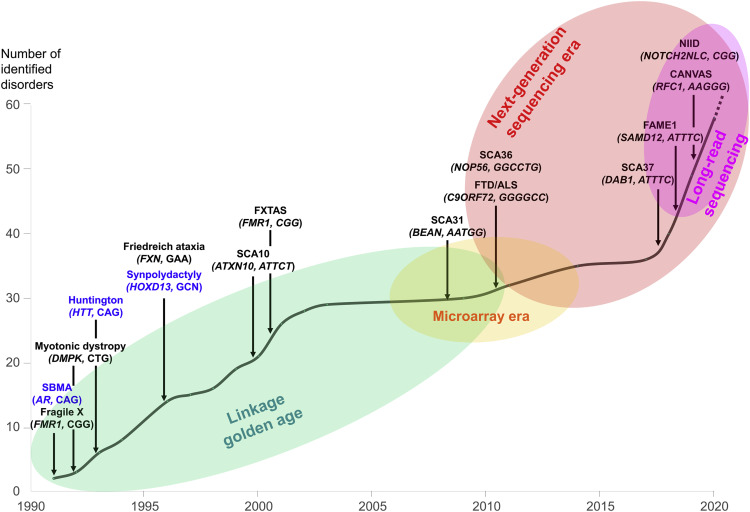
1. Classification by unit size
- STR (microsatellites): 1-6 bp → thickness of neurological pathology
- VNTR (broad sense): variable number of copies, largest unit
- Classic minisatellites: 10-60 bp (INS, MUC1)
- Macrosatellites: thousands of bp — same principle (variable number of copies), much larger unit (FSHD/D4Z4)
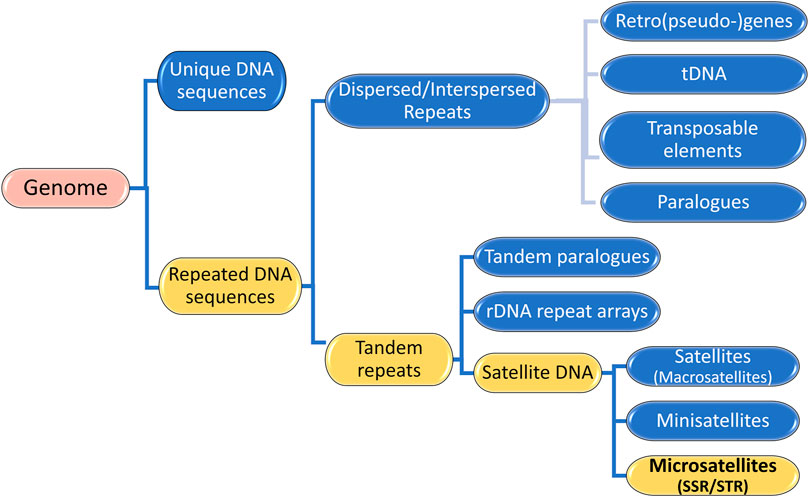
2. Why they are unstable (common mechanism)
- DNA polymerase slippage during replication
- Nascent strand dissociates and reassociates in displaced register → loop
- Loop in nascent strand → expansion
- Mold strand loop → contraction
- The greater the prior length, the greater the probability of loop → nonlinear instability after critical threshold (normal → premutation → complete mutation)
Clinical consequence: genetic anticipation = phenotypic manifestation of this increasing meiotic instability (paternal or maternal bias depending on the disease).
3. Three mechanisms depending on the location of the repeat (STR block)
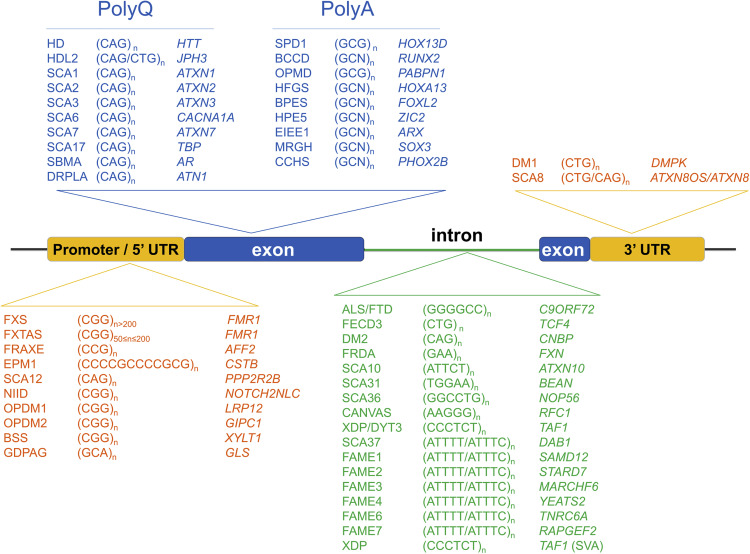
A) Coding exon, triplets (CAG=polyQ)
- Abnormal protein with polyglutamine tract
- Misfolding → intranuclear aggregation
- Toxic gain of function, dominant
- Ex: Huntington, SCAs, Kennedy (X-linked)
B) Non-coding region (UTR, intron), large expansion
- Epigenetic silencing → hypermethylation → loss of function (Fragile X, Friedreich)
- RNA toxicity → sequestration of splicing proteins by messenger RNA with expanded repeat (myotonic, C9orf72)
Neurological diseases caused by STRs.
| Abbreviated phenotype (MIM number) | Gene | Mode of inheritance | Repeat Motif | Location on Gene | Pathogenic repeat numbera | Chromosome | Coordinates (hg38) | Clinical phenotype | References | |
|---|---|---|---|---|---|---|---|---|---|---|
| C9-FTD C9-ALS (#10550) | C9orf72 | AD | GGGGCC | 5’ Region | 24–4000 | chr9 | 27573485 | 27573546 | Frontotemporal dementia, amyotrophic lateral sclerosis | [32, 47, 65] |
| CANVAS (#614575) | RFC1 | AR | (AAGGG)400–2000 (ACAGG)exp AAAAG (normal) | Intron 2 | 400–2000 | chr4 | 39348425 | 39348483 | Cerebellar ataxia, neuropathy, and vestibular areflexia syndrome | [11, 28, 138] |
| DM1 (#160900) | DMPK | AD | CTG (Interruptions: CCG) | 3’ Region | 50–10,000 | chr19 | 45770205 | 45770266 | Myotonic dystrophy 1 | [60, 176] |
| DM2 (#602668) | CNBP (ZNF9) | AD | CCTG | Intron 1 | 50–11,000 | chr3 | 129172577 | 129172656 | Myotonic dystrophy 2 | [176] |
| DRPLA (#125370) | ATN1 | AD | CAG | Exon 5 | 49–93 | chr12 | 6936717 | 6936775 | Dentatorubral-pallidoluysian atrophy | [78] |
| EIEE1/XLID (#308350) (#300419) (#300215) | ARX | XL | GCC | Exon 2 | 17–27 | chrX | 25013654 | 25013697 | Clinical spectrum of disorders including developmental and epileptic encephalopathy 1, hydranencephaly with abnormal genitalia, X-linked lissencephaly 2 and X-linked mental retardation 29 | [73, 150] |
| FAME1 (#601068) | SAMD12 | AD | TTTCA within TTTTA repeat region | Intron 4 | 105–3680 | chr8 | 118366813 | 118366918 | Familial adult myoclonic epilepsy 1 | [22, 68] |
| FAME2 (#607876) | STARD7 | AD | ATTTC within ATTTT repeat region | Intron 1 | 150–460 | chr2 | 96197067 | 96197124 | Familial adult myoclonic epilepsy 2 | [27] |
| FAME3 (#613608) | MARCHF6 | AD | TTTCA within TTTTA repeat region | Intron 1 | 700–1035 | chr5 | 10356339 | 10356411 | Familial adult myoclonic epilepsy 3 | [40] |
| FAME6 (#618074) | TNRC6A | AD | TTTCA within TTTTA repeat region | Intron 1 | ? (only 1 family) | chr16 | 24613439 | 24613532 | Familial adult myoclonic epilepsy 6 | [68] |
| FAME7 (#618075) | RAPGEF2 | AD | TTTCA within TTTTA repeat region | Intron 14 | ? (only 1 family) | chr4 | 159342527 | 159342618 | Familial adult myoclonic epilepsy 7 | [68] |
| FRAXE (#309548) | FMR2 (AFF2) | XLR | CCG | 5’ Region | > 200 | chrX | 148500605 | 148500753 | Mental retardation, X-linked, FRAXE type | [53] |
| FRDA (#229300) | FXN | AR | GAA | Intron 1 | 66–1300 | chr9 | 69037275 | 69037314 | Friedreich ataxia | [5, 19, 162] |
| FXS (#300624) FXTAS (#300623) | FMR1 | XL | CGG | 5’ Region | 200–3000 55–200 | chrX | 147911979 | 147912111 | Fragile X syndrome Fragile X tremor/ataxia syndrome, premature ovarian failure 1 | [162] [56] |
| HD (#143100) | HTT | AD | CAG (Interruptions: CAA) | Exon 1 | 36–250 | chr4 | 3074876 | 3074941 | Huntington disease | [96, 101] |
| HDL1 (#603218) | PRNP | AD | 24-base octapeptide PHGGGWGQ | Exon 2 | 8–14 | chr20 | 4699379 | 4699380 | Huntington disease-like 1 | [108] |
| HDL2 (#606438) | JPH3 | AD | CTG | Exon 2A | 40–59 | chr16 | 87604283 | 87604329 | Huntington disease-like 2 | [62] |
| HMN | VWA1 | AR | GGCGCGGAGC | Exon 1 | 3 | chr1 | 1435799 | 1435820 | Hereditary axonal motor neuropathy | [121] |
| NIID (#603472) | NOTCH2NLC | AD | CGG | 5′ Region | 66–517 | chr1 | 149390803 | 149390842 | Neuronal intranuclear inclusion disease | [55, 118, 146] |
| OPDM1 (#164310) | LRP12 | AD | CGG | 5′ Region | 90–130 | chr8 | 104588965 | 104588999 | Oculopharyngodistal myopathy | [69] |
| OPDM2 (#618940) | GIPC1 | AD | CGG | 5’ Region | 70–164 | chr19 | 14496029 | 14496104 | Oculopharyngodistal myopathy | [172] |
| OPMD (#164300) | PABPN1 | AD | GCG | Exon 1 | 7–18 | chr14 | 23321472 | 23321511 | Oculopharyngeal muscular dystrophy | [15, 129] |
| OPML1 (#618637) | NUTM2B-AS1 | AD | CGG | 5′ Region | 16–160 | chr10 | 79826364 | 79826403 | Oculopharyngeal myopathy with leukoencephalopathy 1 | [69] |
| SBMA (#313200) | AR | XLR | CAG | Exon 1 | 38–68 | chrX | 67545317 | 67545419 | Spinal and bulbar muscular atrophy of Kennedy (Kennedy’s disease) | [44, 82, 147] |
| SCA1 (#164400) | ATXN1 | AD | CAG (Interruptions: CAT) | Exon 8 | 39–91 | chr6 | 16327636 | 16327723 | Spinocerebellar ataxia 1 | [120, 141] |
| SCA2 (#183090) | ATXN2 | AD | CAG (Interruptions: CAA, CGG, CGC) | Exon 1 | 33–200 (29–32 increased ALS risk) | chr12 | 111598950 | 111599019 | Spinocerebellar ataxia 2 | [18, 133, 141, 148] |
| SCA3 (#109150) | ATXN3 | AD | CAG | Exon 10 | 53–87 | chr14 | 92071011 | 92071052 | Spinocerebellar ataxia 3 | [74] |
| SCA6 (183086) | CACNA1A | AD | CAG | Exon 47 | 19–33 | chr19 | 13207858 | 13207897 | Spinocerebellar ataxia 6 | [141, 181] |
| SCA7 (#164500) | ATXN7 | AD | CAG | Exon 1 | 34–460 | chr3 | 63912685 | 63912716 | Spinocerebellar ataxia 7 | [18, 30] |
| SCA8 (#608768) | ATXN8 | AD | CAG/TAG | 3’ UTR | 74–1300 | chr13 | 70139383 | 70139428 | Spinocerebellar ataxia 8 | [79, 141, 155] |
| SCA10 (#603516) | ATXN10 | AD | ATTCT (Interruptions: ATCCT) | Intron 9 | 280–4500 | chr22 | 45795355 | 45795424 | Spinocerebellar ataxia 10 | [88, 100, 141] |
| SCA12 (#604326) | PPP2R2B | AD | CAG | 5’ Region | 51–78 | chr5 | 146878729 | 146878758 | Spinocerebellar ataxia 12 | [63, 94, 141] |
| SCA17 (#607136) | TBP | AD | CAG (Interruptions: CAT, CAA) | Exon 3 | 43–66 | chr6 | 170561907 | 170562017 | Spinocerebellar ataxia 17, Huntington disease-like 4 | [97, 115, 141] |
| SCA31 (#117210) | BEAN1 | AD | TGGAA within TAAAA and TAGAA repeat region | Intron/ Intergenic region | 500–760 (> 110 TGGAA repeats) | chr16 | 66495475 | 66495509 | Spinocerebellar ataxia 31 | [134] |
| SCA36 (#614153) | NOP56 | AD | GGCCTG | Intron 1 | 650–2500 | chr20 | 2652733 | 2652775 | Spinocerebellar ataxia 36 | [77] |
| SCA37 (#615945) | DAB1 | AD | ATTTC within (ATTTT)7–400 repeat region | 5’ Region | 31–75 | chr1 | 57367044 | 57367125 | Spinocerebellar ataxia 37 | [139] |
| ULD (#254800) | CSTB | AR | CCCCGCCCCGCG | Upstream 5’ UTR | 30–125 | chr21 | 43776444 | 43776479 | Progressive myoclonic epilepsy 1A (Unverricht and Lundborg disease) | [87, 91] |
aThese ranges vary between studies and often the upper limit is unknown. It is important to note that these are only potentially pathogenic. There is a small (< 1%) subsection of the healthy control population who have expanded alleles with no clinical manifestations. Similarly, there are alleles lower than the given range who may have intermediate alleles and premutation syndromes
Congenital and developmental diseases caused by STR.
| Phenotype (OMIM #) | Gene | Motif | Pathogenic repeat number | Location | (hg38) | References | ||
|---|---|---|---|---|---|---|---|---|
| BPES (#110100) | FOXL2 | GCG | 22–24 | Exon | chr3 | 138946022 | 138946062 | [116] |
| CCHS (#209880) | PHOX2B | GCG | 24–33 | Exon | chr4 | 41745976 | 41746022 | [7] |
| DBQD2 (#615777) | XYLT1 | GGC | 100–800 | 5’ Region | chr16 | 17470869 | 17470967 | [86] |
| FECD3 (#613267) | TCF4 | TGC | > 50 | Intron | chr18a | 55222184a | 55635956a | [167] |
| GDPAG (#618412) | GLS | GCA | > 300 | 5’ Region | chr2 | 190880873 | 190880920 | [159] |
| HFG (#140000) | HOXA13 | GCG | 24–26 | Exon | chr7 | 27199827 | 27199967 | [50] |
| HPE5 (#609637) | ZIC2 | GCG | 25 | Exon | chr13 | 99985449 | 99985494 | [17] |
| HSAN8 (#616488) | PRDM12 | GCG | 18–19 | Exon | chr9 | 130681606 | 130681641 | [23] |
| SPD1 (#186000) | HOXD13 | GCG | 22–29 | Exon | chr2 | 176093058 | 176093099 | [2] |
| XLMR (#300123) | SOX3 | GCG | 15–26 | Exon | chr3 | 181712415 | 181712456 | [89] |
aLocation of entire gene listed
4. VNTR (wide sense) block
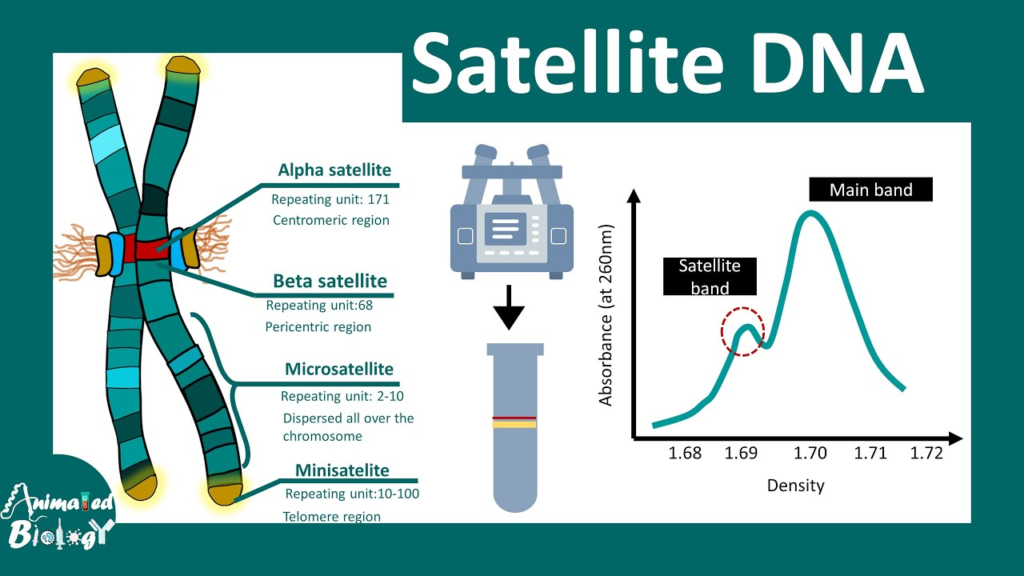
Classic minisatellites
- Copy number variation without abrupt pathogenic threshold
- They modulate polygenic risk (INS → type 1 diabetes) or cause structural disease (MUC1 → ADTKD)
- Historical basis of forensic DNA fingerprinting
Macrosatellites
— FSHD as a paradigmatic case
- D4Z4 (subtelomere 4q35): 3.3 kb unit
- Normal: 11-100 copies / Pathological: ≤10 copies (FSHD1) — contraction, not expansion
- Contraction opens chromatin → derepression of DUX4 (normally silenced in adult muscle) → toxicity
- Requires permissive 4qA haplotype (same contraction in 4qB does not cause disease)
- FSHD2: normal array, but mutation in SMCHD1 → same result (DUX4 derepression) via trans route, not via cis contraction
- Does not follow classical genetic anticipation (epigenetic mechanism, not repetition race)
- Yes, there is a small but important group of diseases that share with FSHD the “atypical” mechanism (large repeat, classic non-microsatellite, and/or epigenetic mechanism instead of direct toxicity). The most relevant ones for your scheme:
—- ICF Syndrome (Immunodeficiency, Centromeric Instability, Facial Anomalies)
- Affects satellite repeats 2 and 3 (pericentromeric sequences, not D4Z4, but same principle of macrosatellite/repetitive heterochromatin)
- Mechanism: mutations in DNMT3B (o ZBTB24, CDCA7, HELLS) → hypomethylation of these repeated regions → pericentromeric decondensation → chromosomal instability
- It is practically the autosomal recessive equivalent of the FSHD2 mechanism: the machinery that keeps the repetitive heterochromatin silenced fails, rather than the repetition itself.
—- Progressive myoclonic epilepsy type 1 (Unverricht-Lundborg).
- gene CSTB (cystatin B)
- Repetition dodecamera (12 bp) in the promoter — border size between microsatellite and minisatellite, another case that does not fit cleanly in classical STR
- Mechanism: expansion (unlike FSHD) but the result is loss of function due to transcriptional reduction, not protein or RNA toxicity — expansion in the promoter simply makes it difficult to transcribe the gene
- Useful as contrast: expansion causing pure loss of function, no toxic gain
19955111
{19955111:N989PCPW},{19955111:XHVJIQA4}
1
vancouver
50
default
2455
https://neuropediatoolkit.org/wp-content/plugins/zotpress/
%7B%22status%22%3A%22success%22%2C%22updateneeded%22%3Afalse%2C%22instance%22%3Afalse%2C%22meta%22%3A%7B%22request_last%22%3A0%2C%22request_next%22%3A0%2C%22used_cache%22%3Atrue%7D%2C%22data%22%3A%5B%7B%22key%22%3A%22N989PCPW%22%2C%22library%22%3A%7B%22id%22%3A19955111%7D%2C%22meta%22%3A%7B%22creatorSummary%22%3A%22Depienne%20and%20Mandel%22%2C%22parsedDate%22%3A%222021-05-06%22%2C%22numChildren%22%3A1%7D%2C%22bib%22%3A%22%26lt%3Bdiv%20class%3D%26quot%3Bcsl-bib-body%26quot%3B%20style%3D%26quot%3Bline-height%3A%201.35%3B%20%26quot%3B%26gt%3B%5Cn%20%20%26lt%3Bdiv%20class%3D%26quot%3Bcsl-entry%26quot%3B%20style%3D%26quot%3Bclear%3A%20left%3B%20%26quot%3B%26gt%3B%5Cn%20%20%20%20%26lt%3Bdiv%20class%3D%26quot%3Bcsl-left-margin%26quot%3B%20style%3D%26quot%3Bfloat%3A%20left%3B%20padding-right%3A%200.5em%3B%20text-align%3A%20right%3B%20width%3A%201em%3B%26quot%3B%26gt%3B1.%26lt%3B%5C%2Fdiv%26gt%3B%26lt%3Bdiv%20class%3D%26quot%3Bcsl-right-inline%26quot%3B%20style%3D%26quot%3Bmargin%3A%200%20.4em%200%201.5em%3B%26quot%3B%26gt%3BDepienne%20C%2C%20Mandel%20JL.%2030%20years%20of%20repeat%20expansion%20disorders%3A%20What%20have%20we%20learned%20and%20what%20are%20the%20remaining%20challenges%3F%20The%20American%20Journal%20of%20Human%20Genetics%20%5BInternet%5D.%202021%20May%206%20%5Bcited%202021%20Sept%2019%5D%3B108%285%29%3A764%26%23x2013%3B85.%20Available%20from%3A%20%26lt%3Ba%20class%3D%26%23039%3Bzp-ItemURL%26%23039%3B%20href%3D%26%23039%3Bhttps%3A%5C%2F%5C%2Fwww.sciencedirect.com%5C%2Fscience%5C%2Farticle%5C%2Fpii%5C%2FS0002929721000951%26%23039%3B%26gt%3Bhttps%3A%5C%2F%5C%2Fwww.sciencedirect.com%5C%2Fscience%5C%2Farticle%5C%2Fpii%5C%2FS0002929721000951%26lt%3B%5C%2Fa%26gt%3B%26lt%3B%5C%2Fdiv%26gt%3B%5Cn%20%20%26lt%3B%5C%2Fdiv%26gt%3B%5Cn%26lt%3B%5C%2Fdiv%26gt%3B%22%2C%22data%22%3A%7B%22itemType%22%3A%22journalArticle%22%2C%22title%22%3A%2230%20years%20of%20repeat%20expansion%20disorders%3A%20What%20have%20we%20learned%20and%20what%20are%20the%20remaining%20challenges%3F%22%2C%22creators%22%3A%5B%7B%22creatorType%22%3A%22author%22%2C%22firstName%22%3A%22Christel%22%2C%22lastName%22%3A%22Depienne%22%7D%2C%7B%22creatorType%22%3A%22author%22%2C%22firstName%22%3A%22Jean-Louis%22%2C%22lastName%22%3A%22Mandel%22%7D%5D%2C%22abstractNote%22%3A%22Tandem%20repeats%20represent%20one%20of%20the%20most%20abundant%20class%20of%20variations%20in%20human%20genomes%2C%20which%20are%20polymorphic%20by%20nature%20and%20become%20highly%20unstable%20in%20a%20length-dependent%20manner.%20The%20expansion%20of%20repeat%20length%20across%20generations%20is%20a%20well-established%20process%20that%20results%20in%20human%20disorders%20mainly%20affecting%20the%20central%20nervous%20system.%20At%20least%2050%20disorders%20associated%20with%20expansion%20loci%20have%20been%20described%20to%20date%2C%20with%20half%20recognized%20only%20in%20the%20last%20ten%20years%2C%20as%20prior%20methodological%20difficulties%20limited%20their%20identification.%20These%20limitations%20still%20apply%20to%20the%20current%20widely%20used%20molecular%20diagnostic%20methods%20%28exome%20or%20gene%20panels%29%20and%20thus%20result%20in%20missed%20diagnosis%20detrimental%20to%20affected%20individuals%20and%20their%20families%2C%20especially%20for%20disorders%20that%20are%20very%20rare%20and%5C%2For%20clinically%20not%20recognizable.%20Most%20of%20these%20disorders%20have%20been%20identified%20through%20family-driven%20approaches%20and%20many%20others%20likely%20remain%20to%20be%20identified.%20The%20recent%20development%20of%20long-read%20technologies%20provides%20a%20unique%20opportunity%20to%20systematically%20investigate%20the%20contribution%20of%20tandem%20repeats%20and%20repeat%20expansions%20to%20the%20genetic%20architecture%20of%20human%20disorders.%20In%20this%20review%2C%20we%20summarize%20the%20current%20and%20most%20recent%20knowledge%20about%20the%20genetics%20of%20repeat%20expansion%20disorders%20and%20the%20diversity%20of%20their%20pathophysiological%20mechanisms%20and%20outline%20the%20perspectives%20of%20developing%20personalized%20treatments%20in%20the%20future.%22%2C%22date%22%3A%22May%206%2C%202021%22%2C%22section%22%3A%22%22%2C%22partNumber%22%3A%22%22%2C%22partTitle%22%3A%22%22%2C%22DOI%22%3A%2210.1016%5C%2Fj.ajhg.2021.03.011%22%2C%22citationKey%22%3A%22%22%2C%22url%22%3A%22https%3A%5C%2F%5C%2Fwww.sciencedirect.com%5C%2Fscience%5C%2Farticle%5C%2Fpii%5C%2FS0002929721000951%22%2C%22PMID%22%3A%22%22%2C%22PMCID%22%3A%22%22%2C%22ISSN%22%3A%220002-9297%22%2C%22language%22%3A%22en%22%2C%22collections%22%3A%5B%22QKPQST8L%22%5D%2C%22dateModified%22%3A%222026-07-15T22%3A41%3A32Z%22%7D%7D%2C%7B%22key%22%3A%22XHVJIQA4%22%2C%22library%22%3A%7B%22id%22%3A19955111%7D%2C%22meta%22%3A%7B%22creatorSummary%22%3A%22Chintalaphani%20et%20al.%22%2C%22parsedDate%22%3A%222021-05-25%22%2C%22numChildren%22%3A2%7D%2C%22bib%22%3A%22%26lt%3Bdiv%20class%3D%26quot%3Bcsl-bib-body%26quot%3B%20style%3D%26quot%3Bline-height%3A%201.35%3B%20%26quot%3B%26gt%3B%5Cn%20%20%26lt%3Bdiv%20class%3D%26quot%3Bcsl-entry%26quot%3B%20style%3D%26quot%3Bclear%3A%20left%3B%20%26quot%3B%26gt%3B%5Cn%20%20%20%20%26lt%3Bdiv%20class%3D%26quot%3Bcsl-left-margin%26quot%3B%20style%3D%26quot%3Bfloat%3A%20left%3B%20padding-right%3A%200.5em%3B%20text-align%3A%20right%3B%20width%3A%201em%3B%26quot%3B%26gt%3B1.%26lt%3B%5C%2Fdiv%26gt%3B%26lt%3Bdiv%20class%3D%26quot%3Bcsl-right-inline%26quot%3B%20style%3D%26quot%3Bmargin%3A%200%20.4em%200%201.5em%3B%26quot%3B%26gt%3BChintalaphani%20SR%2C%20Pineda%20SS%2C%20Deveson%20IW%2C%20Kumar%20KR.%20An%20update%20on%20the%20neurological%20short%20tandem%20repeat%20expansion%20disorders%20and%20the%20emergence%20of%20long-read%20sequencing%20diagnostics.%20Acta%20Neuropathologica%20Communications%20%5BInternet%5D.%202021%20May%2025%20%5Bcited%202021%20Sept%2019%5D%3B9%281%29%3A98.%20Available%20from%3A%20%26lt%3Ba%20class%3D%26%23039%3Bzp-ItemURL%26%23039%3B%20href%3D%26%23039%3Bhttps%3A%5C%2F%5C%2Fdoi.org%5C%2F10.1186%5C%2Fs40478-021-01201-x%26%23039%3B%26gt%3Bhttps%3A%5C%2F%5C%2Fdoi.org%5C%2F10.1186%5C%2Fs40478-021-01201-x%26lt%3B%5C%2Fa%26gt%3B%26lt%3B%5C%2Fdiv%26gt%3B%5Cn%20%20%26lt%3B%5C%2Fdiv%26gt%3B%5Cn%26lt%3B%5C%2Fdiv%26gt%3B%22%2C%22data%22%3A%7B%22itemType%22%3A%22journalArticle%22%2C%22title%22%3A%22An%20update%20on%20the%20neurological%20short%20tandem%20repeat%20expansion%20disorders%20and%20the%20emergence%20of%20long-read%20sequencing%20diagnostics%22%2C%22creators%22%3A%5B%7B%22creatorType%22%3A%22author%22%2C%22firstName%22%3A%22Sanjog%20R.%22%2C%22lastName%22%3A%22Chintalaphani%22%7D%2C%7B%22creatorType%22%3A%22author%22%2C%22firstName%22%3A%22Sandy%20S.%22%2C%22lastName%22%3A%22Pineda%22%7D%2C%7B%22creatorType%22%3A%22author%22%2C%22firstName%22%3A%22Ira%20W.%22%2C%22lastName%22%3A%22Deveson%22%7D%2C%7B%22creatorType%22%3A%22author%22%2C%22firstName%22%3A%22Kishore%20R.%22%2C%22lastName%22%3A%22Kumar%22%7D%5D%2C%22abstractNote%22%3A%22Short%20tandem%20repeat%20%28STR%29%20expansion%20disorders%20are%20an%20important%20cause%20of%20human%20neurological%20disease.%20They%20have%20an%20established%20role%20in%20more%20than%2040%20different%20phenotypes%20including%20the%20myotonic%20dystrophies%2C%20Fragile%20X%20syndrome%2C%20Huntington%5Cu2019s%20disease%2C%20the%20hereditary%20cerebellar%20ataxias%2C%20amyotrophic%20lateral%20sclerosis%20and%20frontotemporal%20dementia.%22%2C%22date%22%3A%22May%2025%2C%202021%22%2C%22section%22%3A%22%22%2C%22partNumber%22%3A%22%22%2C%22partTitle%22%3A%22%22%2C%22DOI%22%3A%2210.1186%5C%2Fs40478-021-01201-x%22%2C%22citationKey%22%3A%22%22%2C%22url%22%3A%22https%3A%5C%2F%5C%2Fdoi.org%5C%2F10.1186%5C%2Fs40478-021-01201-x%22%2C%22PMID%22%3A%22%22%2C%22PMCID%22%3A%22%22%2C%22ISSN%22%3A%222051-5960%22%2C%22language%22%3A%22%22%2C%22collections%22%3A%5B%22QKPQST8L%22%5D%2C%22dateModified%22%3A%222026-05-09T07%3A43%3A45Z%22%7D%7D%5D%7D
1.
Depienne C, Mandel JL. 30 years of repeat expansion disorders: What have we learned and what are the remaining challenges? The American Journal of Human Genetics [Internet]. 2021 May 6 [cited 2021 Sept 19];108(5):764–85. Available from: https://www.sciencedirect.com/science/article/pii/S0002929721000951
1.
Chintalaphani SR, Pineda SS, Deveson IW, Kumar KR. An update on the neurological short tandem repeat expansion disorders and the emergence of long-read sequencing diagnoses. Acta Neuropathologica Communications [Internet]. 2021 May 25 [cited 2021 Sept 19];9(1):98. Available from: https://doi.org/10.1186/s40478-021-01201-x