

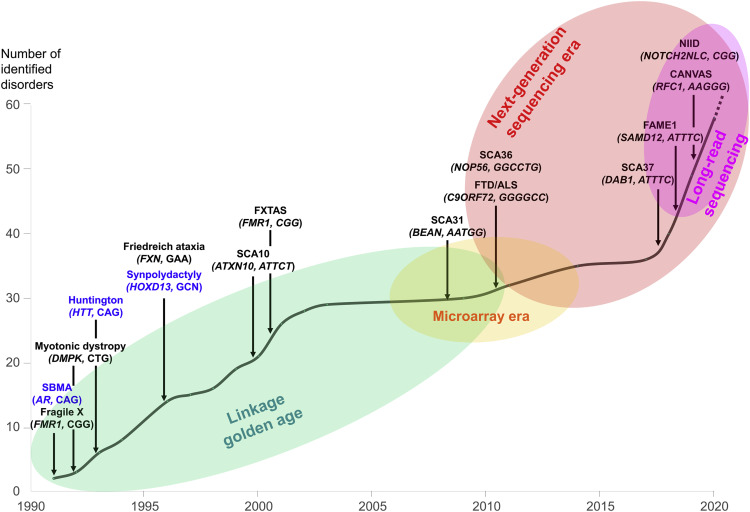
1. Classification par taille d'unité
- STR (microsatellites) : 1-6 pb → épaisseur de pathologie neurologique
- VNTR (sens large) : nombre variable de copies, plus grande unité
- Minisatellites classiques : 10-60 pb (INS, MUC1)
- Macrosatellites : milliers de pb — même principe (nombre de copies variable), unité beaucoup plus grande (FSHD/D4Z4)
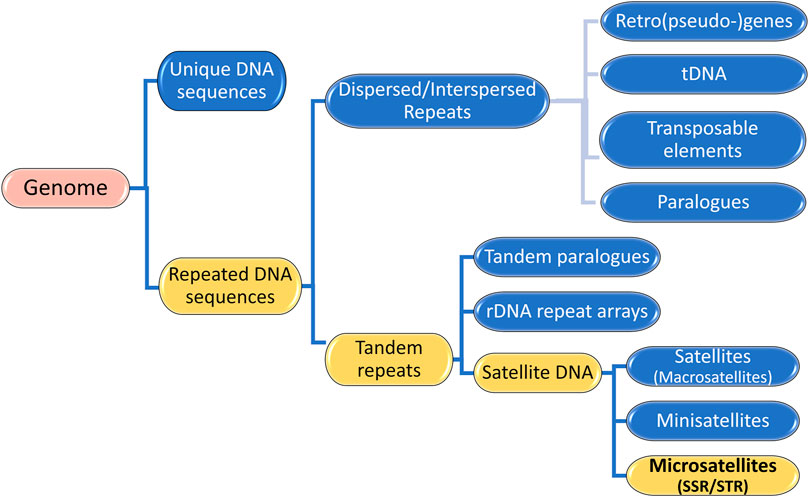
2. Pourquoi ils sont instables (mécanisme commun)
- Glissement de l'ADN polymérase pendant la réplication
- Le brin naissant se dissocie et se réassocie dans un registre déplacé → boucle
- Boucle dans le brin naissant → expansion
- Boucle de brin de moule → contraction
- Plus la longueur préalable est grande, plus la probabilité de boucle → instabilité non linéaire après le seuil critique est grande (normal → prémutation → mutation complète)
Conséquence clinique : anticipation génétique = manifestation phénotypique de cette instabilité méiotique croissante (biais paternel ou maternel selon la maladie).
3. Trois mécanismes selon l'emplacement de la répétition (bloc STR)
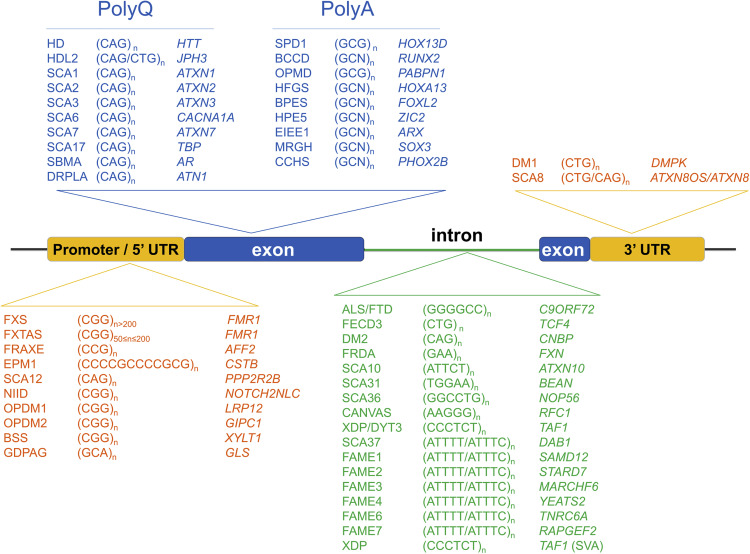
A) Exon codant, triplets (CAG=polyQ)
- Protéine anormale avec tractus polyglutamine
- Mauvais repliement → agrégation intranucléaire
- Gain de fonction toxique, dominant
- Ex : Huntington, SCA, Kennedy (lié à l'X)
B) Région non codante (UTR, intron), grande expansion
- Silence épigénétique → hyperméthylation → perte de fonction (Fragile X, Friedreich)
- Toxicité de l'ARN → séquestration des protéines d'épissage par ARN messager à répétition expansée (myotonique, C9orf72)
Maladies neurologiques causées par STR.
| Phénotype abrégé (numéro MIM) | Gène | Mode d'héritage | Motif répétitif | Localisation sur Gene | Pathogenic repeat numbera | Chromosome | Coordonnées (hg38) | Phénotype clinique | Références | |
|---|---|---|---|---|---|---|---|---|---|---|
| C9-FTD C9-ALS (#10550) | C9orf72 | ANNONCE. | GGGGCC | Région 5' | 24-4000 | chr9 | 27573485 | 27573546 | Démence frontotemporale, sclérose latérale amyotrophique | [32, 47, 65] |
| TOILE (#614575) | RFC1 | A.R. | (AAGGG)400-2000 (ACAGG)expérience AAAAG (normal) | Intron2 | 400-2000 | chr4 | 39348425 | 39348483 | Ataxie cérébelleuse, neuropathie et syndrome d'aréflexie vestibulaire | [11, 28, 138] |
| DM1 (#160900) | DMPK | ANNONCE. | CTG (Interruptions : GCC) | Région 3' | 50 à 10 000 | chr19 | 45770205 | 45770266 | Dystrophie myotonique 1 | [60, 176] |
| DM2 (#602668) | CNBP (ZNF9) | ANNONCE. | CCTG | Intron1 | 50 à 11 000 | chr3 | 129172577 | 129172656 | Dystrophie myotonique 2 | [176] |
| DRPLA (#125370) | ATN1 | ANNONCE. | CAG | Exon 5 | 49-93 | chr12 | 6936717 | 6936775 | Atrophie dentatorubrale-pallidoluysienne | [78] |
| EIEE1/XLID (#308350) (#300419) (#300215) | ARX | XL | CCG | Exon 2 | 17-27 | chrX | 25013654 | 25013697 | Spectre clinique de troubles comprenant l'encéphalopathie développementale et épileptique 1, l'hydranencéphalie avec organes génitaux anormaux, la lissencéphalie liée à l'X 2 et le retard mental lié à l'X 29 | [73, 150] |
| FAME1 (#601068) | SAMD12 | ANNONCE. | TTTCA dans la région de répétition TTTTA | Intron4 | 105-3680 | chr8 | 118366813 | 118366918 | Épilepsie myoclonique familiale adulte 1 | [22, 68] |
| FAME2 (#607876) | STARD7 | ANNONCE. | ATTTC dans la région de répétition ATTTT | Intron1 | 150-460 | chr2 | 96197067 | 96197124 | Épilepsie myoclonique familiale adulte 2 | [27] |
| FAME3 (#613608) | MARSF6 | ANNONCE. | TTTCA dans la région de répétition TTTTA | Intron1 | 700-1035 | chr5 | 10356339 | 10356411 | Épilepsie myoclonique familiale adulte 3 | [40] |
| RENOMMÉE6 (#618074) | TNRC6A | ANNONCE. | TTTCA dans la région de répétition TTTTA | Intron1 | ? (seulement 1 famille) | chr16 | 24613439 | 24613532 | Épilepsie myoclonique familiale adulte 6 | [68] |
| FAME7 (#618075) | RAPGEF2 | ANNONCE. | TTTCA dans la région de répétition TTTTA | Intron 14 | ? (seulement 1 famille) | chr4 | 159342527 | 159342618 | Épilepsie myoclonique familiale de l'adulte 7 | [68] |
| FRAXÉ (#309548) | FMR2 (AFF2) | XLR | CCG | Région 5' | > 200 | chrX | 148500605 | 148500753 | Retard mental lié à l'X, type FRAXE | [53] |
| FRDA (#229300) | FXN | A.R. | GAA | Intron1 | 66-1300 | chr9 | 69037275 | 69037314 | Ataxie de Friedreich | [5, 19, 162] |
| FXS (#300624) FXTAS (#300623) | RMF1 | XL | CGG | Région 5' | 200 à 3 000 55-200 | chrX | 147911979 | 147912111 | Syndrome du X fragile Syndrome de tremblement/ataxie du X fragile, insuffisance ovarienne prématurée 1 | [162] [56] |
| HD (#143100) | HTT | ANNONCE. | CAG (Interruptions : CAA) | Exon1 | 36-250 | chr4 | 3074876 | 3074941 | La maladie de Huntington | [96, 101] |
| HDL1 (#603218) | PRNP | ANNONCE. | 24 bases octapeptide PHGGGWGQ | Exon 2 | 8-14 | chr20 | 4699379 | 4699380 | Semblable à la maladie de Huntington 1 | [108] |
| HDL2 (#606438) | JPH3 | ANNONCE. | CTG | Exon 2A | 40-59 | chr16 | 87604283 | 87604329 | Maladie de Huntington 2 | [62] |
| HMN | VWA1 | A.R. | GGCGCGGGAGC | Exon1 | 3 | chr1 | 1435799 | 1435820 | Neuropathie motrice axonale héréditaire | [121] |
| NIID (#603472) | NOTCH2NLC | ANNONCE. | CGG | Région 5′ | 66-517 | chr1 | 149390803 | 149390842 | Maladie d'inclusion intranucléaire neuronale | [55, 118, 146] |
| OPDM1 (#164310) | LRP12 | ANNONCE. | CGG | Région 5′ | 90-130 | chr8 | 104588965 | 104588999 | Myopathie oculopharyngodistal | [69] |
| OPDM2 (#618940) | GIPC1 | ANNONCE. | CGG | Région 5' | 70-164 | chr19 | 14496029 | 14496104 | Myopathie oculopharyngodistal | [172] |
| OPMD (#164300) | PABPN1 | ANNONCE. | G.C.G. | Exon1 | 7-18 | chr14 | 23321472 | 23321511 | Dystrophie musculaire oculopharyngée | [15, 129] |
| OPML1 (#618637) | NUTM2B-AS1 | ANNONCE. | CGG | Région 5′ | 16-160 | chr10 | 79826364 | 79826403 | Myopathie oculopharyngée avec leucoencéphalopathie 1 | [69] |
| SBMA (#313200) | A.R. | XLR | CAG | Exon1 | 38-68 | chrX | 67545317 | 67545419 | Amyotrophie spinale et bulbaire de Kennedy (maladie de Kennedy) | [44, 82, 147] |
| SCA1 (#164400) | ATXN1 | ANNONCE. | CAG (Interruptions : CAT) | Exon 8 | 39-91 | chr6 | 16327636 | 16327723 | Ataxie spinocérébelleuse 1 | [120, 141] |
| SCA2 (#183090) | ATXN2 | ANNONCE. | CAG (Interruptions : CAA, CGG, CGC) | Exon1 | 33-200 (29-32 risque accru de SLA) | chr12 | 111598950 | 111599019 | Ataxie spinocérébelleuse 2 | [18, 133, 141, 148] |
| SCA3 (#109150) | ATXN3 | ANNONCE. | CAG | Exon 10 | 53-87 | chr14 | 92071011 | 92071052 | Ataxie spinocérébelleuse 3 | [74] |
| SCA6 (183086) | CACNA1A | ANNONCE. | CAG | Exon 47 | 19-33 | chr19 | 13207858 | 13207897 | Ataxie spinocérébelleuse 6 | [141, 181] |
| SCA7 (#164500) | ATXN7 | ANNONCE. | CAG | Exon1 | 34-460 | chr3 | 63912685 | 63912716 | Ataxie spinocérébelleuse 7 | [18, 30] |
| SCA8 (#608768) | ATXN8 | ANNONCE. | CAG/ÉTIQUETTE | 3'UTR | 74-1300 | chr13 | 70139383 | 70139428 | Ataxie spinocérébelleuse 8 | [79, 141, 155] |
| SCA10 (#603516) | ATXN10 | ANNONCE. | ATTCT (Interruptions : ATCCT) | Intron9 | 280-4500 | chr22 | 45795355 | 45795424 | Ataxie spinocérébelleuse 10 | [88, 100, 141] |
| SCA12 (#604326) | PPP2R2B | ANNONCE. | CAG | Région 5' | 51-78 | chr5 | 146878729 | 146878758 | Ataxie spinocérébelleuse 12 | [63, 94, 141] |
| SCA17 (#607136) | PAD | ANNONCE. | CAG (Interruptions : CAT, CAA) | Exon 3 | 43-66 | chr6 | 170561907 | 170562017 | Ataxie spinocérébelleuse 17, pseudo-maladie de Huntington 4 | [97, 115, 141] |
| SCA31 (#117210) | HARICOT1 | ANNONCE. | TGGAA dans la région de répétition TAAAA et TAGAA | Intron/ Région intergénique | 500-760 (> 110 répétitions TGGAA) | chr16 | 66495475 | 66495509 | Ataxie spinocérébelleuse 31 | [134] |
| SCA36 (#614153) | NOP56 | ANNONCE. | GGCCTG | Intron1 | 650-2500 | chr20 | 2652733 | 2652775 | Ataxie spinocérébelleuse 36 | [77] |
| SCA37 (#615945) | DAB1 | ANNONCE. | ATTTC dans (ATTTT)7 à 400 répéter la région | Région 5' | 31-75 | chr1 | 57367044 | 57367125 | Ataxie spinocérébelleuse 37 | [139] |
| ULD (#254800) | CSTB | A.R. | CCCCGCCCCGCG | En amont 5'UTR | 30-125 | chr21 | 43776444 | 43776479 | Épilepsie myoclonique progressive 1A (maladie d'Unverricht et de Lundborg) | [87, 91] |
aCes plages varient selon les études et souvent la limite supérieure est inconnue. Il est important de noter que ceux-ci ne sont que potentiellement pathogènes. Il existe une petite sous-section (< 1 %) de la population témoin saine qui présente des allèles élargis sans manifestations cliniques. De même, il existe des allèles inférieurs à la plage donnée qui peuvent avoir des allèles intermédiaires et des syndromes de prémutation.
Maladies congénitales et développementales causées par STR.
| Phénotype (OMIM#) | Gène | Motif | Pathogenic repeat number | Emplacement | (hg38) | Références | ||
|---|---|---|---|---|---|---|---|---|
| BPES (#110100) | RENARD2 | G.C.G. | 22-24 | Exon | chr3 | 138946022 | 138946062 | [116] |
| ESCC (#209880) | PHOX2B | G.C.G. | 24-33 | Exon | chr4 | 41745976 | 41746022 | [7] |
| DBQD2 (#615777) | XYLT1 | GGC | 100-800 | Région 5' | chr16 | 17470869 | 17470967 | [86] |
| FECD3 (#613267) | TCF4 | TGC | > 50 | Intron | chr18a | 55222184a | 55635956a | [167] |
| GDPAG (#618412) | GLS | GCA | > 300 | Région 5' | chr2 | 190880873 | 190880920 | [159] |
| H.F.G. (#140000) | HOXA13 | G.C.G. | 24-26 | Exon | chr7 | 27199827 | 27199967 | [50] |
| HPE5 (#609637) | ZIC2 | G.C.G. | 25 | Exon | chr13 | 99985449 | 99985494 | [17] |
| HSAN8 (#616488) | PRDM12 | G.C.G. | 18-19 | Exon | chr9 | 130681606 | 130681641 | [23] |
| SPD1 (#186000) | HOXD13 | G.C.G. | 22-29 | Exon | chr2 | 176093058 | 176093099 | [2] |
| XLMR (#300123) | SOX3 | G.C.G. | 15-26 | Exon | chr3 | 181712415 | 181712456 | [89] |
aEmplacement du gène entier répertorié
4. Bloc VNTR (sens large)
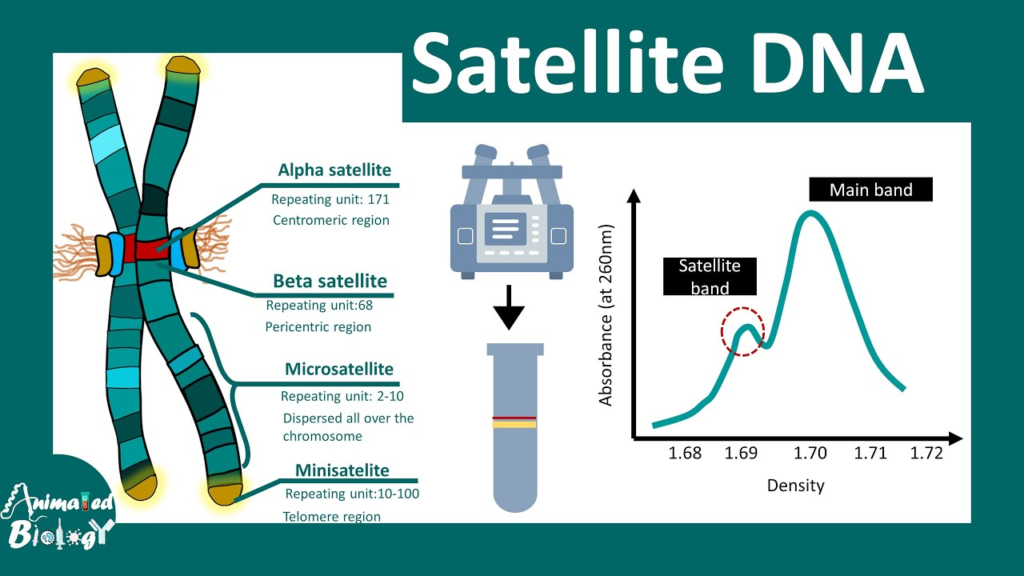
Minisatellites classiques
- Variation du nombre de copies sans seuil pathogène abrupt
- Ils modulent le risque polygénique (INS → diabète de type 1) ou provoquent des maladies structurelles (MUC1 → ADTKD)
- Base historique des empreintes génétiques médico-légales
Macrosatellites
— FSHD comme cas paradigmatique
- D4Z4 (subtélomère 4q35) : unité de 3,3 Ko
- Normal : 11-100 copies / Pathologique : ≤10 copies (FSHD1) — contraction, pas d'expansion
- La contraction ouvre la chromatine → dérépression de DUX4 (normalement silencieux dans le muscle adulte) → toxicité
- Nécessite un haplotype permissif 4qA (la même contraction en 4qB ne provoque pas de maladie)
- FSHD2: tableau normal, mais mutation dans SMCHD1 → même résultat (dérépression DUX4) via voie trans, pas via contraction cis
- Ne suit pas l’anticipation génétique classique (mécanisme épigénétique, pas de course à répétition)
- Oui, il existe un groupe restreint mais important de maladies qui partagent avec la FSHD le mécanisme « atypique » (grande répétition, mécanisme classique non microsatellite et/ou épigénétique au lieu de toxicité directe). Les plus pertinents pour votre projet :
—- Syndrome ICF (immunodéficience, instabilité centromérique, anomalies faciales)
- Affecte les répétitions satellites 2 et 3 (séquences péricentromériques, pas D4Z4, mais même principe de macrosatellite/hétérochromatine répétitive)
- Mécanisme : mutations dans DNMT3B (o ZBTB24, CDCA7, LES ENFER) → hypométhylation de ces régions répétées → décondensation péricentromérique → instabilité chromosomique
- Il s’agit pratiquement de l’équivalent autosomique récessif du mécanisme FSHD2 : la machinerie qui maintient au silence l’hétérochromatine répétitive échoue, plutôt que la répétition elle-même.
—- Épilepsie myoclonique progressive de type 1 (Unverricht-Lundborg).
- G CSTB (cystatine B)
- Répétition dodécamera (12 pb) dans le promoteur — taille de la frontière entre microsatellite et minisatellite, un autre cas qui ne rentre pas clairement dans le STR classique
- Mécanisme: expansion (contrairement à FSHD) mais le résultat est perte de fonction due à une réduction transcriptionnelle, pas de toxicité pour les protéines ou l'ARN - l'expansion du promoteur rend simplement difficile la transcription du gène
- Utile comme contraste : expansion entraînant une pure perte de fonction, pas de gain toxique
19955111
{19955111:N989PCPW},{19955111:XHVJIQA4}
1
Vancouver
50
défaut
2455
https://neuropediatoolkit.org/wp-content/plugins/zotpress/
%7B%22status%22%3A%22success%22%2C%22updateneeded%22%3Afalse%2C%22instance%22%3Afalse%2C%22meta%22%3A%7B%22request_last%22%3A0%2C%22request_next%22%3A0%2C%22used_cache%22%3Atrue%7D%2C%22data%22%3A%5B%7B%22key%22%3A%22N989PCPW%22%2C%22library%22%3A%7B%22id%22%3A19955111%7D%2C%22meta%22%3A%7B%22creatorSummary%22%3A%22Depienne%20and%20Mandel%22%2C%22parsedDate%22%3A%222021-05-06%22%2C%22numChildren%22%3A1%7D%2C%22bib%22%3A%22%26lt%3Bdiv%20class%3D%26quot%3Bcsl-bib-body%26quot%3B%20style%3D%26quot%3Bline-height%3A%201.35%3B%20%26quot%3B%26gt%3B%5Cn%20%20%26lt%3Bdiv%20class%3D%26quot%3Bcsl-entry%26quot%3B%20style%3D%26quot%3Bclear%3A%20left%3B%20%26quot%3B%26gt%3B%5Cn%20%20%20%20%26lt%3Bdiv%20class%3D%26quot%3Bcsl-left-margin%26quot%3B%20style%3D%26quot%3Bfloat%3A%20left%3B%20padding-right%3A%200.5em%3B%20text-align%3A%20right%3B%20width%3A%201em%3B%26quot%3B%26gt%3B1.%26lt%3B%5C%2Fdiv%26gt%3B%26lt%3Bdiv%20class%3D%26quot%3Bcsl-right-inline%26quot%3B%20style%3D%26quot%3Bmargin%3A%200%20.4em%200%201.5em%3B%26quot%3B%26gt%3BDepienne%20C%2C%20Mandel%20JL.%2030%20years%20of%20repeat%20expansion%20disorders%3A%20What%20have%20we%20learned%20and%20what%20are%20the%20remaining%20challenges%3F%20The%20American%20Journal%20of%20Human%20Genetics%20%5BInternet%5D.%202021%20May%206%20%5Bcited%202021%20Sept%2019%5D%3B108%285%29%3A764%26%23x2013%3B85.%20Available%20from%3A%20%26lt%3Ba%20class%3D%26%23039%3Bzp-ItemURL%26%23039%3B%20href%3D%26%23039%3Bhttps%3A%5C%2F%5C%2Fwww.sciencedirect.com%5C%2Fscience%5C%2Farticle%5C%2Fpii%5C%2FS0002929721000951%26%23039%3B%26gt%3Bhttps%3A%5C%2F%5C%2Fwww.sciencedirect.com%5C%2Fscience%5C%2Farticle%5C%2Fpii%5C%2FS0002929721000951%26lt%3B%5C%2Fa%26gt%3B%26lt%3B%5C%2Fdiv%26gt%3B%5Cn%20%20%26lt%3B%5C%2Fdiv%26gt%3B%5Cn%26lt%3B%5C%2Fdiv%26gt%3B%22%2C%22data%22%3A%7B%22itemType%22%3A%22journalArticle%22%2C%22title%22%3A%2230%20years%20of%20repeat%20expansion%20disorders%3A%20What%20have%20we%20learned%20and%20what%20are%20the%20remaining%20challenges%3F%22%2C%22creators%22%3A%5B%7B%22creatorType%22%3A%22author%22%2C%22firstName%22%3A%22Christel%22%2C%22lastName%22%3A%22Depienne%22%7D%2C%7B%22creatorType%22%3A%22author%22%2C%22firstName%22%3A%22Jean-Louis%22%2C%22lastName%22%3A%22Mandel%22%7D%5D%2C%22abstractNote%22%3A%22Tandem%20repeats%20represent%20one%20of%20the%20most%20abundant%20class%20of%20variations%20in%20human%20genomes%2C%20which%20are%20polymorphic%20by%20nature%20and%20become%20highly%20unstable%20in%20a%20length-dependent%20manner.%20The%20expansion%20of%20repeat%20length%20across%20generations%20is%20a%20well-established%20process%20that%20results%20in%20human%20disorders%20mainly%20affecting%20the%20central%20nervous%20system.%20At%20least%2050%20disorders%20associated%20with%20expansion%20loci%20have%20been%20described%20to%20date%2C%20with%20half%20recognized%20only%20in%20the%20last%20ten%20years%2C%20as%20prior%20methodological%20difficulties%20limited%20their%20identification.%20These%20limitations%20still%20apply%20to%20the%20current%20widely%20used%20molecular%20diagnostic%20methods%20%28exome%20or%20gene%20panels%29%20and%20thus%20result%20in%20missed%20diagnosis%20detrimental%20to%20affected%20individuals%20and%20their%20families%2C%20especially%20for%20disorders%20that%20are%20very%20rare%20and%5C%2For%20clinically%20not%20recognizable.%20Most%20of%20these%20disorders%20have%20been%20identified%20through%20family-driven%20approaches%20and%20many%20others%20likely%20remain%20to%20be%20identified.%20The%20recent%20development%20of%20long-read%20technologies%20provides%20a%20unique%20opportunity%20to%20systematically%20investigate%20the%20contribution%20of%20tandem%20repeats%20and%20repeat%20expansions%20to%20the%20genetic%20architecture%20of%20human%20disorders.%20In%20this%20review%2C%20we%20summarize%20the%20current%20and%20most%20recent%20knowledge%20about%20the%20genetics%20of%20repeat%20expansion%20disorders%20and%20the%20diversity%20of%20their%20pathophysiological%20mechanisms%20and%20outline%20the%20perspectives%20of%20developing%20personalized%20treatments%20in%20the%20future.%22%2C%22date%22%3A%22May%206%2C%202021%22%2C%22section%22%3A%22%22%2C%22partNumber%22%3A%22%22%2C%22partTitle%22%3A%22%22%2C%22DOI%22%3A%2210.1016%5C%2Fj.ajhg.2021.03.011%22%2C%22citationKey%22%3A%22%22%2C%22url%22%3A%22https%3A%5C%2F%5C%2Fwww.sciencedirect.com%5C%2Fscience%5C%2Farticle%5C%2Fpii%5C%2FS0002929721000951%22%2C%22PMID%22%3A%22%22%2C%22PMCID%22%3A%22%22%2C%22ISSN%22%3A%220002-9297%22%2C%22language%22%3A%22en%22%2C%22collections%22%3A%5B%22QKPQST8L%22%5D%2C%22dateModified%22%3A%222026-07-15T22%3A41%3A32Z%22%7D%7D%2C%7B%22key%22%3A%22XHVJIQA4%22%2C%22library%22%3A%7B%22id%22%3A19955111%7D%2C%22meta%22%3A%7B%22creatorSummary%22%3A%22Chintalaphani%20et%20al.%22%2C%22parsedDate%22%3A%222021-05-25%22%2C%22numChildren%22%3A2%7D%2C%22bib%22%3A%22%26lt%3Bdiv%20class%3D%26quot%3Bcsl-bib-body%26quot%3B%20style%3D%26quot%3Bline-height%3A%201.35%3B%20%26quot%3B%26gt%3B%5Cn%20%20%26lt%3Bdiv%20class%3D%26quot%3Bcsl-entry%26quot%3B%20style%3D%26quot%3Bclear%3A%20left%3B%20%26quot%3B%26gt%3B%5Cn%20%20%20%20%26lt%3Bdiv%20class%3D%26quot%3Bcsl-left-margin%26quot%3B%20style%3D%26quot%3Bfloat%3A%20left%3B%20padding-right%3A%200.5em%3B%20text-align%3A%20right%3B%20width%3A%201em%3B%26quot%3B%26gt%3B1.%26lt%3B%5C%2Fdiv%26gt%3B%26lt%3Bdiv%20class%3D%26quot%3Bcsl-right-inline%26quot%3B%20style%3D%26quot%3Bmargin%3A%200%20.4em%200%201.5em%3B%26quot%3B%26gt%3BChintalaphani%20SR%2C%20Pineda%20SS%2C%20Deveson%20IW%2C%20Kumar%20KR.%20An%20update%20on%20the%20neurological%20short%20tandem%20repeat%20expansion%20disorders%20and%20the%20emergence%20of%20long-read%20sequencing%20diagnostics.%20Acta%20Neuropathologica%20Communications%20%5BInternet%5D.%202021%20May%2025%20%5Bcited%202021%20Sept%2019%5D%3B9%281%29%3A98.%20Available%20from%3A%20%26lt%3Ba%20class%3D%26%23039%3Bzp-ItemURL%26%23039%3B%20href%3D%26%23039%3Bhttps%3A%5C%2F%5C%2Fdoi.org%5C%2F10.1186%5C%2Fs40478-021-01201-x%26%23039%3B%26gt%3Bhttps%3A%5C%2F%5C%2Fdoi.org%5C%2F10.1186%5C%2Fs40478-021-01201-x%26lt%3B%5C%2Fa%26gt%3B%26lt%3B%5C%2Fdiv%26gt%3B%5Cn%20%20%26lt%3B%5C%2Fdiv%26gt%3B%5Cn%26lt%3B%5C%2Fdiv%26gt%3B%22%2C%22data%22%3A%7B%22itemType%22%3A%22journalArticle%22%2C%22title%22%3A%22An%20update%20on%20the%20neurological%20short%20tandem%20repeat%20expansion%20disorders%20and%20the%20emergence%20of%20long-read%20sequencing%20diagnostics%22%2C%22creators%22%3A%5B%7B%22creatorType%22%3A%22author%22%2C%22firstName%22%3A%22Sanjog%20R.%22%2C%22lastName%22%3A%22Chintalaphani%22%7D%2C%7B%22creatorType%22%3A%22author%22%2C%22firstName%22%3A%22Sandy%20S.%22%2C%22lastName%22%3A%22Pineda%22%7D%2C%7B%22creatorType%22%3A%22author%22%2C%22firstName%22%3A%22Ira%20W.%22%2C%22lastName%22%3A%22Deveson%22%7D%2C%7B%22creatorType%22%3A%22author%22%2C%22firstName%22%3A%22Kishore%20R.%22%2C%22lastName%22%3A%22Kumar%22%7D%5D%2C%22abstractNote%22%3A%22Short%20tandem%20repeat%20%28STR%29%20expansion%20disorders%20are%20an%20important%20cause%20of%20human%20neurological%20disease.%20They%20have%20an%20established%20role%20in%20more%20than%2040%20different%20phenotypes%20including%20the%20myotonic%20dystrophies%2C%20Fragile%20X%20syndrome%2C%20Huntington%5Cu2019s%20disease%2C%20the%20hereditary%20cerebellar%20ataxias%2C%20amyotrophic%20lateral%20sclerosis%20and%20frontotemporal%20dementia.%22%2C%22date%22%3A%22May%2025%2C%202021%22%2C%22section%22%3A%22%22%2C%22partNumber%22%3A%22%22%2C%22partTitle%22%3A%22%22%2C%22DOI%22%3A%2210.1186%5C%2Fs40478-021-01201-x%22%2C%22citationKey%22%3A%22%22%2C%22url%22%3A%22https%3A%5C%2F%5C%2Fdoi.org%5C%2F10.1186%5C%2Fs40478-021-01201-x%22%2C%22PMID%22%3A%22%22%2C%22PMCID%22%3A%22%22%2C%22ISSN%22%3A%222051-5960%22%2C%22language%22%3A%22%22%2C%22collections%22%3A%5B%22QKPQST8L%22%5D%2C%22dateModified%22%3A%222026-05-09T07%3A43%3A45Z%22%7D%7D%5D%7D
1.
Depienne C, Mandel JL. 30 ans de troubles de l'expansion à répétition : qu'avons-nous appris et quels sont les défis restants ? Le Journal américain de génétique humaine [Internet]. 6 mai 2021 [cité le 19 septembre 2021];108(5):764-85. Disponible à partir de : https://www.sciencedirect.com/science/article/pii/S0002929721000951
1.
Chintalaphani SR, Pineda SS, Deveson IW, Kumar KR. Une mise à jour sur les troubles neurologiques d’expansion de répétitions en tandem courtes et l’émergence de diagnostics de séquençage à lecture longue. Acta Neuropathologica Communications [Internet]. 25 mai 2021 [cité le 19 septembre 2021];9(1):98. Disponible à partir de : https://doi.org/10.1186/s40478-021-01201-x