
Early-onset Cerebellar Ataxia (EOAc)
EOAc affects children and young people up to the age of 25. It is heterogeneous: it can be hereditary, metabolic, autoimmune or of unknown origin.
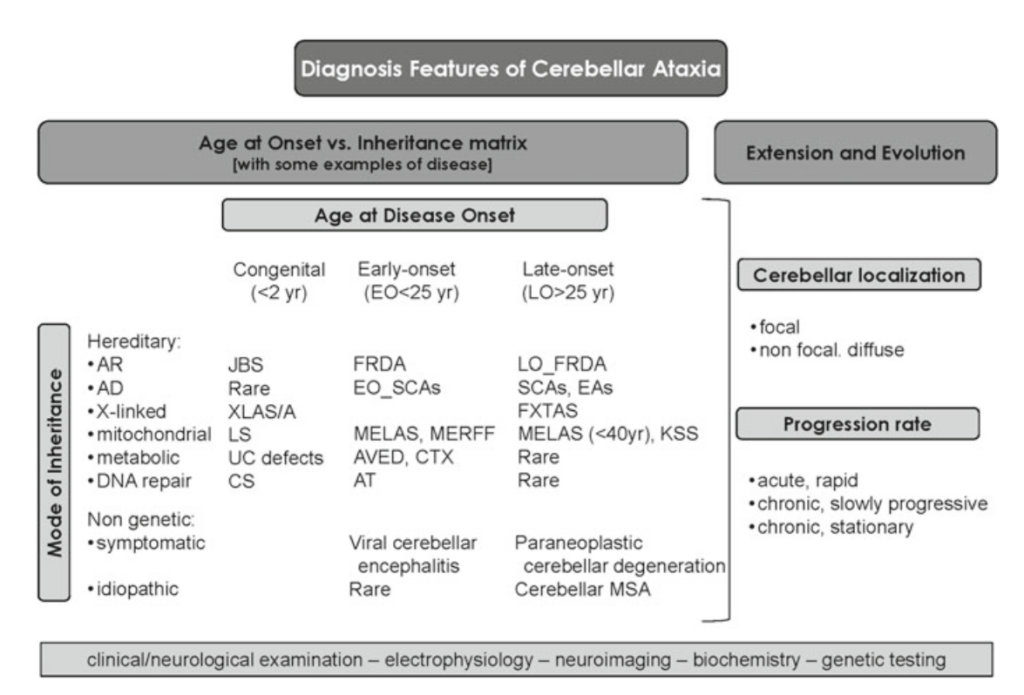
Classification by Age of Onset (Diagnostic Key)
According to the startup-based approach, three categories are identified:
- Congenital: before the age of 2 years (e.g. malformations, developmental disorders).
- Early: between 2 and 25 years (includes EOAc).
- Late: after 25 years.
Diagnostic Algorithm (CACG-EPNS)
- Step 1: Confirm EOAc by signs: gait ataxia, incoordination, hypotonia.
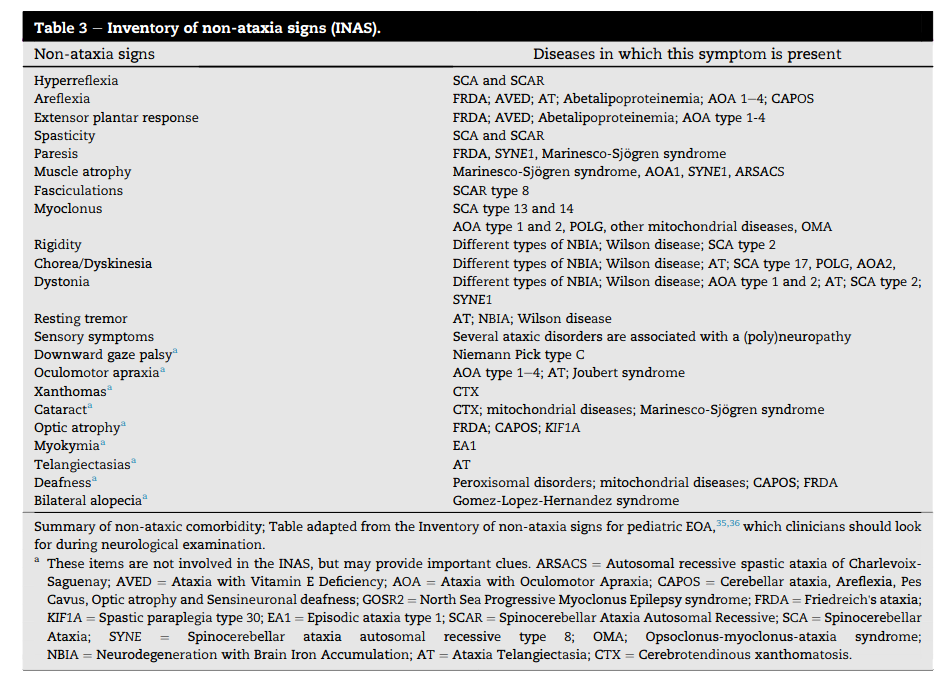
- Step 2: Apply Inventory of Non-Ataxic Signs (INAS) to identify non-ataxic signs (e.g. spasticity, myoclonus, systemic signs).
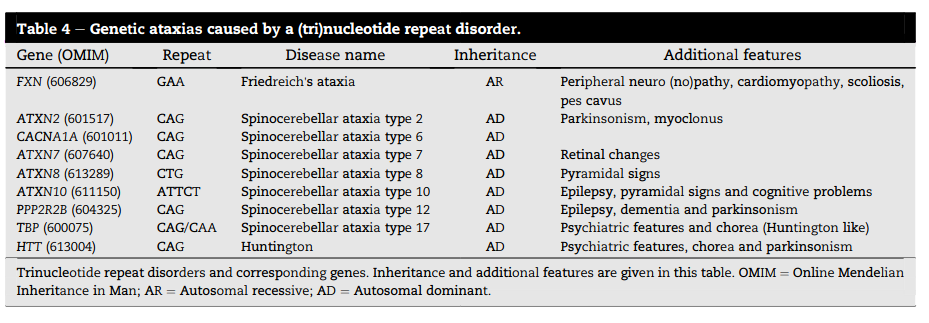
- Step 3: Evaluate family history: autosomal recessive, dominant or sporadic inheritance.
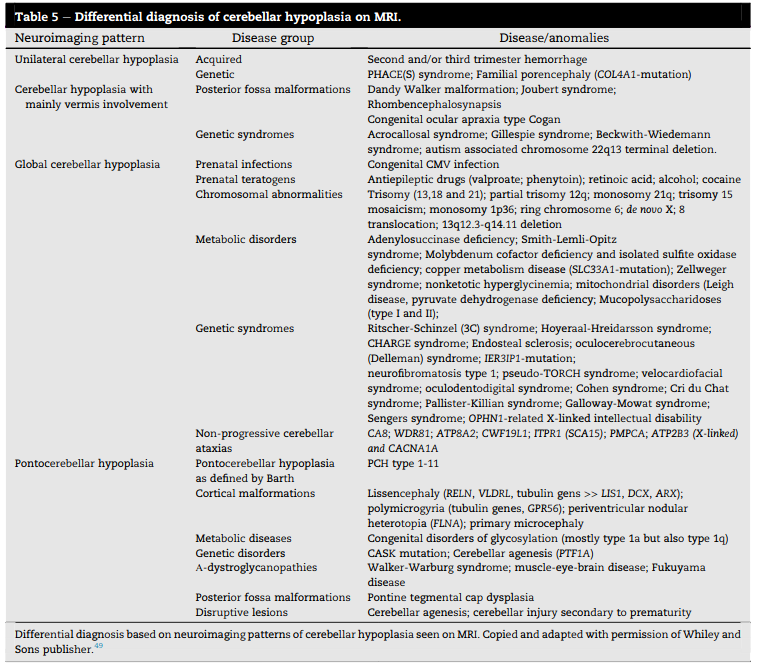
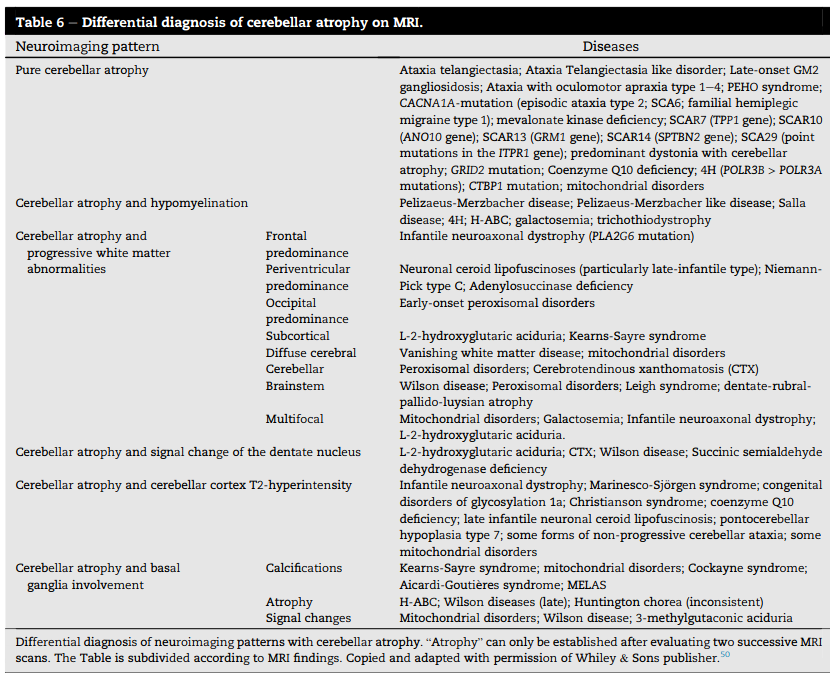
- Step 4: Brain MRI: look for cerebellar atrophy, structural abnormalities (e.g. small cerebellum, cysts).
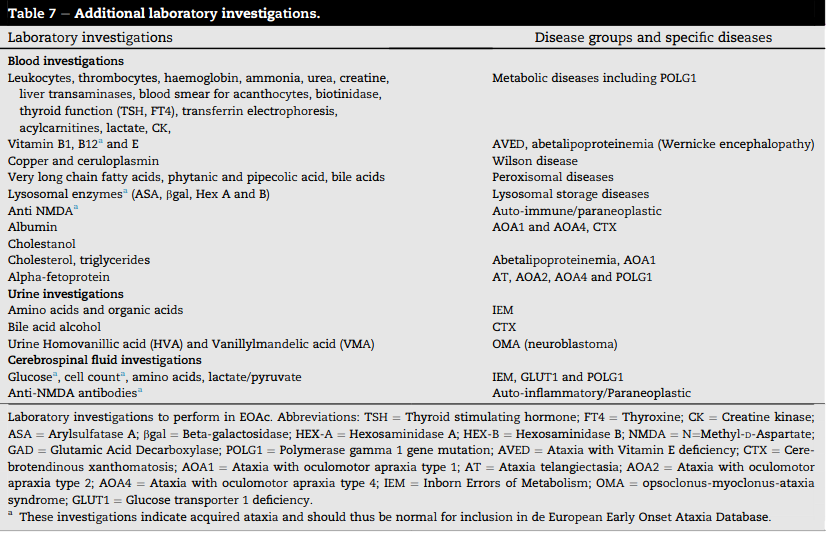
- Step 5: Laboratories: vitamins (B1, B12, E), thyroid, autoantibodies, metabolites (lactate, amino acids).
- Step 6: Genetic testing: array CGH o NGS (high-throughput sequencing) for genes like ATXN1, ATXN2, ATXN3, TUBB2B, RAB7L1.
- Step 7: Integrate clinical findings, imaging and genetics for final diagnosis.

More details (optional)
• In early ataxias, the inheritance pattern is key: autosomal recessive (more common in EOAc), dominant or X-linked.
• MRI may show cerebellar atrophy (especially in vermis) or structural abnormalities (e.g. vermis cyst).
• Genetic testing with NGS has high sensitivity; A specific ataxia panel is recommended.
Keys to Clinical Practice
- The onset before 2 years suggests congenital or genetic causes.
- The hypotonia in EOAc suggests neurodegenerative disorder.
- The INAS improves diagnostic accuracy by identifying non-ataxic signs.
- The systematic use of the algorithm reduces errors and optimizes the diagnostic process.
References: Brandsma et al. (2019), Palau et al. (2019)

19955111
{19955111:EVRTGK2A}
1
vancouver
50
default
7757
https://neuropediatoolkit.org/wp-content/plugins/zotpress/
statussuccessupdateneededfalseinstancefalsemetarequest_last0request_next0used_cachetruedatakeyEVRTGK2Alibraryid19955111metacreatorSummaryBrandsmaetal.parsedDate2019-09-01numChildren1bibltdivclassquotcsl-bib-bodyquotstylequotline-height1.35quotgtnltdivclassquotcsl-entryquotstylequotclearleftquotgtnltdivclassquotcsl-left-marginquotstylequotfloatleftpadding-right0.5emtext-alignrightwidth1emquotgt1.ltdivgtltdivclassquotcsl-right-inlinequotstylequotmargin0.4em01.5emquotgtBrandsmaRVerschuuren-BemelmansCCAmromDBarisicNBaxterPBertiniEetal.Aclinicaldiagnosticalgorithmforearlyonsetcerebellarataxia.EuropeanJournalofPaediatricNeurologyInternet.2019Sept1cited2025Feb24235692x2013706.Availablefromltaclass039zp-ItemURL039href039httpswww.sciencedirect.comsciencearticlepiiS1090379819300273039gthttpswww.sciencedirect.comsciencearticlepiiS1090379819300273ltagtltdivgtnltdivgtnltdivgtdataitemTypejournalArticletitleAclinicaldiagnosticalgorithmforearlyonsetcerebellarataxiacreatorscreatorTypeauthorfirstNameR.lastNameBrandsmacreatorTypeauthorfirstNameC.C.lastNameVerschuuren-BemelmanscreatorTypeauthorfirstNameD.lastNameAmromcreatorTypeauthorfirstNameN.lastNameBarisiccreatorTypeauthorfirstNameP.lastNameBaxtercreatorTypeauthorfirstNameE.lastNameBertinicreatorTypeauthorfirstNameL.lastNameBlumkincreatorTypeauthorfirstNameV.lastNameBrankovic-SreckoviccreatorTypeauthorfirstNameO.F.lastNameBrouwercreatorTypeauthorfirstNameK.lastNameBu00fcrkcreatorTypeauthorfirstNameC.E.lastNameCatsman-BerrevoetscreatorTypeauthorfirstNameD.lastNameCraiucreatorTypeauthorfirstNameI.F.M.lastNamedeCoocreatorTypeauthorfirstNameJ.lastNameGburekcreatorTypeauthorfirstNameC.lastNameKennedycreatorTypeauthorfirstNameT.J.lastNamedeKoningcreatorTypeauthorfirstNameH.P.H.lastNameKremercreatorTypeauthorfirstNameR.lastNameKumarcreatorTypeauthorfirstNameA.lastNameMacayacreatorTypeauthorfirstNameA.lastNameMicalizzicreatorTypeauthorfirstNameM.lastNameMirabelli-BadeniercreatorTypeauthorfirstNameA.lastNameNemethcreatorTypeauthorfirstNameS.lastNameNuovocreatorTypeauthorfirstNameB.lastNamePoll-ThecreatorTypeauthorfirstNameT.lastNameLerman-SagiecreatorTypeauthorfirstNameM.lastNameSteinlincreatorTypeauthorfirstNameM.lastNameSynofzikcreatorTypeauthorfirstNameM.A.J.lastNameTijssencreatorTypeauthorfirstNameG.lastNameVascocreatorTypeauthorfirstNameM.A.A.P.lastNameWillemsencreatorTypeauthorfirstNameG.lastNameZannicreatorTypeauthorfirstNameE.M.lastNameValentecreatorTypeauthorfirstNameE.lastNameBoltshausercreatorTypeauthorfirstNameD.A.lastNameSivalabstractNoteEarlyonsetcerebellarAtaxiaEOAccomprisesalargegroupofrareheterogeneousdisorders.Determinationoftheunderlyingetiologycanbedifficultgiventhebroaddifferentialdiagnosisandthecomplexityofthegenotypeu2013phenotyperelationships.Thismaychangethediagnosticwork-upintoatime-consumingcostlyandnotalwaysrewardingtask.InthisoverviewtheChildhoodAtaxiaandCerebellarGroupoftheEuropeanPediatricNeurologySocietyCACG-EPNSpresentsadiagnosticalgorithmforEOAcpatients.InsevenconsecutivestepsthealgorithmleadstheclinicianthroughthediagnosticprocessincludingEOAidentificationapplicationoftheInventoryofNon-AtaxicSignsINASconsiderationofthefamilyhistoryneuro-imaginglaboratoryinvestigationsgenetictestingbyarrayCGHandNextGenerationSequencingNGS.InchildrenwithEOActhisalgorithmisintendedtocontributetothediagnosticprocessandtoallowuniformdataentryinEOAcdatabases.date2019-09-01sectionpartNumberpartTitleDOI10.1016j.ejpn.2019.08.004citationKeyurlhttpswww.sciencedirect.comsciencearticlepiiS1090379819300273PMIDPMCIDISSN1090-3798languageencollectionsRHJ4SR7BdateModified2026-07-15T224127Z
1.
Brandsma R, Verschuuren-Bemelmans CC, Amrom D, Barisic N, Baxter P, Bertini E, et al. A clinical diagnostic algorithm for early onset cerebellar ataxia. European Journal of Pediatric Neurology [Internet]. 2019 Sept 1 [cited 2025 Feb 24];23(5):692–706. Available from: https://www.sciencedirect.com/science/article/pii/S1090379819300273