Non-progressive congenital ataxias are a rare and complex condition characterized by lack of order and coordination in voluntary movements and loss of balance. These conditions are distinguished by the absence of progressive signs and by presenting a form of ataxia that does not worsen over time.
Categories of Congenital Ataxias
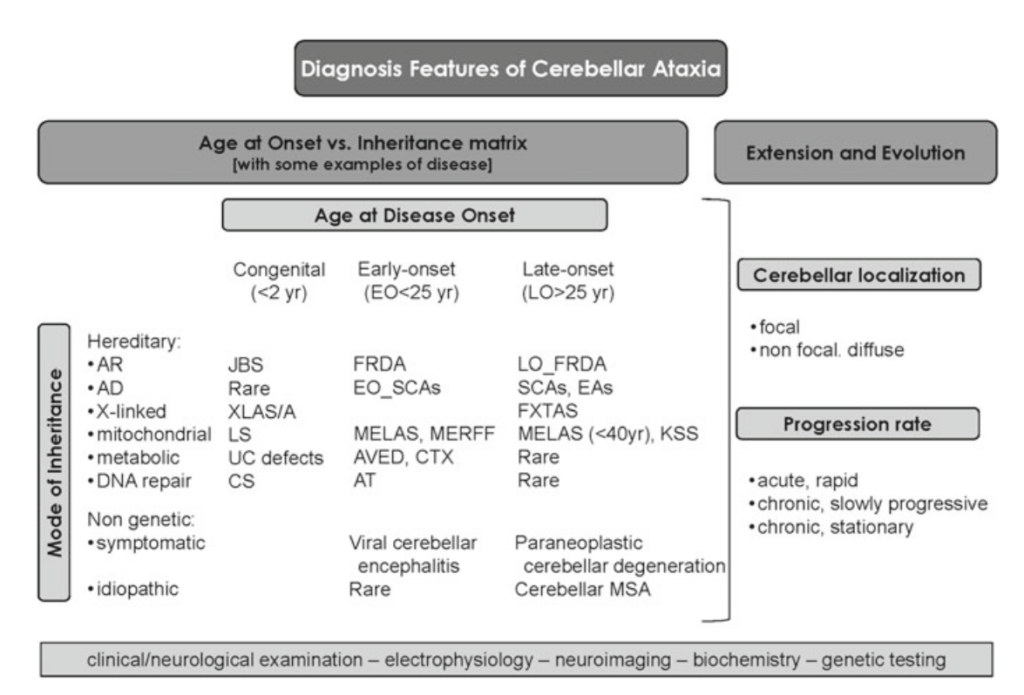
These ataxias can be classified into three main categories according to age of onset:
Congenital ataxias in infancy and young children ((<2 years)These ataxias typically present symptoms from the first months of life. They are associated with deficiencies in the formation and development of the cerebellum, and may be related to genetic problems or congenital malformations.
Early-onset in childhood, adolescence, and young adulthood ((<25 years)These ataxias begin during childhood, adolescence, or early young adulthood. They may be caused by neurogenetic disorders, developmental abnormalities, or acquired injuries.
Late-onset cerebellar ataxiasThey appear after the age of 25 and may be secondary to neurological, genetic, or environmental factors.
Importance of Age at Onset in Diagnostic Differentiation
The age of onset is crucial in the diagnostic differentiation among various forms of ataxia. In clinical practice, the Differential Diagnosis of Cerebellar Ataxias on the Basis of the Age at Onset (Difamino, 2020) provides a valuable guide to understanding how the age of onset may influence the identification of specific pathologies.
Typical Case of Congenital Ataxia
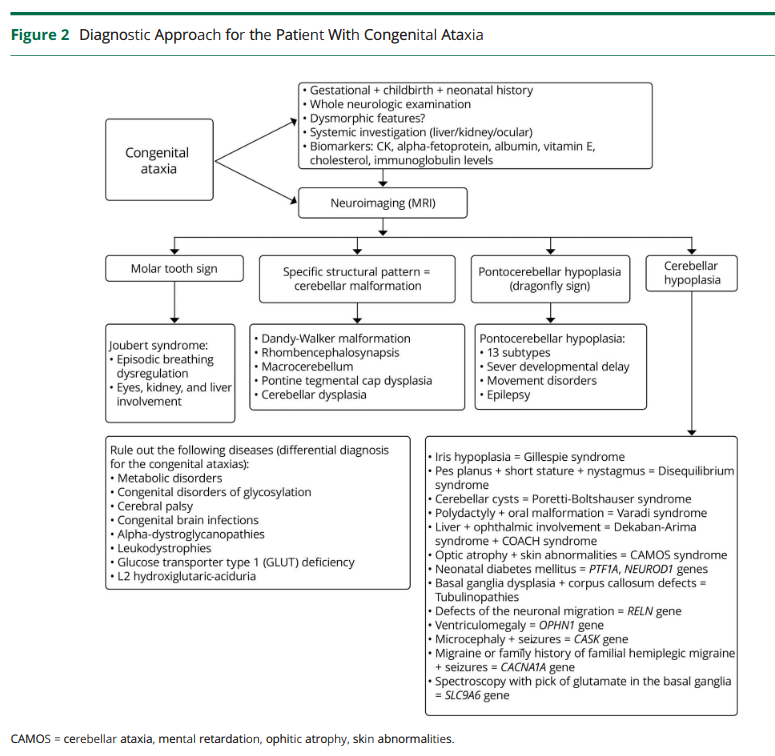
A prototype case of congenital ataxia could be a 6-month-old infant who has difficulty sitting, walking, and controlling fine movements. Clinical evaluation and complementary studies, such as cerebral MRI, may reveal abnormalities in the cerebellum, pointing toward congenital ataxia.
Mechanisms and Anatomophysiological Foundations
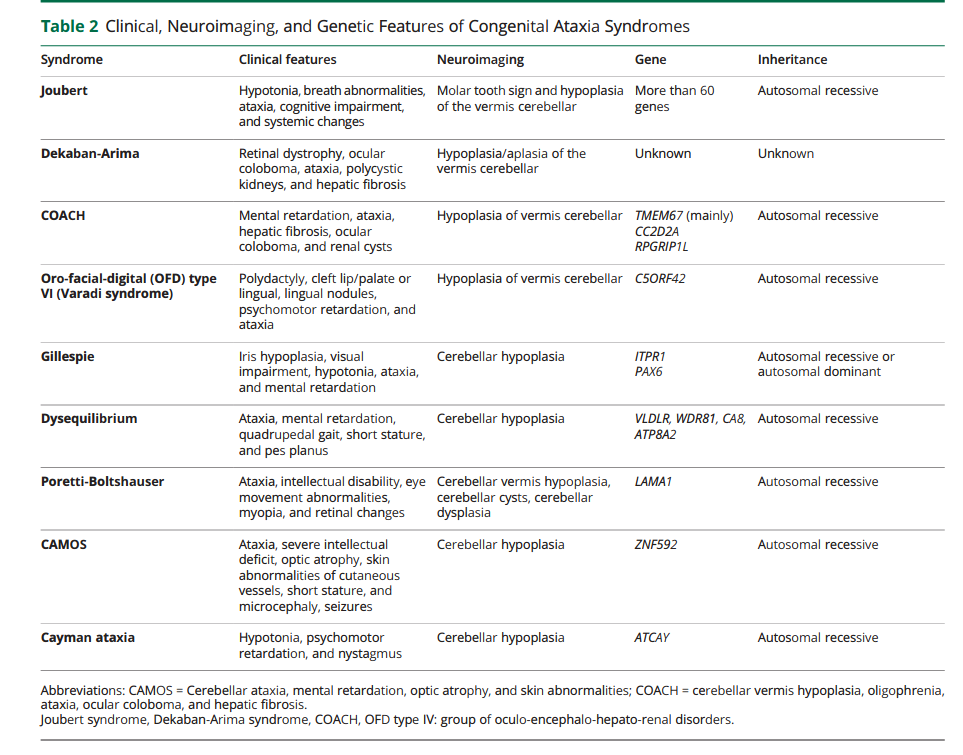
Congenital ataxia is caused by defects in the formation and development of the cerebellum, which is essential for muscle coordination and balance. Alterations in genes such as ATXN1, ATXN2, ATXN3among others, may lead to non-progressive congenital ataxias.
Image Interpretation
The images (Figures 1–5) show patterns of cerebellar atrophy in patients with congenital ataxias. Figure 1 illustrates reduced cerebellar volume, while Figure 2 shows preservation of the cerebellar basal structure. Figures 3 and 4 detail decreased functional activity of the cerebellum in affected patients. Finally, Figure 5 demonstrates the relationship between age of onset and anatomical location of the affected cerebellar areas.
Conclusions
Age of onset is a crucial factor in the diagnostic differentiation of cerebellar ataxias. Understanding the clinical, anatomical, and molecular characteristics of these ataxias enables evidence-based management and more accurate prognosis. The integration of diagnostic tools and the study of genetic biomarkers are fundamental for precise diagnosis and effective treatment.
Bibliographic References
[Palau, Arpa, Gruol, Koibuchi, 2020] Differential Diagnosis of Cerebellar Ataxias on the Basis of the Age at Onset. DOI: 10.1007/978-3-319-24551-5_70
Palau F, Arpa J. Differential Diagnosis of Cerebellar Ataxias on the Basis of the Age at Onset. In: Gruol DL, Koibuchi N, Manto M, Molinari M, Schmahmann JD, Shen Y, editors. Essentials of Cerebellum and Cerebellar Disorders: A Primer For Graduate Students [Internet]. Cham: Springer International Publishing; 2016 [cited 2025 Feb 24]. p. 523–9. Available from: https://doi.org/10.1007/978-3-319-24551-5_70
Figure 6. Diagram classifying non-progressive congenital ataxias according to age of onset, distinguishing the three main groups by the timing of symptom appearance.Figure 7. Diagram illustrating the importance of age of onset as a fundamental criterion for the differential diagnosis of cerebellar ataxias.Figure 8. Graphical representation of the categories of non-progressive congenital ataxias and their relationship with the underlying etiology of each group, including cerebellar malformations and genetic alterations.Figure 9. Clinical diagram showing the correlation between age of onset and the possible genetic or structural causes of each group of ataxia.