Main features:
- It is also not possible to evoke voluntary motor responses (which will appear from 6 months of life) through verbal command, which is why it is necessary to use reflex strategies to assess movement patterns.
- During this stage it is not possible to explore cognition, as language has not yet appeared, so the exploration of higher functions is based on free observation.
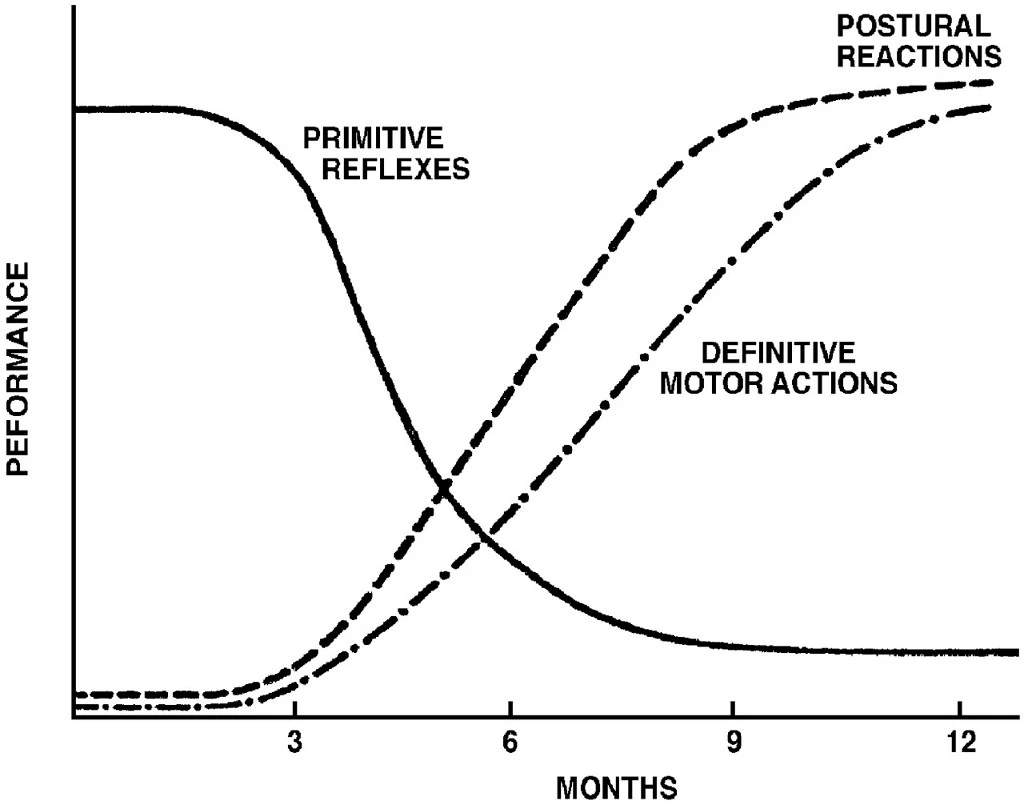
- During this stage, as during the rest of development, findings must be correctly interpreted according to developmental age, and therefore it is necessary to know the timeline of appearance and disappearance of each of the primitive reflexes and postural reactions.
- Sensory and coordination examination cannot be formally performed.
GENERAL PEDIATRIC EXAMINATION:
- Cranial morphology –. Sutures –. Fontanelles –.
- Dysmorphic features –.
- Skin examination –.
MORPHOLOGICAL EXAMINATION:
- Weight: (z=). Height: (z=). HC: (z=). Standards of —.
- Auscultation: Rhythmic heart sounds without murmurs or rubs. Good bilateral air entry without pathological sounds.
- Abdomen: Soft, depressible, without masses or visceromegaly.
- Genitals normally conformed male/female.
NEUROLOGICAL EXAMINATION:
 . =# ....................................... REACTIONS
 . -* ......................... POSTURAL
 . =@:++==@@@*   .        ...........   +@@+:.    :@@@
 . -* @@ REFLECTIONS ........ @@ @@ .
 . =# ....... @* PRIMITIVES..... @@ @@ ......
 . =# .........  @@        .....  -@.     @@   .........
 . =# ..........  @+ ..........  @@     @@.  ...........
 . =# ........... .@  ........  @-    +@:  .............
 . =# ............ %@  .....  =@     @=          .......
 . =# ............ @# ... @# # ACTIONS .....
 . =# ............. @: .. -@= @ VOLITIVE MOTORS ..
 . =# ..............  @    -    @@  ....................
 . =# ...............  @  @    @   .....................
 . =# ................  @#   @#  .......................
 . =# ...............  @ +@@@   ........................
 . =# .............   @  @@@@    .......................
 . =# ...........   *= @@    #@@     ...................
 . =# ..........   @.@#   ..    #@@@
 . -+            @#@    .......      -=#@@@@@@@@@@@@@@@@
 . =%.::-.*:@@@@@
 . :@@@@@@@@@@@@@@@@@@@@@@@@@@@@@@@@@@@@@@@@@@@@@@@@@@@@
 ..             3           6           9            12
                               MONTHS
- Primitive reflexes (0-6 months): Stepping reflex —. Palmar grasp —. Moro reflex –. Asymmetric tonic neck reflex –. Galant reflex –. Plantar grasp –.
- Postural reactions (6-12 months): Lateral propping reaction –. Parachute reaction –. Placing reflex –. Pull-to-sit –. Ventral suspension (Landau) –. Axillary suspension normal. Horizontal suspension (Collis) –. Vojta lateral reaction –. Blanket test –.
- Higher functions on free observation: Conscious. Attentive. Age-appropriate behavior. Attachment –. Social smile –. Play –.
- Cranial nerves: Threat campimetry –. Hirschberg –. Oculocephalic normal. Red reflex –. Cochleopalpebral reflex (clap) –. Facial symmetry. Absence of lingual fasciculations.
- Motor system:
- Resting posture: Normal.
- Passive tone: Angles: Adductor angle –. Popliteal angle –. Heel-to-ear angle –. Foot dorsiflexion angle –. Scarf sign –. Flexion of hand on forearm –. Lateral rotation of head –.
- Active tone: Head control –. Pull-to-sit –. Prone position with weight-bearing on elbows/hands and chest elevation/pelvis elevation. Sitting –. Standing –. Walking –.
Bibliography:
Neurological examination and assessment of the infant, by Juan José García Peña. SPAPEX Forum. March 2004. https://www.spapex.es/sites/default/files/bol15.pdf
Internationale Vojta Gesellshaft. https://www.vojta.com/es/principio-vojta/diagnostico-vojta/reacciones-posturales