Main features:
- During this stage language emerges, so interaction with the child becomes richer and allows for closer observation. However, in this age range, cooperation is often very difficult, and children frequently show resistance to the medical environment, so free observation remains a key tool for neurological examination.
- Sensory and coordination examination may not be feasible.
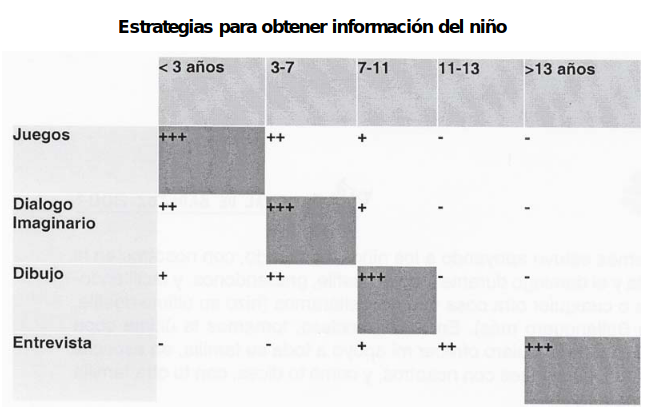
- Other indirect assessment strategies exist such as play and drawing. During this stage, as during the rest of development, findings must be correctly interpreted according to developmental age, and therefore it is necessary to know the timeline of their appearance.
GENERAL PEDIATRIC EXAMINATION:
- Weight: (z=). Height: (z=). HC: (z=). Standards –.
- Auscultation: Rhythmic heart sounds without murmurs or rubs. Good bilateral air entry without pathological sounds.
- Abdomen: Soft, depressible, without masses or visceromegaly.
- Genitals normally conformed male/female.
MORPHOLOGICAL EXAMINATION:
- Cranial morphology –. Sutures –. Fontanelles –.
- Dysmorphic features –.
- Skin examination –.
NEUROLOGICAL EXAMINATION:
- Functions superior to free observation: Conscious. Attentive. Eye contact –. Attachment –. Social smile –. Language observed in an age-appropriate consultation. Age-appropriate behavior. Play normal for age. Drawing normal for age.
- Cranial Nerves: Threat Campimetry –. Hirschberg –. Oculocephalic –. EOM –. Red reflex –. Cover-uncover –. Cochleopalpebral reflex (pat) –. Facial symmetry. Absence of lingual fasciculations. Centred uvula.
- Motor system:
- Resting posture: Normal.
- Passive tone: No rigidity or spasticity.
- Active tone: Sedation –. Bipedation –. March –.
- Coordination not assessable.
- Sensation not assessable.
Bibliography.
Neurological examination of preschoolers, older children and adolescents: A “different” clinical perspective. Ulián Vaquerizo Madrid, Cristina Cáceres Marzal and Sara López Ridruejo. 2004. SPAPEX Pediatric Forum. https://www.spapex.es/sites/default/files/bol15.pdf