What is a pseudogene?
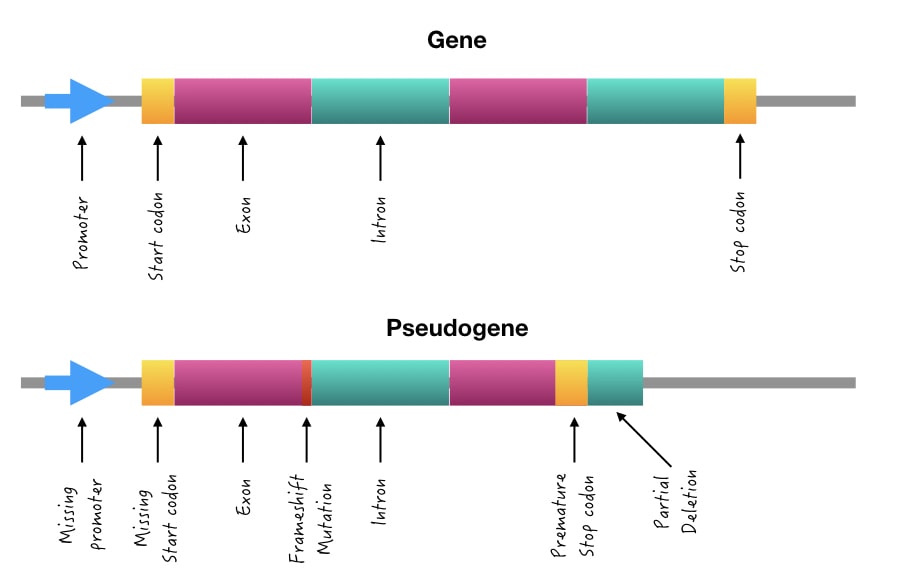
A pseudogene is a type of non-functional DNA sequence that closely resembles a functional gene, but does not produce a functional protein product. Pseudogenes are considered evolutionary relics, often arising from genes that were once functional but have accumulated mutations over time, rendering them unable to produce a functional protein.
There are two main types of pseudogenes:
- Processed pseudogenes: These pseudogenes arise from the reverse transcription and integration of a processed messenger RNA molecule into the genome. This usually occurs when messenger RNA from a functional gene is reverse transcribed back to DNA by a retrotransposon (a type of genetic element that can move within a genome). The resulting DNA sequence is integrated into the genome, but generally lacks introns and regulatory elements, making it non-functional.
- Unprocessed pseudogenes: These pseudogenes generally result from gene duplication events. When a gene is duplicated, one copy can accumulate mutations over time, losing its ability to produce a functional protein. These mutations may involve disruptions in coding regions, the introduction of premature stop codons, or deletions affecting regulatory regions.
Pseudogenes used to be considered “junk DNA” with no biological meaning. However, more recent research has revealed that some pseudogenes may still play a role in various cellular processes. For example, they could act as templates for the generation of small regulatory RNAs or participate in the regulation of nearby genes. However, most pseudogenes are non-functional and do not contribute to protein production.
Clinical consequences of pseudogenes.
The clinical consequences of pseudogenes can vary and are highly dependent on the specific context and functions of the pseudogenes involved. Although most pseudogenes have no direct clinical impact, some may be associated with certain diseases or conditions. Here are some ways pseudogenes could have clinical consequences:
- Interference with genetic tests: In some cases, pseudogenes can be very similar to functional genes and can interfere with genetic testing aimed at detecting mutations in specific genes. This problem is particularly important in massive sequencing tests based on shotgun sequencing, since DNA fragmentation means that the sequences of genes and their homologous pseudogenes can be confused.
- Effects on gene expression: Some pseudogenes can act as molecular “competitors” to their related functional genes. This means they could interfere with normal functional gene expression, which could have effects on gene regulation and contribute to conditions such as cancer.
- Gene regulation: Some pseudogenes may play a role in gene regulation by producing non-coding RNAs that interact with other genes. This may affect the expression levels of related genes and have implications for diseases.
- Role in diseases: Sometimes, specific pseudogenes can be linked to particular diseases or disorders. For example, some pseudogenes have been found to be involved in drug resistance or neurological disorders.
- Therapeutic potential: Some pseudogenes may have potential therapeutic applications.
Neurogenetic diseases caused by pseudogenes.
Gene conversion is a process by which the DNA sequence of a functional gene is replaced or modified by the sequence of a related pseudogene. This phenomenon can have significant consequences and in some cases can be associated with genetic diseases. Here is a summary of how pseudogene gene conversion can cause disease:
- Homologs and Recombination: Pseudogenes often share sequence similarity with their related functional genes. Due to this similarity, a recombination process can occur between the functional gene sequence and that of the pseudogene. Recombination is the process in which segments of DNA are exchanged between different DNA molecules, creating a new combined sequence.
- Sequence Exchange: During recombination, segments of the pseudogene sequence can be incorporated into the functional gene, or vice versa. If a portion of the pseudogene is inserted into the functional gene, this could disrupt the gene sequence, affecting its ability to code for a functional protein. On the other hand, if a portion of the functional gene is inserted into the pseudogene, the latter could acquire characteristics that make it more similar to the functional gene.
- Impact on Expression and Function: If recombination interferes with the coding structure of the functional gene, this could result in the production of a defective or non-functional protein. This could have a direct impact on cellular function or metabolic pathways regulated by that gene. In more extreme cases, recombination could even completely inactivate the functional gene.
- Associated Diseases: Diseases caused by pseudogene gene conversion typically result from loss of function of an essential gene. Depending on the function of the affected gene, this could lead to a wide variety of diseases. For example, if a gene responsible for the production of a crucial enzyme is inactivated due to gene conversion, this could lead to a metabolic disorder.
- Examples in Practice: There are examples in the scientific literature of diseases caused by gene conversion of pseudogenes.

The example of SMN1 and SMN2.
The SMN1 (Survival Motor Neuron 1) and SMN2 (Survival Motor Neuron 2) genes are linked to a serious neuromuscular genetic disease called spinal muscular atrophy (SMA). Both genes, SMN1 and SMN2, encode the same essential protein called SMN (Survival Motor Neuron), which plays a fundamental role in the maintenance and function of motor neurons. Most cases of SMA are caused by loss or deletion of the SMN1 gene. This loss results in severe insufficiency of the SMN protein, leading to degeneration of motor neurons and, ultimately, muscle weakness and other characteristic symptoms of the disease.
Although SMN2 is very similar to SMN1, there is a change in one of the DNA bases. The protein produced by SMN2 is less functional than that produced by SMN1 (it does not become a pseudogene, since it retains some functionality, but almost), and because of this, it is not capable of guaranteeing by itself the survival of motor neurons in the absence of SMN1. However, it does retain a role in the disease, since the functional amount of the SMN protein produced by SMN2 influences the severity of SMA. Individuals with more copies of SMN2 usually have a milder form of the disease, since the SMN protein produced by SMN2 can partially compensate for the SMN1 deficiency.
Therapeutic approach: Since SMN2 plays a modifying role in the severity of SMA, treatments for this disease often focus on increasing the amount of SMN protein produced by SMN2.