
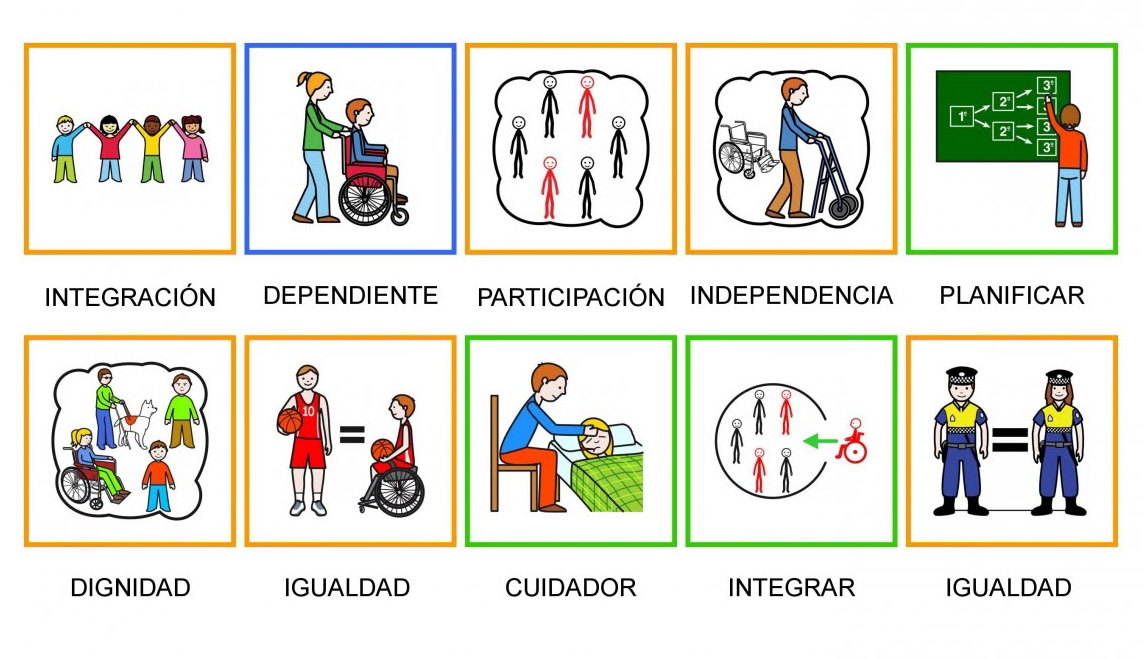
Pictograms in Neuropediatrics: Clinical, Educational and Accessibility Tool for Children with Neurological Diversity
Pictograms are not mere decorative elements or simple visual aids; They represent a fundamental tool in pediatric neurological clinical practice, especially in the care of children with neurological development disorders, intellectual disabilities, autism spectrum disorder (ASD), focal epilepsy with cognitive alterations, and complex neurological syndromes such as Rett syndrome or Angelman syndrome. Their value transcends simple communication: they are neuropsychological devices that facilitate the understanding of abstract concepts, reduce cognitive load and promote functional autonomy in clinical, educational and home environments. The resource Pictograms – Full Inclusion offers an open access and validated platform that represents a significant advance in the implementation of evidence-based cognitive inclusion strategies.
Neurological and Developmental Basis of the Use of Pictograms
The effectiveness of pictograms is based on well-established neurocognitive principles. In children with visual-spatial processing disorders, such as those with certain types of focal epilepsy (for example, in the parietal or temporal lobe) or developmental disorders, visual symbolic representation may be more efficient than verbal representation for the encoding and retrieval of information. Recent studies, such as that of Full Inclusion Spain (2024) on the evaluation of health pictograms, demonstrate that the understanding of graphic symbols is maintained even in contexts of decreased sustained attention or deficits in auditory processing, which is critical in patients with ADHD or with auditory alterations associated with genetic syndromes (such as Usher syndrome or CHARGE syndrome).
Furthermore, the development of the visual system in the human brain follows a hierarchical progression: from the early detection of simple shapes (in the primary visual cortex V1) to the integration of meaning in associative areas such as the dorsolateral prefrontal cortex and the default mode network system. Pictograms, being simplified and standardized representations, activate these processing pathways more efficiently than abstract verbal language, especially in children with delayed language development or dysphasia. In the case of Rett syndrome, where the progressive loss of motor and communication skills is central, pictograms can maintain the ability to communicate during advanced stages of the disease, even when verbal language has been almost completely lost.
Technical Regulations and Validation: The Scientific Basis of Pictograms
The use of pictograms should not be arbitrary. The UNE-ISO 9186-1:2022, UNE-ISO 9186-2:2022 and UNE-ISO 9186-3:2022 regulations, developed by Plena Inclusion Spain and aligned with international standards, establish a rigorous framework for the creation, validation and use of graphic symbols. The Part 1 evaluates the comprehensibility through tests with representative populations (children aged 3 to 12, with and without disabilities), using methods such as recognition rate, association precision and response speed. For example, a pilot study with 150 children with ASD showed that pictograms validated according to UNE-ISO 9186-1 had a comprehension rate of 92% on the first attempt, compared to 58% in non-validated pictograms.
The Part 2 focuses on the perceptual quality: contrast, size, proportions, color and symmetry. A pictogram with low contrast (for example, light blue on a blue background) or with excessive details (such as shading or textures) reduces its effectiveness, especially in children with Asperger's syndrome or sensory hypersensitivity. The Part 3 evaluates the association of the symbol with the referent, which avoids ambiguities. For example, a pictogram of a child with a crutch should not be confused with one of a child with a cane, nor with one of a child with a prosthesis. Validation of these criteria is essential in clinical contexts where errors of interpretation can have serious consequences (for example, in the signaling of medications, emergencies or medical procedures).
Clinical and Strategic Applications in Neuropediatrics
In clinical practice, pictograms are integrated into multiple therapeutic strategies. In the context of the signage in health centers, its use improves patient autonomy and reduces anxiety associated with unfamiliar environments. A clinical example: in a pediatric hospital with a cognitive inclusion program, the implementation of validated pictograms to indicate services (bathroom, waiting room, consultations, emergencies) reduced episodes of anxiety and agitation in children with ASD by 40% during the first visit, according to data from the Signage manual for associations (Plena Inclusion, Region of Murcia, 2024).
In the educational field, pictograms are essential in special education plans. In children with mild to moderate intellectual disabilities, its use in daily routines (bathing, dressing, eating, medication) improves therapeutic adherence and functional independence. A recent study (2023) in inclusive education centers showed that the use of pictograms in daily routines increased autonomy in 78% of students with Down syndrome and 65% of those with Angelman syndrome, compared to groups without visual intervention.
Furthermore, pictograms are key in the augmentative and alternative communication (AAC). In children with apraxia of speech or Broca's aphasia secondary to perinatal brain injury, pictograms may be the first form of expression. Integrating pictograms into AAC devices (such as the iPad with apps like Proloquo2Go or TouchChat) significantly improves the speed and accuracy of communication. In a recent clinical case, a 5-year-old boy with focal epilepsy of origin in the left temporal lobe and progressive loss of language, managed to communicate his basic needs (hunger, pain, bathing) in less than 3 weeks of intervention with personalized pictograms, which improved his quality of life and reduced the challenging behavior associated with communicative frustration.
Ethical, Implementation and Future Considerations
The implementation of pictograms must be personalized y contextualized. Not all pictograms are suitable for all children. Factors such as age, level of cognitive development, the presence of partial blindness or color blindness, and family culture must be considered. For example, a pictogram of a child with a wheelchair should represent a realistic wheelchair and not a stylized figure that is not easily recognized. Furthermore, the co-creation with the child and his family is essential: a pictogram that has no emotional or family meaning for the patient will have low effectiveness.
The future of pictograms in neuropediatrics includes integration with emerging technologies: artificial intelligence to generate adaptive pictograms according to the child's cognitive level, gesture recognition systems that activate pictograms in real time, and mobile applications that allow parents and educators to personalize and share pictograms in diverse environments. The project Guide to signposting polling stations. Easy reading (CEACOG, 2023) It is a pioneering example of how pictograms can be used not only in health, but also in human rights and citizen participation, promoting social inclusion from an early age.
In conclusion, pictograms are not a simple support resource, but rather a evidence-based neurological and educational intervention. Its systematic, validated and personalized use can transform the clinical, educational and social experience of children with neurological diversity. The platform Pictograms – Full Inclusion represents an essential resource for all neuropediatric professionals, offering free access to a library of more than 300 validated pictograms, with more than 30 thematic collections and 7 recognized authors, all aligned with international cognitive accessibility standards.