Natural History of Scoliosis in Children with Severe Cerebral Palsy
- Prevalence: 59% scoliosis (Cobb ≥10°) in children with severe CP (GMFCS III–V).
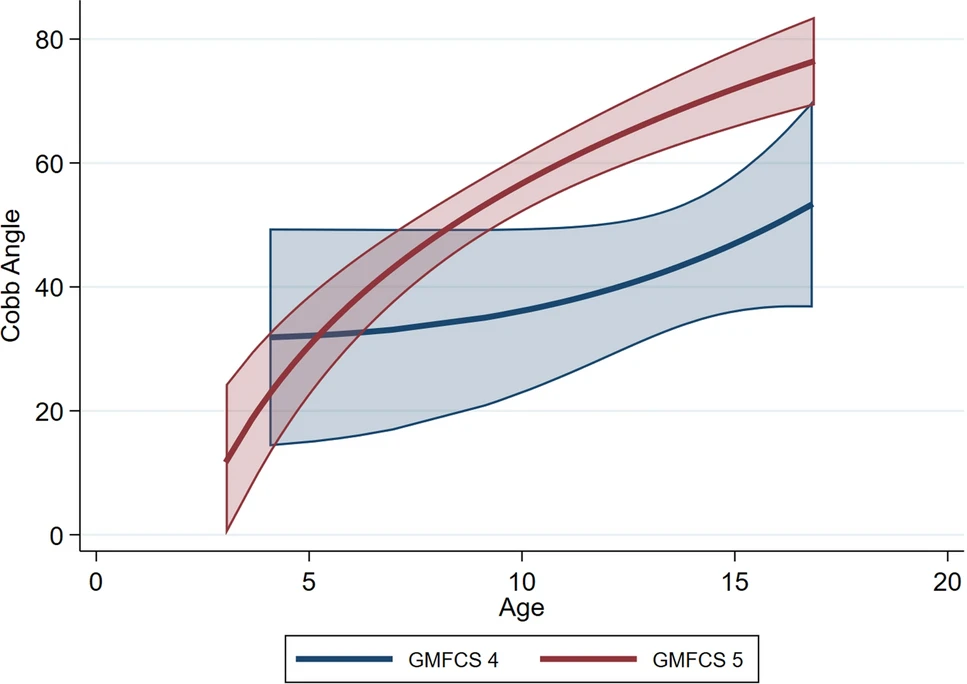
- Associated severity: Prevalence increases with decreased functional level:
- GMFCS III: 6%
- GMFCS IV: 19%
- GMFCS V: 62%
Predictive factors of progression
- High initial Cobb angle → increased risk of progression.
- Cobb ≥30° at 10 years → strong predictor of severe scoliosis (≥40°).
- GMFCS V → associated with the highest rate of progression.
- In GMFCS V, annual progression is high (up to 9.7°/year in 3–5 years), then decelerates (2–3°/year ≥11 years).
Clinical recommendations
- Follow-up: Annual x-rays from age 5; every 6 months in GMFCS V between 8–14 years.
- Intervention: Refer to neuromuscular equipment if Cobb ≥30° at 10 years.
- Treatment:
- Orthopedic correction (corsets): limited due to lack of muscle control.
- Spinal fusion surgery (with systems such as Luque or Cotrel-Dubousset): high effectiveness in GMFCS V, improved posture, quality of life and functionality.
- Systemic impact: Severe curvature affects lung, gastrointestinal and functional autonomy.
More details
Data based on the NorCP study (206 children, 2002–2008, GMFCS III–V). Published in European Spine Journal (DOI: 10.1007/s00586-023-07868-1).
Clue: GMFCS V with Cobb ≥30° at 10 years requires intensive surveillance and early referral to specialists.
🔗 Consult linked resource: Natural history of scoliosis in PCI