
Dravet Syndrome: Natural History and Clinical Evolution in Multidimensional Perspective
Dravet Syndrome (DS), initially described as early-onset myoclonic epilepsy, is now recognized as one of the most severe forms of early-onset epileptic encephalopathy (EE, for its English acronym). Its historical trajectory is complex, progressive, and multifaceted, transcending the mere presence of seizures and encompassing a broad spectrum of neurological, behavioral, cognitive, and social alterations that evolve dynamically throughout life. Understanding this historical trajectory is essential for differential diagnosis and clinical management, as well as underscoring the need for early, personalized, and multidisciplinary interventions.
Initial Presentation and Development Phase: The First Year of Life
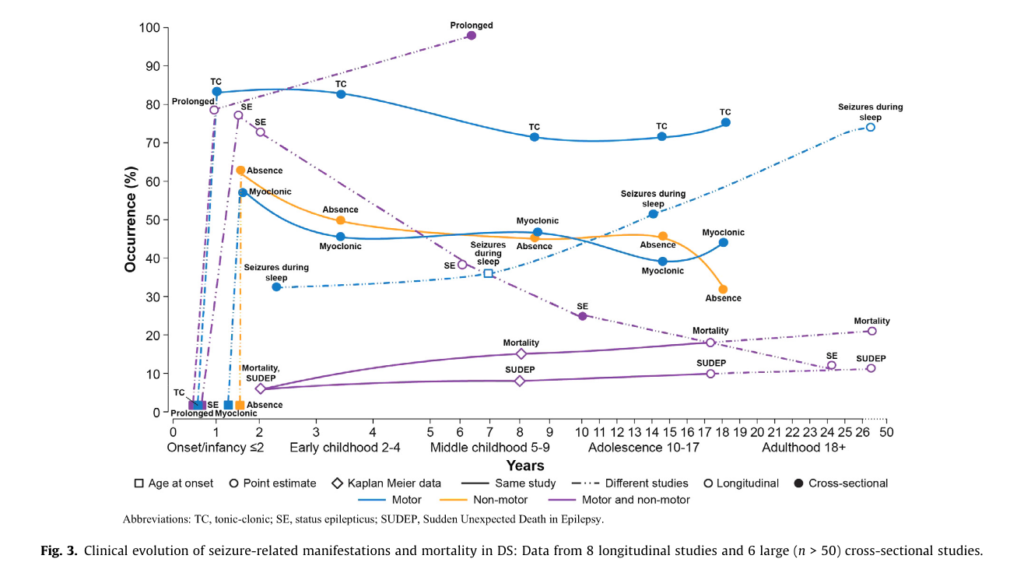
The SD is characterized by its early presentation, with over 80% of cases beginning before 12 months of age, and in many cases even in the first trimester of life. The most common clinical manifestation is the prolonged febrile seizure (LPFC), which usually presents as generalized tonic-clonic seizures lasting longer than 10 minutes and can be unilateral or with predominant hemispheric dominance, leading to confusion following a cerebral vascular accident. However, the distinguishing feature is that these seizures are not limited to fever: they occur in over 50% of cases without fever, alerting the clinician to the possibility of early-onset epilepsy. The presence of hyperthermia as a trigger It is a key finding, since 70-80% of patients experience exacerbations of their seizures with fever, which is due to the functional dysfunction of the neuronal sodium channel type Nav.v1.1, encoded by the gene SCN1AThis mutation, in more than 80% of the cases, causes a functional decrease of GABAergic interneurons in the cortex and hippocampus generalized neuronal hyperexcitability which manifests itself in crises that are difficult to control.
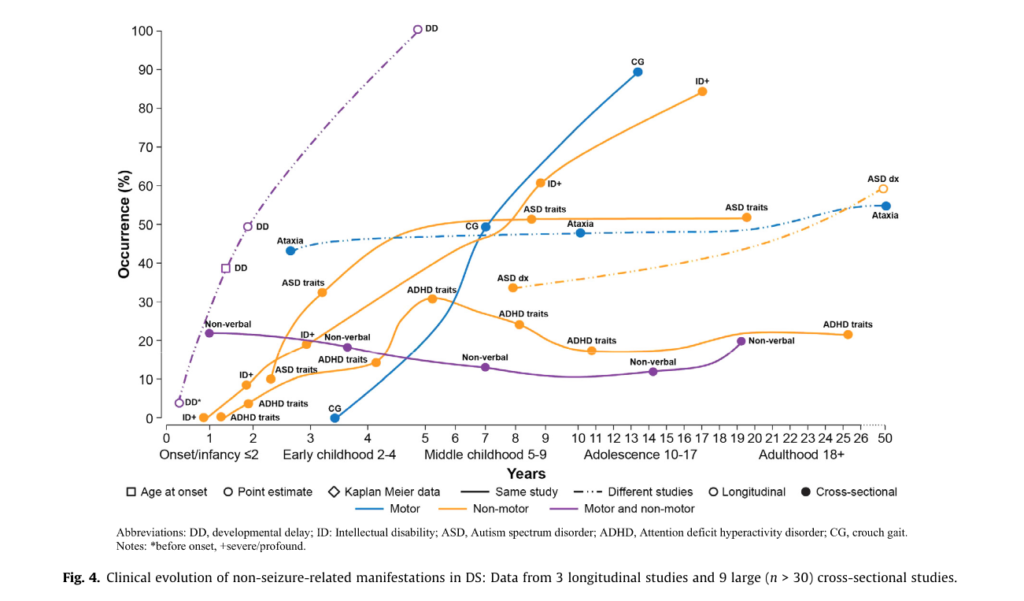
In this initial phase, in addition to the crises, signs of altered neurological developmentRecent studies, such as that of Sullivan et al. (2022), highlight that children may initially show normal development but often experience delays in motor, cognitive, and language development from the first year. non-convulsive problems are already present in early childhood1. Preserve ALL HTML tags, shortcodes, placeholders (e.g. %s, {name}), and attributes exactly as they appear. 2. Keep medical terminology accurate and natural. 3. Output ONLY the translated text without any explanation, markdown backticks, or intro.
Transition to the Phase of Stabilization and Persistence of Neurological Manifestations
Strict rules: 1. Preserve ALL HTML tags, shortcodes, placeholders (e.g. %s, {name}), and attributes exactly as they appear. 2. Keep medical terminology accurate and natural. 3. Output ONLY the translated text without any explanation, markdown backticks, or intro. myoclonus episodes (especially upon awakening or with sensory stimuli), and a greater frequency of episodes of prolonged febrile status epilepticus (PFES), which represent a significant risk of mortality and secondary neurological damage. In this period, the hyperactivity, anxiety, aggression and sleep disorders they become more evident. The study by Sullivan et al. (2022) clearly identifies that Health-related quality of life (HRQoL) deteriorates significantly after 3 years1. Strict rules: 1. The main predictors of this decrease are the severity of seizures, cognitive decline, and the presence of motor and behavioral problems.
The progressive cognitive delay Is one of the most devastating features. Although some patients may maintain a basic comprehension ability, the majority develops a. moderate to severe intellectual disability, with difficulties in abstract reasoning, working memory and planning. Evaluation with scales such as Bayley Scales of Infant Development or ADOS At this stage it reveals a significant deterioration in overall functioning. Furthermore, the progressive ataxia and dysarthria In this context, the impact on caregivers Massive: Sullivan et al. (2022) show that 60% of parents report a significant decline in their quality of life, with limitations in work, social relationships, and mental health, due to the high level of assistance required (for example, need for technical aids, overnight care, specialized transportation).
School Age and Adolescence: Persistence of the Clinical Burden and Changes in the Morbidity Profile
The clinical profile stabilizes to some extent during childhood and adolescence but does not improve. Seizures may decrease in frequency in some patients (up to 30-40% with partial improvement), but they persist as absence seizures, myoclonic seizures, and SEFP episodes. resistance to multiple antiepileptics is the rule, and only the use of specific therapies such as phenobarbital, clobazam, valproate, and more recently, phenobarbital and cannabidiol (Epidiolex), you can achieve partial control. The hyperactivity and attention deficit hyperactivity disorder (ADHD) They are common, and in many cases they are associated with autism spectrum disorders, which complicates differential diagnosis and therapeutic management.
The study by Sullivan et al. (2022) highlights that the economic burden of SD is extremely highStrict rules: 1. Preserve ALL original HTML tags, shortcodes, and placeholders (e.g. %s, {name}) exactly as they appear. 2. Ensure accurate medical terminology and natural phrasing. 3. Return ONLY the final corrected translation. Corrected translation: Strict rules: 1. Preserve ALL original HTML tags, shortcodes, and placeholders (e.g. %s, {name}) exactly as they appear. 2. Ensure accurate medical terminology and natural phrasing. 3. Return ONLY the final corrected translation. reduction in health state utility Which correlates with the severity of neurological symptoms, which has direct implications for clinical decision-making and the evaluation of new therapies.
Considerations about the Prognosis and Future of Care
The prognosis of SD remains restricted: only a small percentage of patients achieve significant functional independence. mortality due to sudden death in sleep (SUDEP) It is a real risk, with rates estimated between 5% and 10% in the general DS population. The presence of Strict rules: 1. Preserve ALL HTML tags, shortcodes, placeholders (e.g. %s, {name}), and attributes exactly as they appear. 2. Keep medical terminology accurate and natural. 3. Output ONLY the translated text without any explanation, markdown backticks, or intro. Therefore, the use of sleep monitors is recommended, and in selected cases, implantation of crisis detection devices is performed.
In summary, DS is not only a seizure disease, but a systemic disease of the central nervous system Strict rules: 1. Preserve ALL HTML tags, shortcodes, placeholders (e.g. %s, {name}), and attributes exactly as they appear. 2. Ensure accurate medical terminology and natural phrasing. 3. Return ONLY the final corrected translation. evolution of neurological, cognitive and functional disability that requires sustained medical, social, and economic care throughout life.