To implement an augmentative and alternative communication system, it is necessary to follow an implementation itinerary:
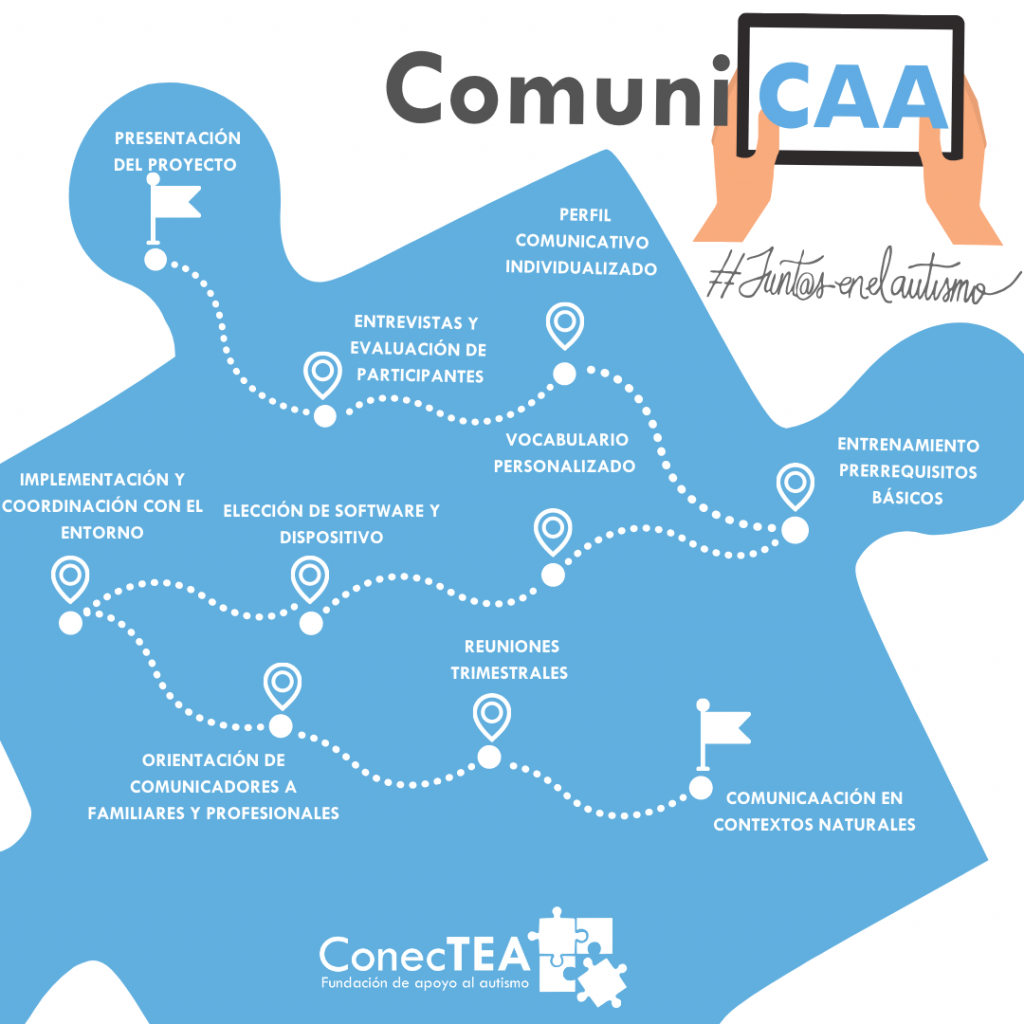
Assessment.
- An individualized interview is carried out to find out what the main access barriers are.
- Sensory problems (vision, hearing).
- Problems in the cognitive prerequisites of language (cognition, attention, communicative intention, etc.).
- Language problems itself. Dysphasia and aphasia. Language through alternative channels to verbal-oral-auditory (pictograms).
- Serious motor problems. Depending on the type of residual mobility, there are various systems available.
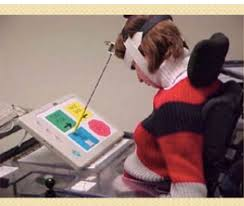
- An individualized communication profile is established.
Cognitive and language training.
- There are usually 2 scenarios:
- People with previously normal language (older children or adults) who, as a result of an acquired condition, lose the ability to communicate autonomously. Once the communication barrier is identified, the implementation and learning of the technology is usually rapid.
- Children with congenital diseases who do not have the ability to communicate, and who have never developed language, or are not yet old enough to have done so. In this case, the process is longer, since we will have to progressively increase the complexity of the communication system, and reciprocally, the implementation of the communication system will provide learning experiences for language development.
- You have to train the language prerequisites (cognition, attention, communicative intention, etc.).
- A personalized vocabulary must be selected that the individual is capable of handling, and then expand it as new needs arise.
- For example, in children under 3 years of age with serious neurological diseases who can only voluntarily use eye movements, we would have to start using analog communicators with a YES/NO response and progressively increase the number of symbols depending on the child's capabilities. The panels can be handmade, or use solutions marketed for this purpose, ETRAN type:
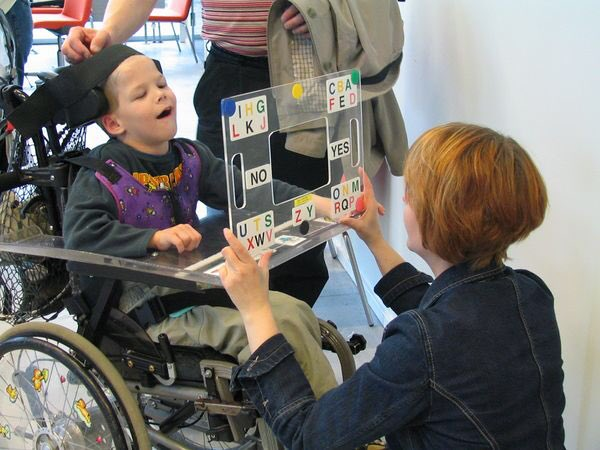
https://www.elaandalucia.es/WP/wp-content/uploads/paneles-para-la-comunicacion-con-la-mirada.pdf
Practical implementation of technology.
- Finally, select the most optimal technological device and implementation begins, initially in the family and school environment to later generalize its use in natural environments.
- Depending on the type of technology, there are different procedures to finance it. There are resources for educational centers and for users:
https://ceice.gva.es/es/web/inclusioeducativa/accessibilitat
https://www.gva.es/es/inicio/procedimientos?id_proc=G94986
- For example, in the previous case, in individuals who only have voluntary eye movements to communicate, the Irisbond system can be used. It is the only health prescription system.