
Natural history of scoliosis in children with severe cerebral palsy: an evidence-based review of the NorCP study
Scoliosis in children with cerebral palsy (CP) of moderate to severe severity represents one of the most significant complications and with the greatest functional impact on the evolution of this neurological condition. Although CP is characterized by permanent brain damage in the perinatal or early life period, the progression of skeletal disorders such as scoliosis is not static, but evolves dynamically throughout growth. The recent study published in European Spine Journal (DOI: 10.1007/s00586-023-07868-1) by Terjesen et al., based on a population-based cohort of 206 children with bilateral CP and classified into GMFCS functional levels III to V, provides one of the strongest evidence to date on the natural history of scoliosis in this group of patients. This analysis not only quantifies the prevalence and progression of curvature, but also identifies key predictive factors that should be integrated into long-term clinical planning.
Scoliosis Prevalence and Progression by GMFCS Level: A Pattern of Progressive Severity
The study reveals an overall prevalence of scoliosis (defined as Cobb angle ≥10°) of 59% in the studied cohort, which underlines that scoliosis is not a rare anomaly, but rather a common condition in the population with severe CP. However, the distribution is not uniform: prevalence increases significantly with decreasing functional level. In GMFCS level III, the prevalence was 6%, while in level IV it reached 19%, and in level V, the figure shot up to 62%. This pattern reflects a direct relationship between the severity of the motor disability and the appearance of structural alterations of the trunk. The pathophysiology behind this relationship is multifactorial: at the lowest levels of the GMFCS, the almost total loss of postural control, the inability to sit independently, and the absence of active mobility in the lower extremities generate a chronic mechanical imbalance in the trunk. The lack of active muscle contraction in the dorsal and abdominal muscles, together with hypotonia or unequal spasticity, favors progressive lateral deviation of the spine, especially in the thoracic and thoracolumbar region. Additionally, disruption of spinal support from prolonged sitting or lying posture in an unaligned position contributes to the development of S-shaped or C-shaped curvatures.
Predictive factors of progression: the Cobb angle as a key marker
One of the most clinically relevant findings of the study is the identification of three independent risk factors for the development of severe scoliosis (Cobb ≥40°): (1) a high initial Cobb angle, (2) a Cobb angle ≥30° at 10 years of age, and (3) GMFCS V level. These factors not only predict the severity of the curvature, but also allow for a more personalized follow-up strategy. For example, a child with CP in GMFCS V who presents with a Cobb angle of 25° at age 8 years is at significant risk of progressing to severe curvature, with an annual progression rate that may exceed 9° in early adolescence. In contrast, a child in GMFCS IV with an initial angle of 15° may have a slower rate of progression, about 2–3° per year starting at age 11 years. This temporal difference in the rate of progression is critical for clinical decision making: patients at higher risk should be monitored more frequently (e.g., every 6 months) and consider early interventions such as the use of orthopedic corsets or even spinal fusion surgery if a threshold of 40–45° is reached.
Clinical implications: evidence-based monitoring and management strategies
The clinical application of these findings requires a systematic approach. In neuropediatric practice, monitoring for scoliosis should begin early, preferably from 5 years of age, with annual clinical evaluations that include measurement of the Cobb angle using plain radiographs (in frontal and lateral positions). In patients with GMFCS V, more frequent evaluation is recommended, especially between 8 and 14 years of age, when the rate of progression is more accelerated. The score sheet Gross Motor Function Measurement (GMFM) in its Spanish version (available at the link provided) not only allows the assessment of functional status, but can also be used as an indirect monitoring tool: a progressive decrease in the GMFM score, especially in the domains related to posture and balance, can be an early indicator of postural decompensation that precedes the appearance of a visible curvature.
In cases with a Cobb angle ≥30° at 10 years, referral to a pediatric orthopedic team specializing in neuromuscular disorders should be considered. Non-surgical treatment, such as the use of traction corsets or lumbar support, may be beneficial in certain cases, although its effectiveness is limited in patients with severe CP due to the lack of muscle control and the presence of spasticity. In contrast, spinal fusion surgery with instrumentation (e.g., with systems such as Luque or Cotrel-Dubousset) has been shown to be highly effective in stabilizing the spine and significantly improving quality of life, especially in patients with GMFCS V who cannot maintain adequate sitting posture. The surgical indication must be made in conjunction with the multidisciplinary team, considering not only the Cobb angle, but also the patient's tolerance, lung function, and ability to support themselves in the wheelchair.
Finally, it is essential to recognize that scoliosis in CP is not only an orthopedic problem, but has systemic implications. A severe curvature can compromise lung function, alter gastrointestinal function due to changes in the position of the abdomen, and negatively affect quality of life and functional autonomy. Therefore, management must be comprehensive, with the participation of neuropediatricians, orthopedists, physiotherapists, and palliative care teams when necessary.
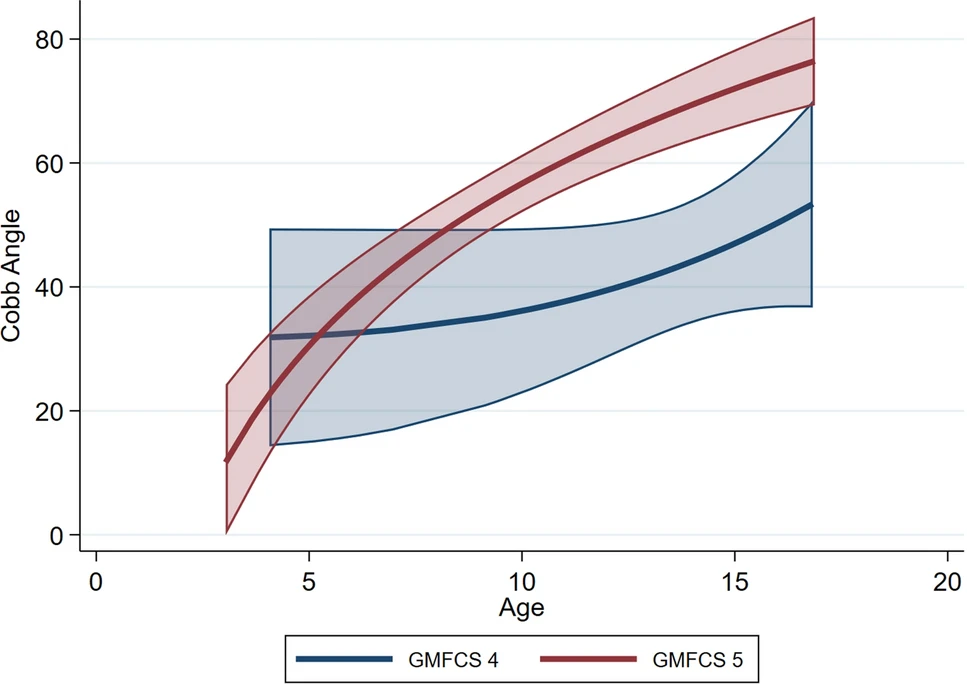
Figure 1. Annual progression of scoliosis according to GMFCS level (GMFCS IV: blue curve; GMFCS V: red curve). Data from the NorCP study (2023). The rate of progression is most accelerated in early adolescence in patients with GMFCS V, underscoring the need for intensive follow-up in this population.
In summary, the natural history of scoliosis in children with severe CP is not a mere consequence of neurological damage, but rather an active process influenced by biomechanical, functional and evolutionary factors. Early identification of risk factors, such as a Cobb angle ≥30° at age 10 years or GMFCS V, allows for timely intervention that can prevent serious complications. This evidence-based approach should be the basis of clinical practice in neuropediatrics, ensuring that each child with severe CP receives personalized and multidisciplinary follow-up that maximizes their functionality and quality of life.