
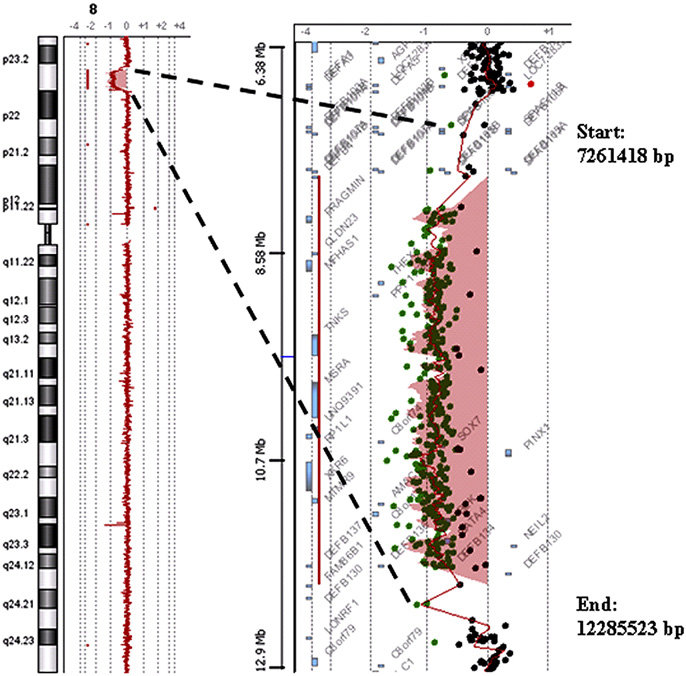
The array comparative genomic hybridization (aCGH) is the complementary genetic test of first choice in children with global developmental delay/intellectual disability and/or multiple congenital malformations, according to the clinical guidelines of the AAP, AAN, ISCA, and ACMG.
Diagnostic threshold:
It has the best diagnostic yield considering each individual test (from 8 to 20%), surpassed only by clinical evaluation by a clinician specialized in global developmental delay/intellectual disability.
Stratification in neuropediatrics:
The variation in diagnostic yield across different studies is explained by the lack of stratification based on severity and associated findings (other comorbid disorders, association with congenital malformations).
It remains uncertain whether it is useful in cases of mild familial intellectual disability. Probably the yield is even lower in non-syndromic grade 1 ASD.
On the other hand, when there are multiple associated congenital anomalies, the ACMG still recommends it as the first choice unless a specific diagnosis is suspected.
Therefore, it is clinically useful to divide cases into simplex (non-syndromic, isolated) vs. complex (syndromic, more severe involvement, comorbidity).
| Phenotype category and subcategory | CGH array Solved N (%) | Clinical exome Solved N (%) |
|---|---|---|
| GDD/ID (all) | 64 (8.4%) | 44 (26.2%)a |
| GDD/ID isol | 38 (6.9%) | 11 (16.2%)a |
| GDD/ID + epi | 6 (16.7%) | 4 (26.7%) |
| GDD/ID + micro/macro | 3 (8.3%) | 5 (55.6%)a |
| GDD/ID synd | 17 (12.1%) | 24 (31.5%)a |
| ASD (all) | 13 (3.0%) | 3 (6.1%) |
| ASD isol | 11 (2.8%) | 0 (–) |
| ASD + epi | 0 (–) | 1 (25.0%) |
| ASD + micro/macro | 0 (–) | 1 (25.0%) |
| ASD synd | 2 (7.4%) | 1 (11.1%) |
| Other NDDs (all) | 3 (1.4%) | 2 (7.1%) |
| Other isol | 3 (1.8%) | 2 (13.3%) |
| Other + epi | 0 (–) | 0 (–) |
| Other + micro/macro | 0 (–) | 0 (–) |
| Other synd | 0 (–) | 0 (–) |
| Total | 80 (5.7%) | 49 (20%)a |
1. Moeschler JB, Shevell M; Committee on Genetics Comprehensive evaluation of the child with intellectual disability or global developmental delays. Pediatrics 2014;134(3):e903–18. [PubMed] [Google Scholar]
2. American Academy of Neurology. Evaluation of the Child with Global Developmental Delay 2011. www.aan.com/guidelines (Accessed March 17, 2017).
3. Silove N, Collins F, Ellaway C. Update on the investigation of children with delayed development. J Paediatr Child Health 2013;49(7):519–25. [PubMed] [Google Scholar]
4. Manning M, Hudgins L; Professional Practice and Guidelines Committee, American College of Medical Genetics Array-based Technology and Recommendations for Utilization in Medical Genetics Practice for Detection of Chromosomal Abnormalities 2010. www.acmg.net/StaticContent/PPG/Array_based_technology_and_recommendations_for.13.pdf (Accessed March 17, 2017).