
Resonancia Magnética (RM) en la Encefalopatía Hipoxicoisquémica (EHI) La resonancia magnética cerebral es el método de elección para valorar la localización, severidad y pronóstico del daño cerebral secundario a un evento de asfixia perinatal. Patrones Principales de Lesión Patrón de Ganglios Basales y Tálamo: Este patrón es típicamente asociado con asfixias agudas y profundas. Afecta …
Category archives: Clinical guide
Panayitopoulos

Panayiotopoulos Syndrome (Benign Occipital Epilepsy of Childhood) Panayiotopoulos syndrome is a common benign idiopathic focal epilepsy of childhood that typically presents between 3 and 6 years of age. Main Characteristics Autonomic crises: The crises consist predominantly of autonomic symptoms such as nausea, emetic vomiting, paleness, mydriasis and incontinence. Duration …
Myelin in the CNS and PNS.

Myelin in the Central Nervous System (CNS) vs. Peripheral Nervous System (PNS) Myelin is a protein-rich lipid sheath that covers and electrically insulates neuronal axons to facilitate the rapid transmission of action potentials. Myelin in the CNS: Produced and maintained by oligodendrocytes. A single oligodendrocyte can myelinate up to…
Dravet syndrome. Natural history.

Myoclonus in childhood

Malformations of cortical development.

Malformations of Cortical Development (CDM) Malformations of cortical development represent a broad group of structural abnormalities of the brain caused by the interruption of the biological processes of cell proliferation, neuronal migration or cortical organization during embryogenesis. Classification by Affected Stage Proliferation/Differentiation Anomalies: Microcephaly, megalencephaly, focal cortical dysplasia type II. Migration Anomalies…
Basic neuroradiology for neuropediatricians.
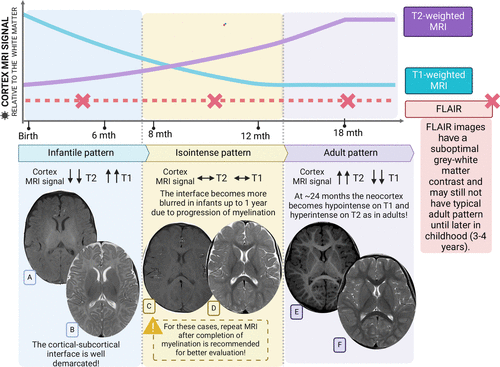
Timing for performing MRI studies: Depending on age, there are different particularities and limitations: Age Justification for repetition 2 years…
Continue reading «Neurorradiología básica para neuropediatras.»